Paralysis
DublinersParalysis in Dubliners is at once a bodily condition and a recurring word-image for lives arrested at the threshold of action. The collection first makes the word frighteningly concrete in the illness and death of Father James Flynn, then returns to its force in scenes of fear, remembered intimacy, and belated recognition. These recurrences do not make every character’s predicament identical: they connect distinct experiences through the gap between understanding a condition and finding a way out of it.
The Word and Father Flynn’s Illness
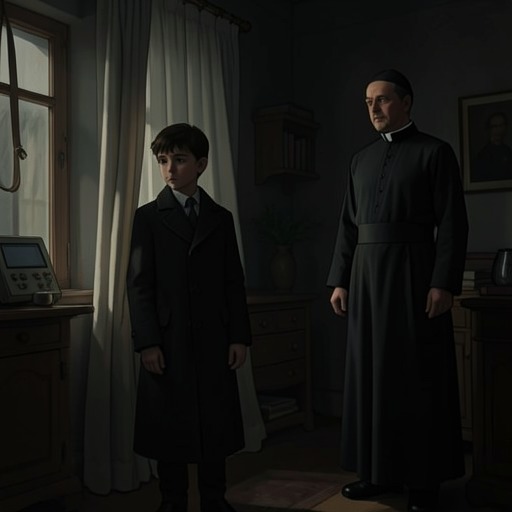
In “The Sisters,” a boy’s attention is fixed on Father James Flynn’s deteriorating health. He knows it is the priest’s third stroke, and night after night, during vacation, he watches the lighted square of the house window. He has been told that two candles will be placed at a corpse’s head, so the window becomes a sign he reads for the moment of death. Father James Flynn had often said that he was not long for the world; the boy had once taken the prediction for idle talk, but now believes it.
The word “paralysis” has already troubled the boy before this death becomes certain. He says it softly to himself as he looks toward the window, and hears in it an ominous name, akin to “gnomon” and “simony” in its strangeness but newly charged with fear. It seems to name a “maleficent and sinful being.” The reaction binds the physical condition to a moral and imaginative disturbance: he fears the illness and longs to draw nearer to the evidence of its work. Paralysis is therefore introduced not as a settled explanation, but as a word whose sound and associations make bodily decline feel at once intimate and uncanny.
The boy’s first night-time response turns the priest’s condition into a troubled dream. After resenting Old Cotter’s allusion to him as a child, he tries to make sense of the older man’s unfinished remarks. In the dark, the boy imagines the paralytic’s grey face following him beneath the blankets. The face seems to murmur and to desire confession; its moist lips and continuing smile sharpen the image. Remembering that Father James Flynn died of paralysis, the boy imagines himself smiling too, as if absolving the priest of simony. The illness thus returns in sleep as an uncertain scene of confession and absolution, entwining the boy’s fear of the dead man with the religious vocabulary already attached to the word.
A Death That Releases and Disturbs
The next morning, the boy goes to the little house in Great Britain Street. The shop, registered under the vague name of Drapery, sells mainly children’s bootees and umbrellas; its usual notice for recovering umbrellas is gone because the shutters are up. A crape bouquet tied to the door-knocker and the death card confirm what the watching window had made him anticipate. The card gives July 1st, 1895, and says Father James Flynn was aged sixty-five.
The boy imagines the familiar scene that death has made impossible: the little dark room behind the shop, Father James Flynn sitting by the fire in his great-coat, and a packet of High Toast brought by the boy. Because the priest’s hands trembled, it had been the boy’s task to empty the packet into his black snuff-box. Snuff scattered over the floor and across the priest’s faded green garments, while a red handkerchief, blackened by snuff-stains, failed to brush it away. These repeated, ordinary details give the illness a material history in the priest’s shaking hands and the boy’s small act of assistance; paralysis is not only a symbol glimpsed from a window, but part of the routines through which the boy knew him.
Although the boy wishes to go in and look at the body, he cannot make himself knock. He walks away along the sunny side of the street, reading theatrical advertisements, and is unsettled that neither he nor the day seems in a mourning mood. More troubling still is a sensation of freedom, as if the priest’s death had released him from something. That response sits beside his acknowledgement that Father James Flynn taught him much: the priest studied at the Irish college in Rome, taught him to pronounce Latin, told him about the catacombs and Napoleon Bonaparte, and explained the Mass and priestly vestments. The boy’s attachment and relief remain unresolved, making the death more than the end of an illness: it leaves him with knowledge, unease, and a freedom he does not fully understand.
Paralysis as Terror of Escape
In “Eveline,” the paralysis motif shifts from a diagnosed illness to a crisis of action. As Eveline considers her mother’s life of commonplace sacrifices and final craziness, she hears again her mother’s repeated words, “Derevaun Seraun!” The remembered voice precedes a sudden impulse to escape. Eveline tells herself that Frank will save her and give her a life, perhaps love, and insists that she has a right to happiness. The wish to leave is sharpened by the life she fears repeating, but the decision becomes less certain once it must be made physically.
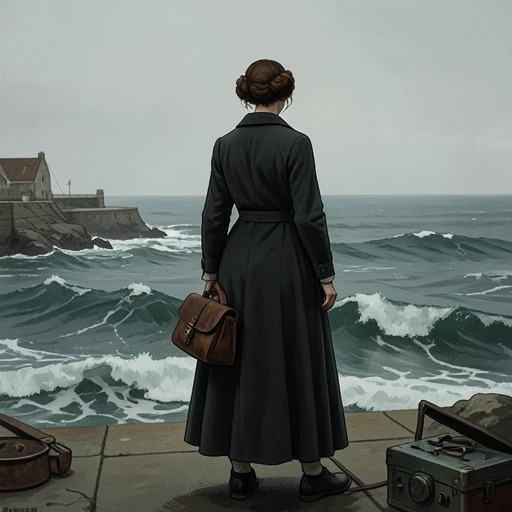
At the North Wall station, Eveline stands in a swaying crowd while Frank holds her hand and talks about the passage. Soldiers with brown baggage fill the station; through the doors she sees the boat beside the quay, its portholes lit. Their passage to Buenos Aires is booked, and the boat’s long whistle makes the departure immediate. Eveline answers nothing. She feels her cheek grow pale and cold, prays to God to show her her duty, and moves her lips in silent prayer as nausea rises. The contrast is stark: escape has seemed like a promise when imagined, but at the station it confronts her as a choice involving duty, fear, and a real separation from home.
When Frank urges her to come, Eveline experiences the surrounding seas as if they were tumbling around her heart. His pull no longer feels like rescue; she imagines that he will drown her. She grips the iron railing with both hands and refuses to move. Her repeated cry of no, and her anguished cry amid the imagined seas, make the refusal bodily rather than merely deliberative. The scene does not establish that Eveline is physically ill. Instead, the paralysis lies in the force of fear that prevents the escape she had just imagined as her salvation, turning the threshold of departure into a place where the promised future cannot be entered.
Recognition and the Cost of Inaction
In “A Painful Case,” paralysis returns through James Duffy’s late understanding of his relation to Emily Sinico. After learning of her death, he sits in a public-house at Chapelizod Bridge, drinking hot punch. As he revisits his life with her and alternates between the images through which he now sees her, he recognizes that she is dead: she has ceased to exist and become a memory. He asks what else he could have done, maintaining that he could neither continue a deception nor live openly with her. Yet the recognition comes with a new awareness that her life must have been lonely, spent night after night alone in that room. He imagines his own future as the same progression into loneliness, death, and memory, perhaps without anyone to remember him.
Duffy leaves after nine and walks through the park along the bleak paths where they had walked four years earlier. The remembered presence of Emily seems near: at moments he feels her voice at his ear and her hand touching his. He asks why he withheld life from her and why he sentenced her to death, and feels his moral nature falling apart. These questions overturn his earlier confidence that he did what was best. The story makes the decisive movement an inward one: memory first restores a sense of closeness, then forces him to see that the relationship’s ending carried a cost for Emily that his reasoning had obscured.
At Magazine Hill, Duffy looks toward the lights of Dublin and sees human figures lying near the park wall. Their hidden loves fill him with despair; he gnaws at the rectitude of his life and feels outcast from life’s feast. The image of exclusion gives physical shape to his recognition that he denied Emily life and happiness, leaving her with ignominy and a death of shame. A goods train winds out of Kingsbridge Station like a worm with a fiery head, and its laborious drone seems to repeat her name. The moving train contrasts with the fixedness of Duffy’s belated remorse: sound and motion carry memory forward, but cannot undo what has happened.
The ending withdraws even the imagined consolation of Emily’s presence. Turning back, Duffy hears the train’s rhythm pound in his ears, then doubts the reality of what memory has told him. He waits under a tree for the rhythm to die away; he can no longer feel Emily near him or hear her voice. The night is perfectly silent, and he recognizes that he is alone. Paralysis here is not a bodily diagnosis but the lasting condition produced by isolation and a past decision: recognition arrives, but only after the possibility of action has passed.
Recurrence and Meaning
Across these episodes, paralysis changes scale without losing its connection to arrested movement. Father James Flynn’s illness is materially present in his strokes and trembling hands; the boy’s response turns the word into a fearful, religiously charged visitation. Eveline’s crisis is concentrated in a station, where a booked passage, a waiting boat, and Frank’s hand make departure concrete but do not overcome her terror. Duffy’s paralysis appears retrospectively, in his solitude and the recognition that his careful defence of his choices did not prevent another person’s suffering.
The recurring word therefore marks more than inability to move. Each story sets a possible passage against an obstruction: the boy approaches the dead priest but cannot knock; Eveline reaches the boat but grips the railing; Duffy revisits a shared path after the relationship has ended and discovers that insight cannot restore it. The varied circumstances matter. The collection does not reduce illness, fear, and moral isolation to a single condition; instead, their recurrence makes the reader notice how often a life can be recognized as constrained only at the moment when release, repair, or companionship is no longer attainable.