West Briton
Dubliners“West Briton” is the political label Miss Ivors applies to Gabriel Conroy when she challenges his writing for The Daily Express and his choice to travel abroad rather than visit Ireland. In the dance-room exchange, the phrase becomes more than an insult: it condenses a dispute over journalism, language, travel, and national identity, while exposing Gabriel’s difficulty in answering a demand that his cultural commitments be publicly legible.
The Accusation and Its Grounds
Miss Ivors first makes the charge by connecting Gabriel’s paid literary column to the politics of the paper that publishes it. She says she has discovered that he writes for The Daily Express and asks whether he is ashamed; when he protests that he sees nothing to be ashamed of, she replies that she is ashamed of him for writing for such a paper. Her conclusion is blunt: she had not thought him a West Briton. The term therefore does not arise from an explicit declaration of political allegiance by Gabriel. It is Miss Ivors’s interpretation of his employment, delivered as a judgment on what that employment signifies.
The narrative gives Gabriel’s circumstances some specificity without making them settle the argument. He writes a literary column every Wednesday and receives fifteen shillings for it. The books he is sent to review matter to him more than the small payment: he likes handling their covers and turning the pages of newly printed volumes. After teaching, he often browses second-hand bookshops along the quays, including Hickey’s on Bachelor’s Walk, Webb’s and Massey’s on Aston’s Quay, and O’Clohissey’s in a by-street. His interest is presented as literary and material, grounded in the pleasure of books, but that account does not answer the national-political meaning Miss Ivors assigns to his newspaper work.
The Charge Becomes a Test of Belonging
The dispute widens when Miss Ivors asks where Gabriel and his wife usually travel. He names France or Belgium, perhaps Germany, and explains that the journeys help him keep up the languages and provide a change. Miss Ivors counters by asking why he does not visit his own land, then presses the point through the question of Irish: does he not have his own language to keep in touch with? Gabriel answers that Irish is not his language. In the exchange, the accusation shifts from the newspaper he writes for to the destinations he chooses and the language he does not claim.
Miss Ivors also frames the question in terms of country and people, asking whether he has a homeland to visit and knows anything of his own people and country. Gabriel suddenly retorts that he is sick of his own country. The abruptness of the answer matters: the narrative says that the challenge has heated him, and that he does not answer when she asks why. His outburst is not a considered explanation of his position. It marks the point at which an argument about travel and cultural affiliation becomes an exposed personal conflict, with his composure and good humour under strain.
Public Encounter and Repetition
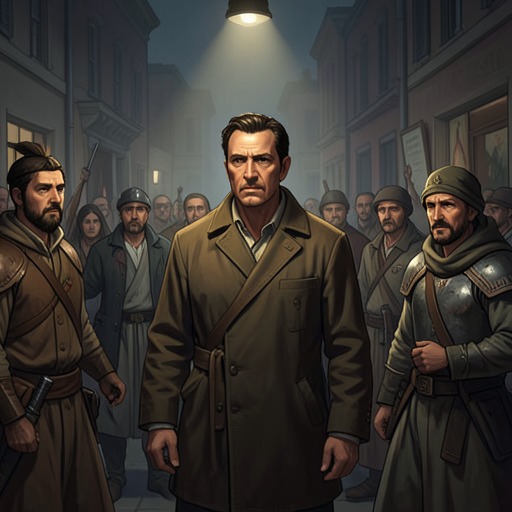
The exchange takes place in company. The surrounding guests have turned to listen as Miss Ivors questions him, and Gabriel glances nervously from side to side while trying to maintain his good humour. The label thus carries a social force beyond the two speakers: it makes his cultural choices audible to the room and turns his response into a performance before witnesses. Gabriel’s discomfort is visible in his blushing, blinking, and effort to smile, while his explanation that reviewing books is not political fails to meet the broader terms of her challenge.
After his angry retort, Gabriel tries to cover his agitation by dancing energetically and avoiding Miss Ivors’s eyes. When they meet again in the long chain, she presses his hand firmly and looks at him quizzically; just as the dance is about to begin again, she leans up and whispers the accusation once more: “West Briton!” The whispered repetition is pointedly different from the earlier public cross-examination, but it ensures the label remains between them. Gabriel then moves to a remote corner to speak with Freddy Malins’s mother and tries to put the incident out of his mind.
Meaning and Unresolved Aftermath
Away from the immediate exchange, Gabriel continues to resent the way the charge was made. He considers Miss Ivors an enthusiast, thinks there is a time for such enthusiasm, and wonders whether he should have answered differently. Yet he also insists to himself that she had no right to call him a West Briton before other people, even in jest. The narrative records both his self-questioning and his sense of humiliation: he remembers her as having tried to make him ridiculous by heckling and staring at him. The aftermath therefore does not establish that he accepts her judgment; it shows how deeply the public naming has unsettled him.
The expression’s force lies in the gap between Gabriel’s self-understanding and Miss Ivors’s political reading of his choices. He presents his work as literary criticism, his travels as practical and restorative, and Irish as a language that is not his. She treats those same choices as evidence of distance from his own country. Because Gabriel does not offer a fuller answer when asked why he is sick of Ireland, the exchange ends without resolving the disagreement. “West Briton” remains an accusation rather than a proven description, and its recurrence turns a short phrase into the sharpest emblem of the evening’s conflict over national belonging.