The Lass of Aughrim
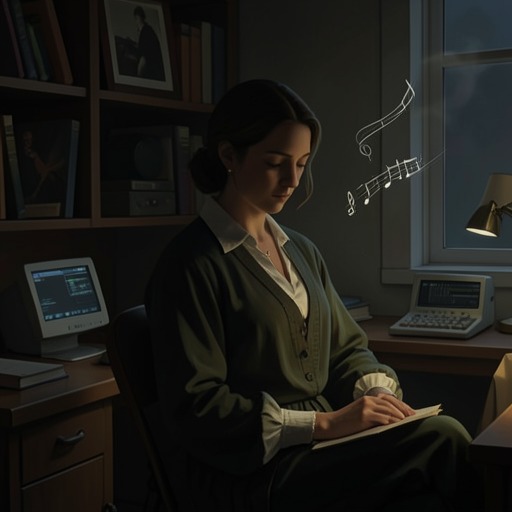
DublinersThe Lass of Aughrim is the song Bartell D'Arcy sings at the Morkan sisters’ gathering in “The Dead.” First heard as a distant, plaintive air, it draws Gretta Conroy’s attention; later, when Gabriel asks why she is crying, she explains that Michael Furey, a young man she knew in Galway, used to sing it. The song’s decisive role is not simply to recall an old tune: it makes a private past audible in the present and reveals a history of love that Gabriel had not understood.
The Song at the Gathering
The song reaches Gabriel and the others after the hall-door has been closed. From where Gretta stands on the stairs, the voice and piano become clearer. Gabriel listens and points toward his wife, while the singing seems uncertain in both its words and its sound. Distance and hoarseness render the voice plaintive, and the fragment he hears is an image of grief: “O, the rain falls on my heavy locks / And the dew wets my skin, / My babe lies cold....” The broken passage offers no full explanation; it supplies a lament whose emotional force precedes Gabriel’s knowledge of what the song means to Gretta.
Mary Jane identifies the singer as Bartell D'Arcy and is surprised that he has sung after refusing to do so throughout the evening. She urges that he be asked for another song, and Aunt Kate agrees. But as Mary Jane hurries toward the staircase, the singing stops and the piano is abruptly closed. The interruption leaves the tune suspended rather than turning the moment into a performance for the company. Its significance lies in the impression it has already made on Gretta, not in a public response to a completed song.
Recognition and Repetition
Later, Gabriel sees Gretta standing beneath the dusty fanlight while the others discuss D'Arcy’s cold. She has not joined their conversation. When she turns, Gabriel notices the colour in her cheeks and the brightness of her eyes, and joy suddenly rises in him. The shift is grounded in what he sees but not yet in what he knows: he reads her absorbed expression as an intimate moment between them, while its cause remains the song.
Gretta asks D'Arcy for the name of the air. He calls it The Lass of Aughrim, adding that he could not remember it properly, and asks whether she knows it. Gretta repeats the title, saying that she could not think of its name. Her recognition is therefore both immediate and incomplete: the tune is familiar before its title comes back to her. Mary Jane calls it a very nice air and regrets that D'Arcy was not in voice that night, treating it as a musical performance even as it has begun to awaken a more personal memory in Gretta.
The Memory of Michael Furey
In the hotel room, Gabriel tries to discover what is troubling Gretta. After a pause, she breaks into tears and says that she is thinking about the song. She goes to the bed, throws her arms across its rail, and hides her face. Gabriel follows, at first astonished; seeing himself in the cheval-glass, he becomes aware of his own appearance before asking why the song has made her cry. His questions move from the tune to the person associated with it.
Gretta explains that she is thinking of someone she knew long ago, when she was living with her grandmother in Galway. Gabriel’s smile fades. He asks ironically whether the person was someone she loved, and Gretta identifies him as a young boy named Michael Furey. He was delicate, she says, and used to sing The Lass of Aughrim. She remembers his big, dark eyes and the expression in them. The song thus discloses not an abstract sadness but a specific remembered person, attached to a particular place and an earlier part of Gretta’s life.
Function and Significance
The song connects the gathering and the hotel room through recurrence: first its lamenting fragment is heard from a distance; then Gretta asks its name; finally she names the memory it carries. Each return changes the listener’s understanding. Gabriel initially sees a voice, a staircase, and his wife’s absorbed face; only after Gretta speaks does he learn that the expression which had stirred his joy belonged to a past he had not shared.
Its form matters as much as its association. The first encounter is fragmentary, with words trailing off at “My babe lies cold....” D'Arcy’s uncertain delivery and the abrupt closing of the piano keep the song from being fully possessed by the company. It arrives as an incomplete sound, then returns through Gretta’s increasingly explicit account. That movement from a distant fragment to a named memory gives the song its narrative power: it opens a path from present music to an earlier attachment without making the past visible to Gabriel until Gretta tells him about it.
The Lass of Aughrim consequently marks the limit of Gabriel’s initial interpretation of his wife. Her shining eyes seem to promise a shared, joyful intimacy; the explanation reveals that they have been turned toward Michael Furey. The song does not itself tell the entire story of that relationship, but it gives Gretta a means to speak of the young man and makes Gabriel confront the fact that her emotional life includes a history beyond their marriage. Music becomes both a carrier of memory and the occasion for a change in what Gabriel can know about Gretta.