The Death of Parnell
Dubliners“The Death of Parnell” is the poem Joe Hynes recites at a gathering in a public house, where a request for a remembered piece becomes a solemn performance of political mourning. Its central declaration names Parnell as “Our Uncrowned King,” and the response around the table makes the poem more than a private composition: it briefly gathers the men into shared remembrance, while the silence after the applause shows that this unity is shadowed by loss.
The request and the performance
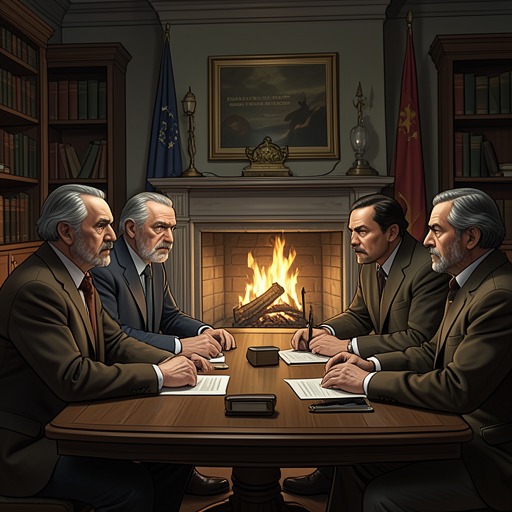
The poem enters the scene through other men’s insistence. Mr O’Connor asks Hynes for the piece he wrote and wants to know whether he has it with him. Mr Henchy praises it as splendid and urges Hynes to give it to the company; Mr O’Connor joins in, pressing him to begin. The request frames the poem as something already known and valued among the group, but Hynes does not immediately perform it.
After hesitating, Hynes takes off his hat, lays it on the table, and stands. He appears to rehearse the poem in his mind, and the company waits through a rather long pause. That preparation changes the mood of the room: the men’s prompting gives way to silence, and the recitation begins as a deliberate public act rather than casual conversation. Hynes first clears his throat once or twice, then announces the title, “THE DEATH OF PARNELL,” and the date, “6th October 1891.” The heading makes the political loss specific in time as well as subject, setting the remembered death before the listeners before the poem’s first line.
Political language and remembered loss
The opening declares, “He is dead. Our Uncrowned King is dead.” The blunt repetition makes death the poem’s governing fact, while the royal title gives Parnell a symbolic authority that does not depend on formal kingship. The next line addresses Erin and calls on it to mourn “with grief and woe,” carrying the lament beyond the individual speaker to Ireland as a collective imagined audience. In the surrounding conversation, this language transforms political allegiance into an expression of shared bereavement.
The poem’s final lines, heard later in the recitation, return to Parnell’s memory as the single grief carried in a pledge to joy. Its movement therefore holds mourning and conviviality together rather than allowing one to cancel the other: the gathering is still a drinking party, but the remembrance remains present within it. The contrast gives the poem’s title its force. Parnell’s death is not treated as a finished episode that the men can leave behind; it recurs as a memory capable of interrupting ordinary social pleasure.
The listeners and the aftermath
When Hynes finishes, he sits down again on the table. The room answers first with silence and then with a burst of clapping. Even Mr Lyons claps, although he had been sitting near Hynes earlier without speaking. The applause crosses, at least for this moment, the divisions and reservations suggested by the men’s political conversation; it registers the effect of the performance without proving that every listener shares the same convictions.
After the applause ends, the listeners drink from their bottles in silence. A cork then flies out of Hynes’s bottle, but Hynes remains seated on the table, flushed and bareheaded, apparently not hearing the invitation. The small, noisy accident punctures the solemnity without dispelling it: the company has returned to drinking, yet Hynes seems absorbed in the emotional aftermath of reciting. Mr O’Connor calls him a good man and takes out cigarette papers and tobacco, occupying himself in a way that conceals his emotion. The scene closes not with discussion of the poem’s political claims but with gestures of feeling, restraint, and silence.
Function in the scene
The poem’s importance lies both in its words and in the way it reorganizes the gathering. Before the recitation, the men coax Hynes to produce a piece they remember; during it, attention is concentrated on the standing speaker and the announced date; after it, applause gives way to quiet drinking. The performance briefly turns a crowded social setting into a commemorative one.
That transformation remains temporary and unresolved. The listeners applaud, but they do not follow with an extended conversation, and the bottles return to their hands in silence. Hynes’s title, date, opening declaration, and final image of remembered grief make Parnell’s absence the substance of the performance, while the room’s restrained response shows how such political memory persists in fragments: a poem recited at a table, a shared pause, and an emotion that its hearers do not fully put into words.