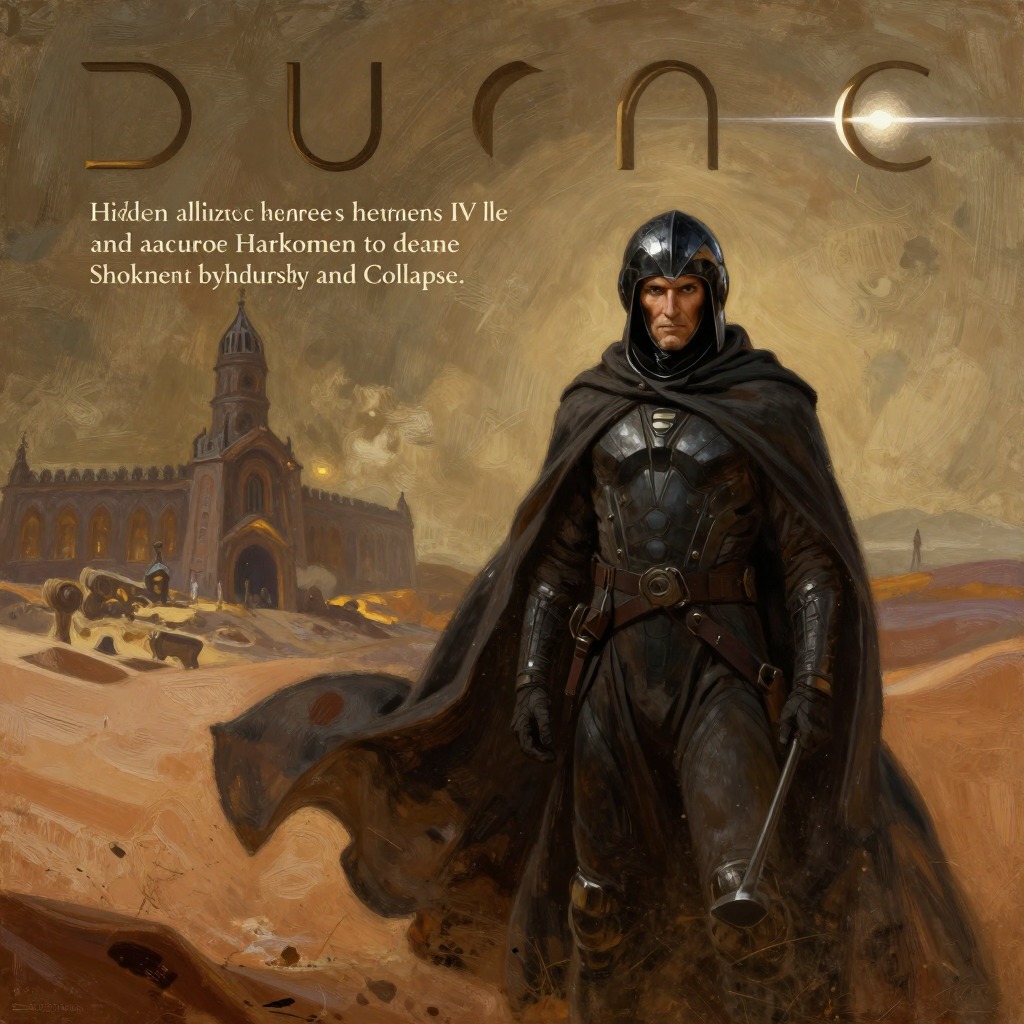
Baron Vladimir Harkonnen
DuneBaron Vladimir Harkonnen is the primary antagonist of Frank Herbert's Dune, a figure of immense physical grotesquerie and even more immense political cunning. As the head of House Harkonnen, he is the architect of the conspiracy that destroys Duke Leto Atreides and seizes control of the desert planet Arrakis. His character is a study in contrasts: a man of refined taste and brutal appetites, a master strategist who is also a slave to his own gluttony and cruelty. His actions set the entire plot of the novel in motion, and his eventual downfall at the hands of his own granddaughter, Alia, is a central irony of the narrative.
Identity and Physical Presence
The Baron is introduced as a figure of almost surreal corpulence, a 'grossly and immensely fat' man whose weight is supported by portable suspensors harnessed to his flesh. He might weigh two hundred Standard kilos in actuality, but his feet would carry no more than fifty of them. This physical dependence on technology is a metaphor for his entire being: he is a man who uses tools, people, and treachery to support his own immense, corrupt weight. His appearance is marked by 'fat-enfolded eyes,' a 'baby-fat face,' and a 'protruding lips' that he rubs with a beringed hand. He is a creature of shadows and opulence, often seen in a room lit by golden balls and surrounded by the trappings of immense wealth, such as a globe of Arrakis with latitude and longitude lines laid in with hair-fine platinum wire and polar caps of cloud-milk diamonds. This love of luxury and display is a key part of his identity, a mask for the ruthless predator beneath.
The Architect of the Atreides' Downfall
The Baron's central role in the novel is as the mastermind behind the destruction of House Atreides. He is not merely a brute; he is a strategist who delights in 'plans within plans within plans.' His scheme to take Arrakis is a masterpiece of manipulation, involving the subversion of Dr. Wellington Yueh, a Suk School graduate with supposedly unbreakable Imperial Conditioning. The Baron found the 'lever' to move the doctor, using his wife, Wanna Marcus, as a hostage. He also orchestrates a diversion to make Thufir Hawat, the Atreides Mentat, suspect the Lady Jessica of treachery, thereby sowing discord and confusion within the enemy camp. His ultimate weapon is the deployment of two legions of Sardaukar, the Emperor's elite troops, disguised in Harkonnen livery, a move that ensures the Atreides' military defeat while maintaining the fiction of a simple House-to-House conflict. The Baron's motivation is a combination of political ambition and a deep-seated, personal hatred for the Atreides, a feud that has its roots in the ancient past, including the banishment of a Harkonnen for cowardice after the Battle of Corrin.
The Tyrant of Arrakis and His Methods
Once the Atreides are defeated, the Baron's methods of rule are revealed to be brutally exploitative. He is concerned not with governing but with extracting maximum wealth from Arrakis, primarily through the spice melange. He instructs his nephew, Glossu Rabban, to 'squeeze' the planet for every cent it can give, using a 'merciless fist' and showing no pity or mercy. He sees the population as 'slaves envious of their masters,' to be driven into utter submission. His plan is to make Rabban so hated that when he later sends his favored nephew, Feyd-Rautha, to take over, the people will welcome him as a savior. This cynical manipulation of entire populations is a hallmark of the Baron's character. He is also shown to be a hedonist, indulging in food, drugs, and young slaves, and he is not above using his power to satisfy his most base desires, as seen when he orders a young man who resembles Paul Atreides brought to his chambers.
Relationships and Conflicts
The Baron's relationships are defined by manipulation and a complete lack of trust. He views his Mentat, Piter de Vries, as a useful but expendable tool, and he is constantly wary of Piter's own cunning. He even plans to have Piter killed once he has outlived his usefulness. His relationship with his nephews is similarly transactional. He sees Rabban as a 'muscle-minded tank-brain' to be used and discarded, while he grooms Feyd-Rautha as his heir, seeing in him a 'sharpness' and 'ferocity' that he admires. However, this relationship is also fraught with tension, as Feyd-Rautha makes several attempts on the Baron's life. The Baron's greatest conflict, however, is with the Atreides, and his hatred for them is so profound that he is willing to spend an unimaginable fortune to see them destroyed. His confrontation with the drugged Duke Leto is a scene of pure sadism, where he gloats over his captive before the Duke's final, desperate act of defiance.
Change and Downfall
The Baron's story is one of a man who believes he has achieved ultimate victory, only to be undone by the very forces he sought to control. After the fall of the Atreides, he is confident that all threats are eliminated, believing Paul and Jessica to be dead. However, his victory is short-lived. He is forced to deal with the political fallout of his actions, including the scrutiny of the Emperor and the rise of a new Fremen leader, Muad'Dib. His downfall comes during the final battle for Arrakis, when he is confronted by Alia, the daughter of Duke Leto and Lady Jessica, who is also his own granddaughter. In a moment of shocking reversal, Alia, a mere child, uses a poisoned needle, the 'gom jabbar,' to kill him. His death is a fitting end for a man who lived by treachery and cruelty, a reminder that the schemes of the powerful can be undone by the most unexpected of agents. His legacy is one of destruction and chaos, but it is also the catalyst for the rise of Paul-Muad'Dib and the transformation of the universe.
In Denis Villeneuve's 2021 film adaptation of Dune, the Baron was portrayed by Swedish actor Stellan Skarsgård, whose performance brought a menacing physicality to the role. The film, which was split into two parts, premiered at the Venice Film Festival in September 2021 and was released widely in October of that year. It received generally favorable reviews and went on to win six Academy Awards, including for its visual effects and sound, which helped bring the Baron's grotesque presence to life. The sequel, Dune: Part Two, was released in March 2024 after delays due to the 2023 SAG-AFTRA strike.