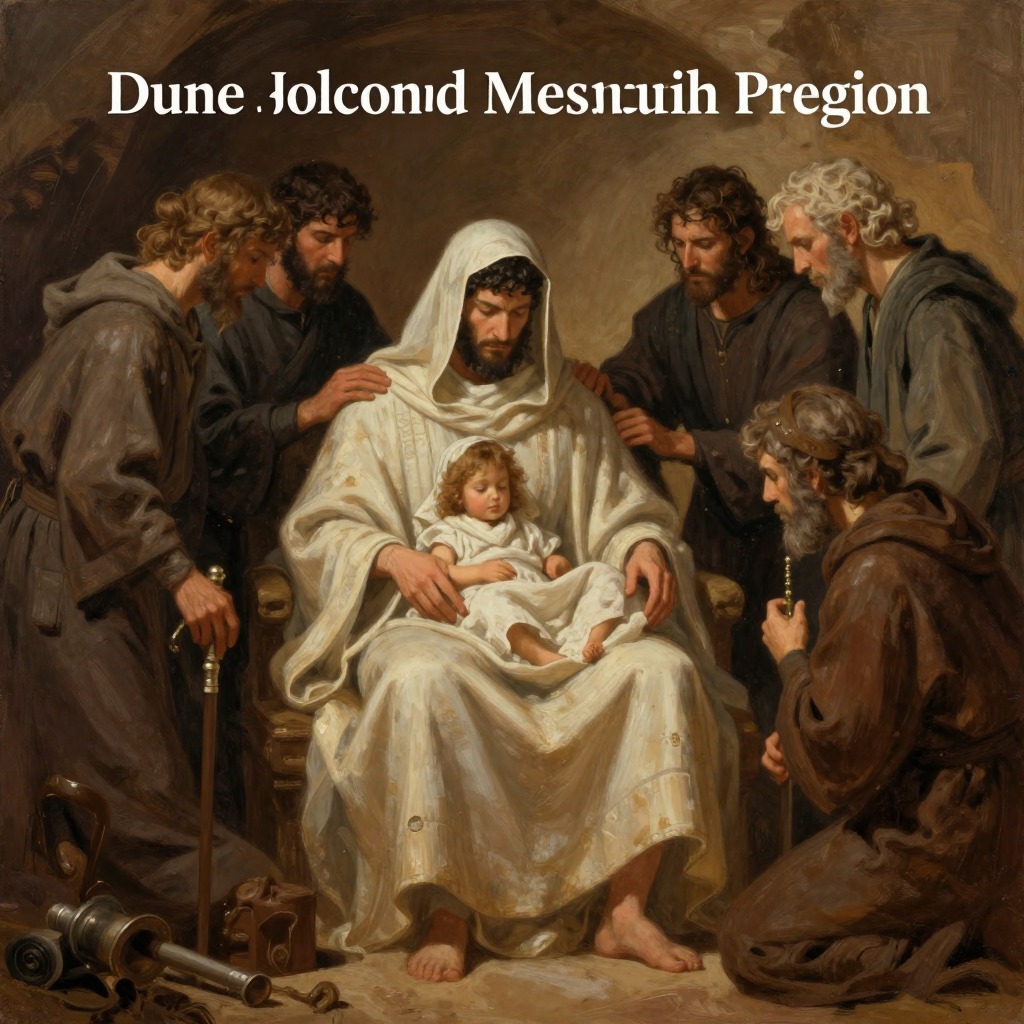
Missionaria Protectiva
DuneThe Missionaria Protectiva is the Bene Gesserit's long-range arm of religious subversion, a systematic program that seeds primitive worlds with carefully crafted superstitions, prophecies, and messianic legends to serve as protective mechanisms for future Bene Gesserit agents. Its most consequential operation unfolds on Arrakis, where centuries-old implanted prophecies about a 'Voice from the Outer World' and a 'Bene Gesserit witch' become the cultural foundation that enables Lady Jessica and Paul Atreides to find sanctuary among the Fremen, transforming a survival strategy into the engine of Paul's messianic rise and the galaxy-shaking jihad.
Nature and Purpose
The Missionaria Protectiva is the arm of the Bene Gesserit order charged with sowing infectious superstitions on primitive worlds, thus opening those regions to exploitation by the Bene Gesserit. It operates through the panoplia propheticus, a comprehensive set of superstitious rituals and prophecies designed to create a pre-existing cultural expectation of a Bene Gesserit's arrival. The program's purpose is purely protective: to ensure that any Bene Gesserit agent stranded on a hostile world would find a prepared refuge, a 'bolt hole' where the local population would be predisposed to shelter and aid her. The Reverend Mother Gaius Helen Mohiam, the Emperor's Truthsayer, acknowledges this function when she tells Paul that the Missionaria Protectiva has been in Arrakis and 'softened it up somewhat.' The program is a calculated act of cultural engineering, planting legends that would lie dormant for generations until activated by a Bene Gesserit's need.
The Arrakeen Prophecy
On Arrakis, the Missionaria Protectiva's work reached its full fruition. The prophetic legends had taken on Arrakis even to the extent of adopted labels, including 'Reverend Mother,' 'canto and respondu,' and most of the Shari-a panoplia propheticus. The Fremen had been seeded with a messianic prophecy foretelling the arrival of a leader, the Lisan al-Gaib, the 'Voice from the Outer World,' who would be the child of a Bene Gesserit witch and lead them to paradise. This prophecy was so deeply ingrained that when Paul Atreides and his mother, Lady Jessica, fled into the desert after the fall of House Atreides, the Fremen were primed to recognize them. The Fremen leader Stilgar, upon encountering the fugitives, immediately considers the possibility that Paul is the Lisan al-Gaib, and Jessica's knowledge of the prophecy's rituals allows her to claim the status of Sayyadina, a religious acolyte, and secure their safety. The prophecy's specific details, such as the expectation that the Messiah would be accompanied by a Bene Gesserit mother, directly mirror Jessica's situation, demonstrating the precision of the Missionaria Protectiva's cultural implantation.
Activation and Consequences
Jessica's encounter with the Fremen housekeeper Shadout Mapes is a direct activation of the Missionaria Protectiva's planted legends. Mapes, having been raised with the prophecy, tests Jessica to see if she is the 'One' foretold. Jessica, recognizing the signs of the Missionaria Protectiva's work, plays the role, speaking in the Chakobsa tongue and referencing the 'Great Mother' and the 'Maker.' This performance convinces Mapes, who gifts Jessica with a crysknife, a sacred Fremen weapon, and pledges her loyalty. Jessica reflects on the irony that the Missionaria Protectiva, a program designed for protection, has created a situation where she must 'play the part of Auliya, the Friend of God' to survive. The consequences of this activation are profound: it not only saves Jessica and Paul but also gives them a foothold within Fremen society, allowing Paul to eventually unite the tribes and launch his campaign against the Harkonnens and the Emperor. The prophecy, originally a defensive measure, becomes the ideological foundation for Paul's messianic rule and the justification for the jihad that sweeps across the universe.
Narrative Role and Evaluation
The Missionaria Protectiva serves as a crucial narrative device, explaining the Fremen's readiness to accept Paul as their messiah. It highlights the Bene Gesserit's long-term, manipulative approach to power, contrasting their subtle, centuries-long schemes with the more direct military force of the Harkonnens and the Emperor. The program's success on Arrakis is a testament to the Bene Gesserit's foresight, but it also reveals the dangers of their methods. The prophecy they planted is not merely a protective shield; it becomes a self-fulfilling prophecy that unleashes a religious war of immense scale. The narrative thus critiques the unintended consequences of cultural manipulation, showing how a tool designed for preservation can become an engine of destruction. The Missionaria Protectiva is a key element in the novel's exploration of religion, politics, and power, demonstrating how belief systems can be weaponized and how even the most carefully laid plans can spiral beyond control.