Monk's return to Washington and caregiving
ErasureThelonious Ellison’s return to Washington, D.C., begins as a family response to Bill Ellison’s inability to care for their mother, Agnes Ellison, and becomes a long confrontation with the limits of private caregiving. The move is not a clean act of sacrifice or a simple homecoming: it is shaped by Bill’s financial collapse, the debts surrounding Lisa Ellison’s clinic, Lorraine’s place in the household, Agnes’s progressive cognitive impairment, and Thelonious’s shame at recognizing that duty and self-interest coexist.
The decision to return
Bill Ellison tells Thelonious that he lives in Arizona, has lied to his wife for fifteen years, and believes he has endangered her. He acknowledges that his children are confused, that he cannot face them, and that his debts exceed his income. Thelonious feels sympathy and is impressed by his brother’s recognition of the damage, but the confession also makes Bill’s practical limits unmistakable. Agnes needs care, and Thelonious does not think Bill can provide it. Lorraine, who is nearly Agnes’s age, may herself eventually need care; Thelonious has never been told of family of her own who might support her.
The consequences arrive in Thelonious’s imagination before he has finished sitting at the kitchen table. He feels his body react as he watches the life he knows begin to change, and pictures himself packing his Santa Monica apartment. He imagines taking leave from teaching, putting his belongings in storage, flying east on an L1011 beside an eighty-two-year-old woman traveling to a rosarian convention in Georgia, and moving in with Agnes and Lorraine. What has been a distant obligation becomes, in his mind, an immediate relocation.
He later describes the decision as a leave of absence: the most logical course, but not an uncomplicated one. Agnes still has some awareness of her circumstances, yet not enough for him to feel that he can simply place her elsewhere. She knows her house and Lorraine, and Thelonious recognizes that moving her would disrupt the familiar world she can still navigate. He also catches himself assuming he might be gone only a year because Agnes would probably die by then. His recognition of that thought leaves him ashamed; the return is thus marked from the outset by care and by the private calculations that care does not erase.
A household under pressure
The practical burdens extend beyond Agnes’s daily needs. Lisa Ellison’s medical practice carries the debts common to young doctors, and its finances are precarious: Lisa depended on grants and part-time hospital work, while insurance on her life would largely go toward paying bills. Agnes has savings but is not wealthy, though the family house is paid for. The office that had belonged to Ben Ellison drains money. Until Thelonious can sell Lisa’s share, he owns a third of the Women’s Clinic Southeast, but the two physicians who worked there with Lisa are frightened of becoming targets and unwilling to buy him out. The return therefore brings both domestic responsibility and a difficult financial inheritance.
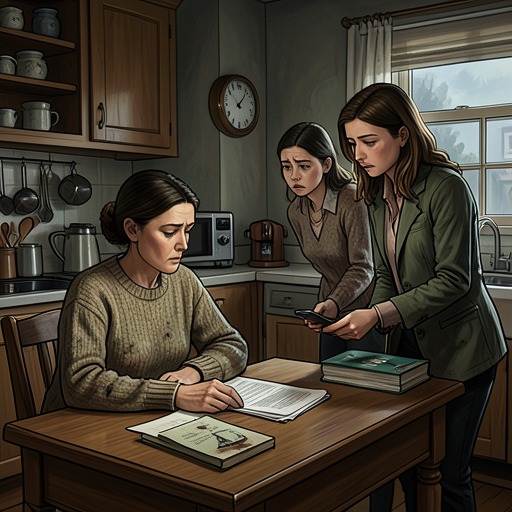
Thelonious understands that Lorraine is already doing much of the work. During a meal, he tells her he appreciates that she has to manage everything with Agnes and recognizes that the arrangement is unfair. His question about whether he can help carries the strain of someone arriving to take responsibility while confronting labor that another person has long performed. He sees Lorraine in the kitchen in her yellow apron, cooking rice, an image that recalls his childhood: he had imagined she owned many yellow aprons, although he had only ever seen her wear that one. The detail makes her presence in the old household feel continuous across the years, even as Thelonious now depends on her in a new way.
When he asks Lorraine what will happen to her after Agnes dies, she says she will stay and take care of him. Thelonious accepts, unable at first to find anything else to say. The exchange reveals a reciprocal attachment, but it does not make Lorraine’s future secure or remove the imbalance between her age and the work she performs. Care in this household is distributed through promises and routines, not through a stable arrangement that resolves everyone’s needs.
Care, safety, and changing recognition
Agnes’s condition is difficult to define medically. Thelonious takes her to a doctor, who rules out a lung infection, a stroke, and a vitamin B-12 deficiency; the examination does find tangled nerve fibers. During the appointment, the doctor repeats the same conversation with Agnes, who responds by asking why they are going over it again. The exchange makes the problem visible in ordinary interaction: Agnes can participate, but repetition has entered the conversation in a way that she herself notices.
At home, her impairment also creates immediate risks. One morning Lorraine points out the window, where Agnes is standing in the family’s light-blue skiff on the pond. Thelonious swims out because there is no other way to reach her. Agnes strikes at him with an oar when he approaches, and he realizes that she is not recognizing him as her son. Rather than try to force his way aboard, he takes hold of the boat’s rope and speaks calmly. When he addresses her formally as Mrs. Ellison and tells her that standing is not allowed in the boat, she sits. The scene shows both the danger of her disorientation and the continuing importance of adapting his approach to the person in front of him. Lorraine, Maynard Boatwright, and Marilyn Tilman help Agnes back to shore, while Marilyn attends to Thelonious after the swim.
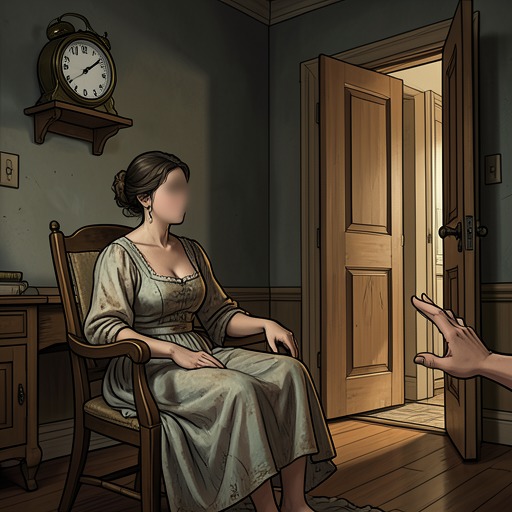
Thelonious cannot rely on a good evening to assure him that Agnes is safe. After Lorraine’s wedding, he stays awake beside her, exhausted and afraid that he might wake to find her gone and injured. The prospect of arranging care outside the family home consequently becomes more urgent, even as the word commit troubles him for the finality it suggests. In the morning Agnes recognizes him briefly and addresses him affectionately, but cannot recall the dreams she says she had. Recognition persists, then recedes; the alternation gives Thelonious no dependable measure of how much supervision she needs.
The cost of arranging a future
Thelonious’s concern for Lorraine and Agnes is entangled with a desire to recover his own life. When Lorraine’s marriage to Maynard Boatwright is threatened by an argument, he recognizes that he wants them to marry partly so that he will not have to care for Lorraine in her later years. He also admits to himself that he does want Agnes placed in a care home—not only for her sake, but for his. At the same time, he resists describing the decision as committing her, because the word carries a sense of permanence that he cannot accept easily. The possibility of admitting her to the retreat in Columbia, Maryland, looms as a decisive separation, even though his exhaustion and fear have made continued care at home increasingly difficult.
The conflict is not resolved by declaring one motive more virtuous than another. Thelonious wants Lorraine to have a future with Maynard, wants Agnes safe, and wants relief from a responsibility that has consumed his attention. These desires overlap without becoming identical. His candid recognition of that overlap complicates the image of caregiving as pure self-denial: he is trying to meet real needs while also looking for a way not to remain the only person answerable to them.
Institutional care and the altered family bond
Later, Agnes is in a care facility, where her incontinence has worsened and she no longer chooses to move herself around despite seeming physically able. Thelonious arrives as staff change her bed and provide personal care, then steps into the corridor. He remembers the woman who once described seeing colors while listening to Mahler’s Fourth Symphony, naming autumnal greens, reds, and ochre. The contrast is not simply between health and illness: it sets Agnes’s former powers of perception and expression against the dependence and diminished recognition of her present life.
Her placement brings some of the safety Thelonious had desperately wanted, but it does not free him from grief or from the labor of witnessing change. Earlier he had feared finding her missing from her bed or at the bottom of the stairs; now the risk is answered by institutional supervision, while the familiar person he remembers seems increasingly distant. The return to Washington therefore ends not in a restored household but in a changed form of responsibility. Its central measure is the repeated adjustment between what Agnes needs, what Lorraine can provide, what Thelonious can bear, and what the family’s resources allow.