Hitler Youth
FatherlandThe Hitler Youth appears in the novel as an institution that makes political conformity part of childhood: ten-year-old Pili March wears its uniform, takes pride in passing its initiation test, and learns its prescribed exercises and songs. His father, Xavier March, sees the boy’s enthusiasm and the dagger bearing a swastika as signs of a world that has made belonging conditional on participation.
Identity and Entry
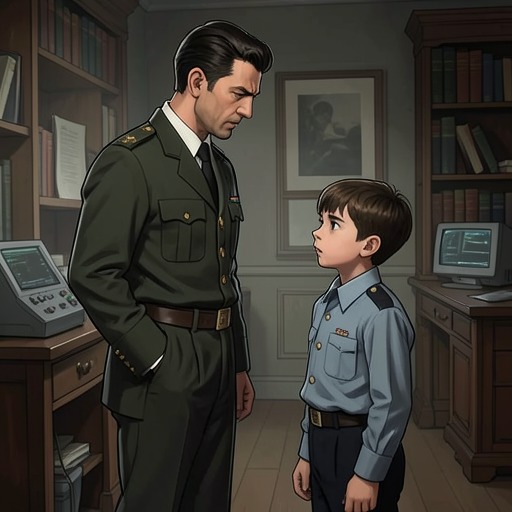
Pili has newly entered the junior ranks, the Pimpfen. On a school vacation, he arrives at Xavier March’s car in a crisp black shirt and dark blue shorts, wearing the organization’s uniform. The father gives him an awkward hug; the boy climbs in wordlessly. Their Sunday visits already follow a strained routine, and the uniform makes the political institution an immediate presence within this fragile family encounter.
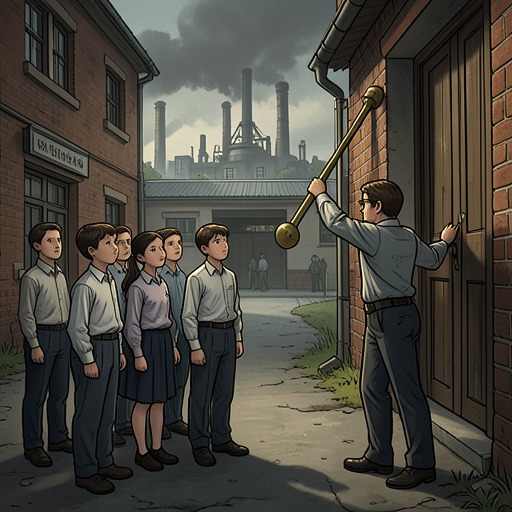
The novel places the Pimpfen within a staged progression. A child could join at ten and remain until fourteen, when he passed into the full Hitler Youth. Before entry, Pili says, a boy was “a nonuniformed creature who has never participated in a group meeting or a route march.” His formulation makes the contrast plain: membership is presented not simply as an activity but as the threshold between being outside the group and being recognized as part of it.
Training and Ritual
Pili is proud to have ranked first in his initiation test. He describes a sixty-meter run to be completed in twelve seconds, a long jump, shot put, a day-and-a-half route march, written work in Party philosophy, and recitation of the “Horst Wessel Lied.” Physical tests, endurance, ideological instruction, and ritualized performance are combined in a single measure of readiness. The boy recounts the requirements as concrete achievements rather than as an imposed political program.
The conversation briefly turns to Pili’s dagger. He takes it from his pocket and lays it carefully on the table. March picks it up, recognizing the swastika on its hilt and remembering the excitement he felt when he received his own dagger as a boy. The object links father and son across generations, but also marks a change: March now handles the symbol with the knowledge of an adult who has become alienated from the society that once welcomed him into its ranks.
Belonging and Family Conflict
During the drive back from the station, Pili suddenly asks whether his father is an asocial. The question exposes how political classifications have entered a child’s understanding of his parent. March rejects it as nonsense, but the encounter shows the reach of a society in which being outside organized associations can be treated as evidence of disloyalty. The Hitler Youth’s promise of group belonging sits within this larger pressure to participate and conform.
Pili’s account of his initiation also gives the meeting a fleeting warmth: when the conversation turns to the Pimpfen, he brightens, and March praises his success. Yet their ease is limited. March had tried to take his son’s hand in the crowded station, and Pili had shaken him off; the uniformed boy’s enthusiasm belongs to a collective world that his father watches from the margins. Through this small family scene, the Hitler Youth is shown not only as a youth organization but as one of the forces shaping the distance between them.