United States Department of State
FatherlandThe United States Department of State is the American institution whose caution shapes the possibility of Martin Luther’s defection. Through the embassy’s negotiations, the novel presents the department not simply as a route to safety but as part of a government balancing evidence, political risk, and détente with Germany. Luther’s proposed testimony could expose the regime’s crimes; accepting him could also threaten the diplomatic progress surrounding the summit.
Role in the Defection Negotiations
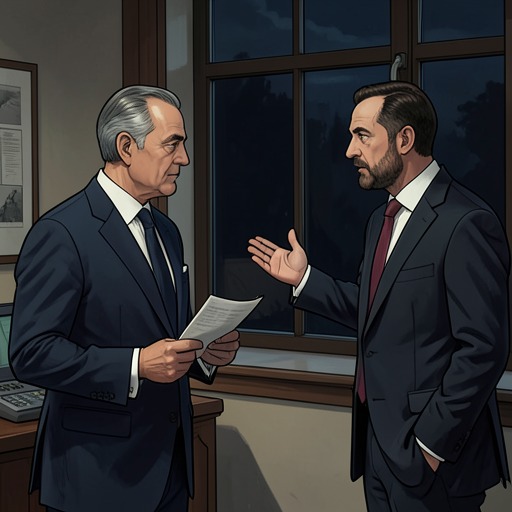
The immediate question is whether Luther can reach the United States Embassy and whether American officials will accept his account. Charlie Maguire presses the urgency: if Luther does not go directly to the embassy, she warns, he will be captured and killed. The embassy representative, Henry Nightingale, refuses to treat that danger as sufficient authority to admit him. He says that he cannot accept every former Nazi who wishes to defect, especially without authorization and under the current political circumstances.
Nightingale’s objection is institutional as well as evidentiary. He says he will have to speak with Ambassador Lindbergh, who in turn will have to speak with Washington, and predicts that both will demand more proof than the photocopies Xavier March has brought. He does not regard Luther’s offer, as relayed by March, as a guarantee that the evidence is genuine or adequate. The decision therefore depends not only on what Luther may know but on whether the department is prepared to stake its diplomatic position on his account.
Evidence and Political Risk
The negotiations take place amid efforts to preserve détente. Nightingale argues that Washington will not want to endanger the progress made during the summit week on the strength of March’s theories. He also refuses to assume that a former Nazi seeking to defect should automatically be trusted. The scene makes the distinction between the truth of a claim and the institutional threshold for acting on it: Luther may possess proof, but the embassy still has to decide whether it can verify and receive it.
Nightingale describes the possible political consequences if Luther’s disclosures provoke public controversy: congressional speeches, demonstrations, editorials, and trouble for the White House during an election year. He predicts that the administration could try to discredit both Luther and Charlie, casting the material as an old story supplemented by documents that might be forged. His warning exposes the vulnerability of evidence in a political environment where officials can question its timing, provenance, or supposed sponsors rather than confront its substance.
Conditional Agreement and Limits
The parties eventually arrange a limited test rather than an immediate promise of asylum. Nightingale agrees to meet Charlie on the steps of the Great Hall shortly before nine. If Luther appears, March will drive him to the meeting; Nightingale will hear his account and then decide whether to take him to the embassy. He undertakes not to tell the ambassador, Washington, or anyone else in advance what he plans to do.
Even this compromise leaves the decisive authority elsewhere. Once Luther is inside the embassy compound, Nightingale says, higher authorities will determine his fate. He expects them to know that Charlie possesses the full story and intends to print it, a consideration that may make turning Luther away more difficult. The proposed arrangement thus offers a narrow opening, not a guarantee: it depends on Luther arriving, Nightingale judging his account persuasive, and officials above him accepting the political and evidentiary risk.
Institutional Significance
The United States Department of State’s role in this episode is defined by the gap between diplomatic access and moral urgency. Charlie sees an immediate danger to Luther and a chance to bring his evidence to light; Nightingale sees a decision requiring authorization, proof, and calculation of consequences for détente and the summit. The negotiation gives institutional form to the novel’s central problem of testimony: facts do not secure belief or protection by themselves, and the authority that could make them consequential may hesitate when doing so carries a political cost.