Kripo
FatherlandThe Kripo, or Criminal Police, is the Reich’s department for investigating ordinary crime, including murder. In the institutional hierarchy described in the novel, it occupies an unstable middle ground between the uniformed police and the political-security agencies: its work concerns the bodies and crimes of everyday life, but its jurisdiction and personnel are embedded in a regime that turns law and administration toward racial persecution and political control.
Identity and Place in the Police System
The Kripo is identified as Department V of the Reich Main Security Office. Below the Security Police in the hierarchy are the ordinary police, who handle public-order duties, emergencies, arrests, and the recovery of bodies from lakes. At the top are the Security Police, comprising the Gestapo and the Party’s security service, the SD, which address terrorism, subversion, counterespionage, and crimes against the state. The Kripo lies between these levels and overlaps with both. Its stated remit extends from burglary and bank robbery to assault, rape, offenses involving mixed marriage, and murder; determining who a body is and how it came to be in a lake is specifically its business.
That division of labor makes the Kripo’s position more than a matter of rank. A death may begin as a criminal investigation, while the state’s political agencies remain ready to treat the same case as a matter of security if the dead person is deemed a traitor or terrorist. The department’s ordinary jurisdiction therefore exists within a system whose categories can shift the meaning of a case and the authority responsible for it.
Procedures and Investigative Work
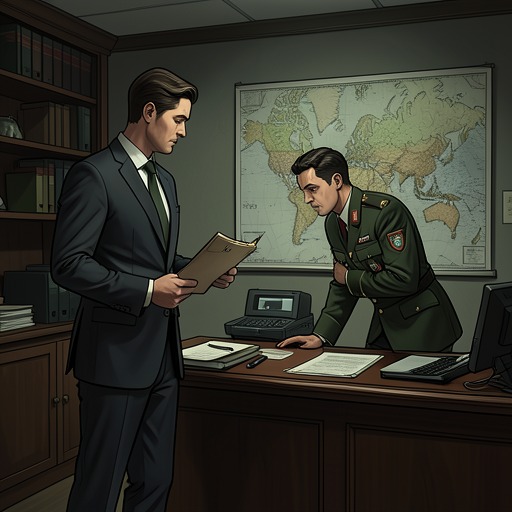
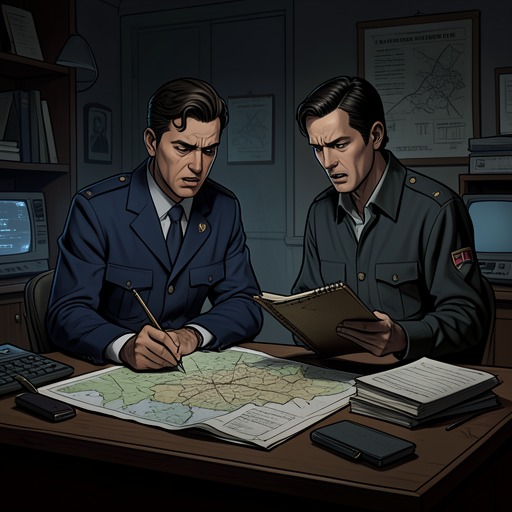
The novel presents the Kripo through a standard response procedure: when a body is discovered, a pathologist, a police photographer, and an investigator are to attend the scene at once. Investigators are assigned through a rota kept at Kripo headquarters in Werderscher Markt. The procedure gives murder investigation a recognizable professional routine, distributing the initial examination among medical, photographic, and investigative roles.
That routine is also the setting for the work of Xavier March, a homicide investigator in the Berlin Kriminalpolizei. The department’s rota determines which investigator attends a body, while its files preserve the records through which later inquiries can recover older cases. In March’s investigation of Wilhelm Stuckart’s death, the Kripo file reaches back more than twenty-five years, showing how an inquiry into a present death can open onto a long administrative history of allegations and inaction.
Files, Law, and Political Complicity
The Stuckart file connects the department’s investigative function to the regime’s racial laws. It records that Stuckart joined the Interior Ministry’s Committee for the Protection of German Blood in 1936, where officials considered marriage applications between Aryans and non-Aryans. The file also contains allegations that he exchanged marriage licenses for bribes and sought sexual favors from women involved. A named complaint by a Dortmund tailor concerned the assault of his fiancée, but the file records no investigation; instead, the complainant and his girlfriend were sent to concentration camps. Other allegations, including one from Stuckart’s wartime Blockwart, likewise produced no action.
The contrast between accumulated documentation and official inaction defines the limits of the Kripo’s investigative record. Its files can preserve evidence of complaints without showing that the department pursued them or protected those who reported abuse. The novel’s account thus places criminal investigation beside a legal-administrative system that classified people by race and punished those harmed by its officials rather than those accused of abusing their authority.
A battered copy of Stuckart’s commentary on German racial laws sharpens that connection. Its chapters discuss the three Nuremberg Laws of 1935, including the Reich Citizenship Law, the Law for the Protection of German Blood and German Honor, and the Law for the Protection of the Genetic Health of the German People. The book’s marriage charts and references to medical examinations and sterilization certificates make racial control appear as a matter of legal classification and paperwork. For March, the material is bewildering; for the reader, it sets the Kripo’s files within a state where bureaucratic form can organize discrimination as well as record crime.
Surveillance and the Limits of Investigation
The novel also places the Kripo’s work in a wider apparatus of monitoring. The Gestapo’s campaign against Swiss banks used agents, intermediaries, intercepted communications, and pressure against account holders to identify German assets abroad. This is not described as ordinary Kripo work, but it reveals the surrounding police-state environment: intelligence gathering and coercion can operate across borders, while routine communication itself is subject to interception.
That surveillance reaches directly into the investigation of Martin Luther. Charlotte Maguire brings out an American portable tape recorder fitted with a suction cup in place of a microphone, then plays a recorded telephone call that March recognizes as Luther’s. Later, a Kripo official rejects March’s suggestion that an embassy tip had revealed Luther’s plans and produces a wiretap transcript from the state research office. The distinction matters: information that March attributes to an informant has in fact come through intercepted communications. The investigative trail therefore runs not only through files and interviews but through a monitoring system capable of turning a private call into state intelligence.
The Kripo’s narrative significance lies in this double condition. It is a criminal-investigation department with procedures, specialist roles, and long-maintained case files; yet those instruments do not stand outside the political order. The same record-keeping that enables March to pursue an old case also exposes how allegations could be filed and left unanswered, while surveillance beyond the department’s formal remit shapes what investigators can know and whom the state can reach.