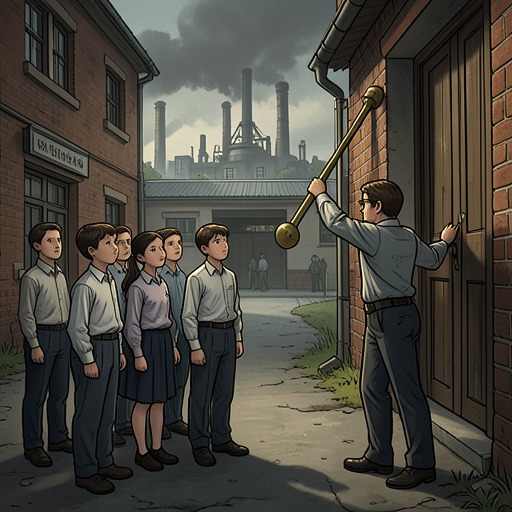
Schutzstaffel
FatherlandSchutzstaffel is the regime’s armed and administrative organization, presented not only through uniformed troops but through officers, prison systems, camp administrations, and chains of command. Its significance lies in the way those parts converge: it can seize people in the street, threaten a criminal investigation with imprisonment, administer camps, and translate mass killing into documented procedure. The novel repeatedly sets its formal authority beside the violence and secrecy that authority enables.
Organization and authority
During the raid on Wilhelm Stuckart’s apartment, Schutzstaffel troops carrying automatic rifles arrive in an army truck behind an unmarked car, turning the investigators’ discovery of evidence into an armed confrontation. The deployment makes the organization’s coercive capacity visible: it can move personnel and weapons into an urban square to take control of a scene. The immediate purpose of the raid is not explained in this episode, but the arrival forces those inside to flee while Xavier March continues searching the papers.
The hierarchy also operates through officers and institutional relationships. Gestapo commander Karl Krebs is identified as one of the SS officers who had been with Odilo Globocnik at Josef Buhler’s villa, linking the apartment raid to an earlier investigation. At Gestapo headquarters, Schutzstaffel and Party authority is made part of the building’s public image: corridors display swastikas and marble busts of the leadership. Yet the authority March encounters is also personal and conditional. Globocnik seeks to have March transferred to the SS prison at Columbia House pending court-martial, but proceedings against a serving Criminal Police officer require Reinhard Heydrich’s permission. Heydrich refers the matter to Artur Nebe, who gives March four days to produce a case against Globocnik before the transfer can proceed. The exchange reveals an organization in which threats are exercised through overlapping offices and negotiated permissions, not simply through force.
Surveillance and control
Schutzstaffel power extends beyond arrests into the monitoring of private communication. When March challenges the claim that Globocnik learned of Martin Luther’s planned meeting through an American Embassy tip, Krebs says the information came from a wiretap. He produces a sheet marked as a top-secret state document, rushed over from the wiretappers in Charlottenburg. The document turns a private telephone call into operational intelligence, allowing the authorities to act before the planned meeting takes place.
This surveillance has an earlier precedent in the Gestapo’s campaign against German account holders in Switzerland. Sent by Heydrich, Georg Hannes Thomae cultivated bank employees and approached banks under the guise of an intermediary. If a bank accepted a deposit, the Gestapo took that as proof that the suspected account existed; its owner could then be arrested and tortured until the account’s details were disclosed. German authorities intercepted communications with Switzerland and sought the repatriation of assets. Swiss resistance produced a banking code that criminalized disclosure of client holdings, and Thomae was expelled. The episode shows the regime trying to extend its reach across borders by combining deception, intercepted communication, and coercion, while the resulting pressure helped make German numbered-account business collapse by 1939.
Camps and administrative procedure
The novel’s most extensive account of Schutzstaffel organization concerns Auschwitz, where Martin Luther’s inspection notes record a system administered through several levels. The camp falls under the SS Economic Administration Main Office; other camps in the Lublin district are controlled by Globocnik. Rudolf Höss receives Luther but delegates the inspection to a young officer, Weidemann, and directs him to answer the visitor’s questions and show him everything. Authority is therefore distributed among camp commanders, administrators, and staff, while remaining part of an organized system.
Luther’s account follows the process from the railway siding to the camp’s facilities. SS troops, some accompanied by dogs, gather when a transport arrives; guards and camp prisoners assist in unloading and sorting those brought there. The inspection records a column of nearly two thousand people directed toward an underground chamber identified by a sign as a bathing and disinfection room. The details establish how deception and routine instructions shaped the process: people are told to undress and remember numbered pegs, while camp trustees encourage them to comply. In the chamber, fixed installations and a managed sequence of actions convert the arrival of a transport into a killing operation.
The report then follows the handling of the dead, the recovery of property, and the use of prisoners’ labor. A Jewish labor detachment removes the bodies; an industrial process follows in which hair and other valuables are collected. Weidemann describes four gas-chamber and crematorium installations, each with a stated capacity of two thousand bodies per day, and says that Jewish labor performed the work, with the personnel changed every two to three months. He describes the operation as self-supporting and its secrecy as self-sealing, while identifying the visible smoke and flames as a security problem. The account’s institutional force comes from its accumulation of connected stages: transport, selection, killing, disposal, and appropriation are represented not as isolated acts but as coordinated procedures.
Documents, euphemism, and concealment
The minutes of the conference held on January 20, 1942, at the Wannsee villa identify the meeting’s subject as the “final solution of the Jewish question” and estimate that about eleven million Jews were involved. Their administrative language describes forced movement eastward and labor exploitation while evading the consequences of the policy. March’s reading of an earlier draft exposes a further layer: the draft records discussion of mass shootings, gas trucks, and experiments with Zyklon B, while Heydrich’s handwritten objection and the abbreviated final version show material being removed from the official record. The documents make Schutzstaffel administration legible both as an instrument of policy and as a means of controlling what the policy’s records disclose.
Other paperwork connects killing to the systematic use of prisoners’ property and labor. An August 1942 circular from Richard Glücks, issued in response to an order from Oswald Pohl, directs that hair cut in concentration camps be used industrially. Female prisoners’ hair is to be disinfected and stored for thread used in socks for U-boat crews and felt stockings for the railways; male prisoners’ hair is usable if it meets a specified length. Monthly totals, separated by sex, must be reported to the SS Economic Administration Main Office. The exact measurements, products, and reporting date give the order the appearance of ordinary administration, even as its subject makes clear that the organization’s accounting extends into the appropriation of human remains.
Political change and narrative significance
Krebs presents the Schutzstaffel as an organization undergoing internal change. He claims that the Reichsführer listens to younger officers, supports restructuring and greater openness, and favors talking to the Americans; he predicts that men like Globocnik are losing influence. He offers March protection from Globocnik in exchange for information about Luther, the woman, and the missing suitcase. His pitch does not erase the organization’s coercive structure. Rather, it shows how a promise of reform can coexist with surveillance, political pressure, and bargaining over a prisoner’s safety.
Across these episodes, Schutzstaffel power is shown in contrasting registers: armed troops at an apartment, discreet surveillance of a telephone call, contested authority over a police officer, and carefully specified procedures within the camps. The contrast is central to the novel’s account of state violence. Persecution does not appear only as a sudden act of force; it is sustained by command relationships, records, technical systems, and administrative language capable of making crimes appear procedural while concealing their human consequences.