General Government of occupied Poland
FatherlandThe General Government of occupied Poland was the German-administered rump territory formed from the part of prewar Poland not incorporated into Germany after the 1939 invasion. In the novel, it is not a marginal remainder but a central instrument of occupation: a place organized through population transfer, Germanization, extraction of wealth, and bureaucratic coordination. The same administrative world that moved people and property also connects to the machinery of genocide documented in the evidence Xavier March uncovers.
Formation and Population Policy
After the invasion, the western provinces of Poland were incorporated into Germany as Reichsgau Danzig-West Prussia and Reichsgau Wartheland; the remaining territory became the General Government. The western provinces were to be Germanized, while the General Government served as the destination for Poles displaced to make room for German settlement. March learns that the 1940 target was a density of one hundred Germans per square kilometer in the new Reichsgaue, a target reportedly achieved during the first three years of the war.
The scale of the transfer was explicit: to make room for one million Germans in the annexed western provinces, one million Poles had to be moved out. The General Government also had to absorb Jews expelled from Germany and from western territories including France, Holland, and Belgium. Halder describes the resulting conditions as overcrowding, starvation, and disease, and says that the territory remained in poor condition despite official claims. These populations appear in the policy as administrative problems to be relocated, but the consequences described are material deprivation and forced displacement.
The novel places these policies alongside their public presentation. Newspapers and television carry East Ministry appeals inviting Germans to settle in the General Government, promising a free farmstead and guaranteed income for five years. The advertisements show prosperous colonists; reports that filter back instead describe poor soil, exhausting work, and drab satellite towns where settlers return at dusk because of partisan attacks. The territory is represented as a promised destination for German settlers and, at the same time, as a harsh and insecure place shaped by occupation and resistance.
Administration and Extraction
The General Government was ruled by Hans Frank, who, according to Halder, exercised absolute authority with Josef Buhler. Buhler, Frank’s former legal partner, served as state secretary from 1939 to 1951 and held the honorary rank of SS-Brigadeführer. The novel emphasizes the contrast between the military title and the character of his work: Halder considers him a desk-bound administrator rather than a combatant. Frank ran the administration from Wawel Castle in Krakow, where Buhler was based.
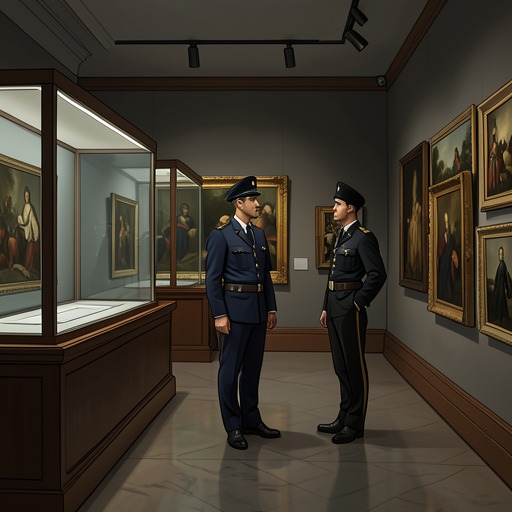
That official position also gave Buhler access to the region’s plunder. Halder recounts reports of extraordinary luxury at Wawel Castle, including paintings, tapestries, church treasures, and jewelry, alongside bribes in cash and kind. He cannot establish Buhler’s precise part in every transaction, but considers it unlikely that the state secretary was uninvolved. March connects this account to Buhler’s house on Schwanenwerder, an apparent sign that wealth accumulated in the occupied East reached officials’ private lives.
The investigation later supplies a more specific account of the art pipeline. A secret inventory compiled by Polish museum authorities in 1940 recorded 2,700 European-school paintings, 10,700 paintings by Polish artists, and 1,400 sculptures removed from Warsaw alone. Buhler, as state secretary, could arrange for objects to be transported under escort to Wilhelm Stuckart at the Interior Ministry, with the transfer made to look legal. Stuckart then arranged storage or smuggling out of the Reich in exchange for portable, untraceable assets such as cash, jewels, and gold. Some sculptures were being dug up in a garden as the investigation proceeded. The episode makes the General Government’s administrative access a means not only of governing occupied territory but of converting cultural property into private or concealed wealth.
Connection to the Machinery of Genocide
The General Government’s place in the novel’s account of mass murder emerges through the evidence surrounding the Wannsee Conference and the extermination system. The conference minutes, dated January 20, 1942, at Am Großen Wannsee 56–58 in Berlin, described a “final solution” involving approximately eleven million Jews across Europe. Their bureaucratic language proposed directing Jews eastward for labor, separating men and women, and allowing those deemed able to work to be depleted through labor and “natural reduction.” The formulation turns deportation and death into administrative euphemism.
The recovered draft minutes reveal that the conference discussion also addressed methods of killing. In the draft, Reinhard Heydrich was asked about the practical difficulty of processing large numbers. Rudolf Lange reported on shootings near Riga, gas trucks at Kulmhof, and experiments with Zyklon B at Auschwitz; Heydrich’s handwritten objection appeared in the margin, while the final minutes reduced the discussion to a single phrase. This contrast between the franker draft and the sanitized final record shows how official documentation could both register and conceal the practical character of policy.
Martin Luther’s inspection notes from Auschwitz expose what such administrative language obscured. They record a railway siding about 1.5 kilometers long, a transport of roughly sixty freight cars carrying Jews from France, and a column of nearly 2,000 people directed through a facility presented as a bath and disinfection room. The notes describe the separation of those sent to work from those led toward the killing installation, followed by the removal and processing of bodies. They also record the scale of the camp’s facilities: four gas-chamber and crematorium installations, each said to have a capacity of 2,000 bodies a day. These details locate the mass killing within a coordinated system of transport, selection, killing, and disposal rather than as an isolated act.
The records further show the conversion of victims’ belongings and bodies into usable materials. At the camp section called Canada, Luther notes large quantities of luggage and personal effects, as well as recorded shipments that included 132,000 men’s shirts, 155,000 women’s coats, and 3,000 kilograms of women’s hair. A 1942 circular from the SS Economic Administration Main Office ordered that human hair cut in concentration camps be used for industrial felt and thread; women’s hair was to be made into socks for U-boat crews and felt stockings for railways, and monthly totals were to be reported. Read beside the forced transfers and looting in the General Government, these records reveal a wider administrative economy in which dispossession and the exploitation of human beings were processed through institutions, transport, inventories, and routine reporting.
Narrative Significance and Historical Fate
The General Government links the novel’s apparently separate lines of inquiry: the forced reshaping of Poland, the enrichment of occupation officials, and the system of deportation and murder. Its civil administration makes the occupation legible as a set of targets, offices, transfers, and inventories. That language does not soften the consequences; rather, the records show how bureaucratic regularity can organize violence and make it easier to conceal behind phrases such as resettlement and labor utilization.
The novel’s account also distinguishes its alternate history from the historical fate stated in the author’s note. Josef Buhler, who served as state secretary in the General Government, was condemned to death in Poland and executed in 1948. This note places the fictional investigation against a real postwar outcome, while the novel’s broader reconstruction uses Buhler’s office to show how territorial administration could connect population policy, personal enrichment, and state violence.