Josef Buhler—Edith Tulard
FatherlandJosef Buhler—Edith Tulard refers to Buhler’s marriage to Edith and the long, isolated widowhood that followed her death. The relationship emerges indirectly, through Buhler’s sister Elisabeth: a wealthy household, Edith’s musical life and illness, and a husband whose ambition gave way to years of inactivity. Against the background of Buhler’s position in occupied Krakau and the art and property transfers associated with him, the marriage also marks the private setting in which public power became private comfort.
Marriage and family distance
Elisabeth told Xavier March that she and Buhler had never been close, even as children; she was eight years older. After Edith died, she said, the siblings had nothing in common. Their estrangement did not mean that contact ceased entirely: Buhler wrote to Elisabeth from time to time, including a birthday letter sent two weeks before March questioned her. The formal note, printed on stationery bearing an engraving of the Schwanenwerder house, offered birthday greetings and reported that Buhler was in good health. Its official-sounding courtesy sits uneasily beside Elisabeth’s account of a brother who did not help her during twenty-four years of widowhood, despite her small pension.
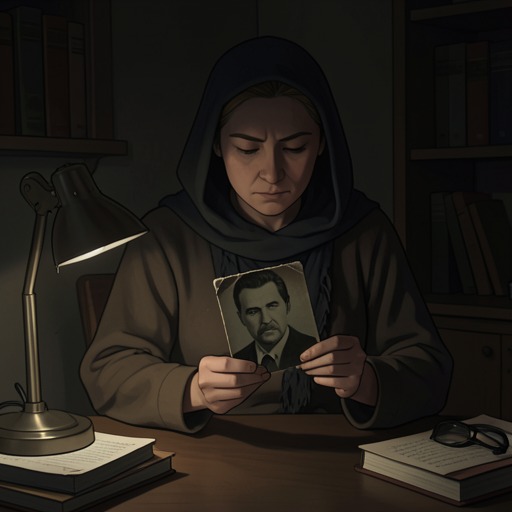
Elisabeth dated Edith’s death to the winter of 1953 and said that she had cancer. She remembered no children; according to her, Buhler was sterile, a fact she related without emphasis. Her account links Edith’s unhappiness to the loss of the life she had wanted: she had no children and spent long periods alone in the large house. Elisabeth described her as a gifted pianist who loved music and recalled the Bechstein piano in the house. The recollection supplies a sharply personal counterpoint to the property and political status that surrounded the couple: Edith’s life in the home is remembered through music, solitude, and illness, rather than public position.
Wealth and the house on Schwanenwerder
The scale of the household appears in two different accounts. Elisabeth said that Edith inherited a fortune during the war and that the couple had money and lived well. Separately, Halder told March that officials in Krakau enjoyed extraordinary luxury while the General Government endured overcrowding, starvation, disease, poor soil, and the threat of partisan attacks. He connected Buhler’s residence on Schwanenwerder to the privileges available to officials in the occupied territory, while acknowledging that Buhler’s exact participation was uncertain.
The larger context is an extractive system, not merely private affluence. Halder described paintings, church treasures, tapestries, jewelry, and cash moving through the administration centered at Wawel Castle in Krakau. Later, Globus explained a more specific chain involving Buhler and Wilhelm Stuckart: as state secretary, Buhler could arrange escorted shipments of art to Stuckart at the Interior Ministry, where it could be stored or smuggled out in exchange for portable wealth. A Polish museum inventory listed 2,700 European paintings, 10,700 paintings by Polish artists, and 1,400 sculptures removed from Warsaw alone. The account does not establish that each object passed through Buhler’s hands, but it places his household’s comfort beside a bureaucracy that turned occupation and confiscation into transferable private assets.
Edith’s death and Buhler’s withdrawal
Elisabeth portrayed Buhler as disciplined and physically active, but said that after leaving Krakau he abandoned his former ambitions. Before the war, he had worked exceptionally long hours; after his departure, he never returned to law. For more than a decade after Edith’s death, he sat alone in the Schwanenwerder house and did nothing, according to his sister. The contrast is not simply between a successful career and retirement: her account describes the cessation of the purposeful work that had once defined him and the narrowing of his life to the house.
The reported chronology connects Edith’s death to Buhler’s prolonged isolation without explaining his inner response. Elisabeth’s judgement of him was severe: she called him cold and said that he had never offered assistance when she was widowed. Her testimony therefore describes the marriage and its aftermath from outside the couple, through remembered habits, family distance, and material circumstances. It makes no claim to reveal what either spouse privately felt, and the evidence leaves the cause of Buhler’s retreat uncertain.
Private life amid official records
The relationship is assembled from uneven forms of evidence: Elisabeth’s spoken recollections, a birthday letter, descriptions of the house, and documents from the political world in which Buhler served. The letter’s polished formality confirms that he maintained at least occasional contact with his sister, but its conventional greeting offers no account of his marriage or grief. Elisabeth’s testimony fills that silence with concrete details—the date and cause she recalled for Edith’s death, the piano, the wealth, and Buhler’s years at home—while remaining a relative’s partial perspective.
That private history is set against the administrative record of mass confiscation and concealment. In a different investigation, March found a notice stating that the minutes of a meeting held on January 20, 1942, had been removed at the request of the Reichsführer-SS; the notice was dated April 6, 1964, eleven days before the investigation reached the document. The archive’s omissions and the family’s limited testimony are distinct kinds of silence, but both shape what can be known. In Buhler and Edith’s case, the surviving details do not yield a full account of their marriage; instead, they show how wealth, isolation, and family estrangement frame the brief record of a life lived within an expansive system of official power.