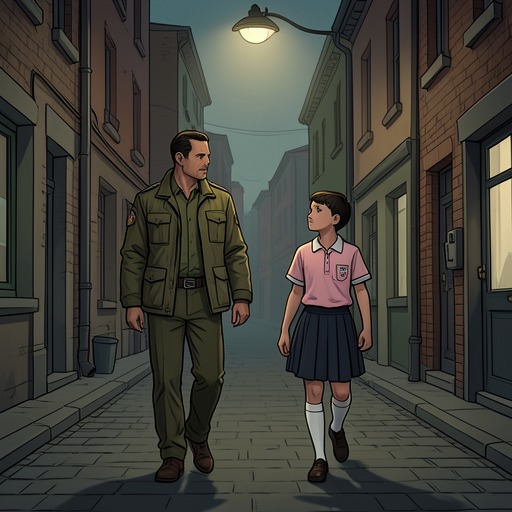
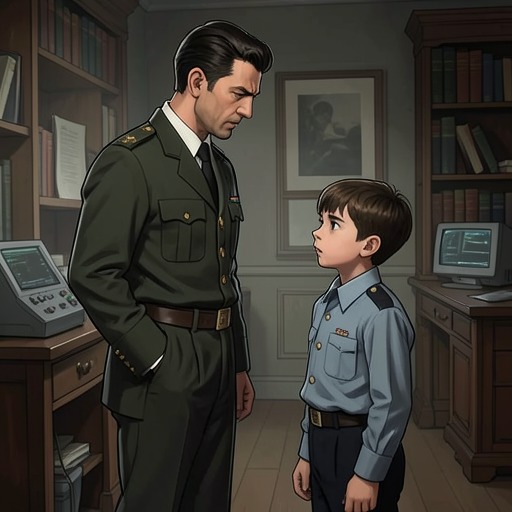
Klara Eckart—Erich Helfferich
FatherlandKlara Eckart’s relationship with Erich Helfferich places Xavier March’s estranged family inside the same political culture that threatens him professionally. Helfferich, a Party bureaucrat who has been seeing Klara, becomes “Uncle Erich” to Pili; his warnings about March turn political suspicion into a rift between father and son. The scene makes the relationship consequential less as romance than as an alliance whose influence reaches into the family home.
Identity and Context
Helfferich is a full-time bureaucrat at the Party’s Berlin headquarters and, in March’s view, a zealot. March’s hostility is sharpened by the knowledge that Helfferich began seeing Klara a year earlier. By the time March confronts the consequences, Pili calls him “Uncle Erich,” a familiar title that signals Helfferich’s place in the household and his access to the boy’s understanding of his father.
The narrative gives no account of how Klara and Helfferich met, what either seeks from the relationship, or how their private feelings have developed. It instead establishes the connection through its public and domestic signs: Helfferich’s position within the Party, Klara’s membership in its women’s organization, and the political account of March that Pili repeats. This emphasis keeps the relationship legible through its effects rather than granting it an independent romantic narrative.
Helfferich’s Influence on Pili
In the car, Pili says that “Uncle Erich” insists March is an asocial. The label has a specific political meaning: in the Party’s vocabulary, an asocial stands one step below a traitor. March understands that the category could be attached to someone who refuses the regime’s associations and rituals, and Pili says Helfferich accuses his father of failing to give the Führer salute and joking about the Party.
Pili also reports Helfferich’s claim that a file on March exists at Party headquarters and that March will soon be arrested. The boy is almost in tears, ashamed and frightened, and says he thinks Helfferich is right. The relationship thus reaches Pili not as a neutral detail of his mother’s life but as a channel through which the danger surrounding March is explained to him. Helfferich’s account makes the state’s surveillance feel intimate and immediate, while leaving Pili caught between his father and the authority of the adult he now calls his uncle.
The Household Confrontation
When the car reaches the house, Pili tells March, “I hate you.” He leaves the car and goes inside; March follows him up the path, hearing a dog barking within. Klara opens the door in the uniform of the NS-Frauenschaft. Behind her, March glimpses Helfferich in brown clothing, a brief visual confirmation of his presence in Klara’s home and of the political setting surrounding the family encounter.
Klara blocks March from following Pili and orders him to leave both the boy and the household alone. She catches the young German shepherd by its collar as Pili pushes past her into the house; when the door slams, the dog is left yelping outside. The gesture and the slammed door make the separation concrete: March can reach the threshold, but Klara controls entry and Helfferich remains behind her. The scene does not show Helfferich speaking or acting directly. His influence has already been carried into the confrontation through Pili’s words and fear.
Significance and Limits
The relationship’s documented significance lies in its effect on the March family. Helfferich’s political authority and closeness to Klara give his warnings weight with Pili; Klara’s refusal to let March enter then turns that influence into a visible domestic boundary. The episode connects private attachment, political conformity, and surveillance without establishing that Klara and Helfferich deliberately coordinated against March.
The evidence also leaves important questions unresolved. It identifies Helfferich as Klara’s partner and shows his presence in her household, but offers no explanation of Klara’s motives or of the relationship’s later course. Its focus remains on the consequences March can see: Pili’s fear and rejection, Klara’s protective barrier at the door, and Helfferich’s presence just behind her. In this way, the relationship marks a fracture in March’s family life while showing how the Party’s language can enter and reshape the most personal of relationships.