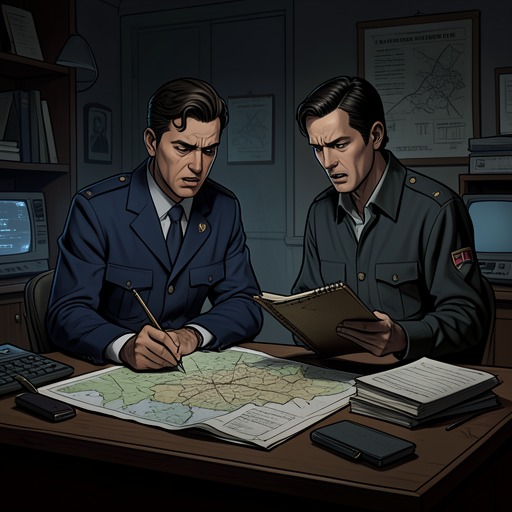
Xavier March—Max Jaeger
FatherlandXavier March and Max Jaeger are partners in the Criminal Police whose years of shared work make their eventual rupture more than a professional betrayal. At first, they operate with the shorthand of old colleagues: Jaeger takes on March’s case, covers practical tasks, and urges him to spend time with his son. But when the investigation becomes dangerous, Jaeger chooses his family’s safety over an advance warning to March. Their final exchange and separation preserve affection alongside that breach, showing how fear can divide men who have long depended on one another.
Identity and Working Partnership
March and Jaeger share an office and have worked together since 1959, sometimes as a team. Colleagues at the Werderscher Markt headquarters call them the Fox and the Bear, a nickname that turns their contrast into an affectionate professional legend: March is the more controlled investigator, while Jaeger is a large, untidy presence. Their partnership is not simply formal. They bicker and cover for each other with the familiarity of an old married couple, suggesting a bond built through repeated days of work rather than declarations of friendship.
Their private circumstances differ. Jaeger lives with his wife and four daughters in a small house in Pankow, and weekday breakfast is nearly his only time with them. March is divorced and lives alone; he has set aside the afternoon to spend with his son. This contrast supplies an early measure of their separate attachments and obligations, but does not initially prevent their cooperation. When March volunteers to take a routine call, he does so partly because the long morning ahead needs distraction; the case that follows draws Jaeger into the same working rhythm.
The Case and Everyday Loyalty
When Jaeger arrives at the office, he greets March expansively and has already heard from the duty room that March has taken a case. March tempers his enthusiasm: the corpse has no identifying possessions, a hundred people have been reported missing in Berlin since Sunday, and March has promised his son the afternoon. Jaeger accepts the assignment despite the limits March sets, becoming the colleague left to work through the case while March keeps his family commitment.
The investigation proceeds through shared scrutiny of a printed missing-person list. March explains that the dead man may not yet have been reported missing, may have disappeared before his death, or may have died earlier than the medical estimate suggests. The list contains 102 names, and March estimates the man’s age at about sixty. Their discussion shows the partnership at its most functional: March frames competing possibilities, while Jaeger contributes blunt skepticism about the medical examiner and helps test the available leads.
The routine labor continues across the day. Jaeger calls through his part of the list, and when March has exhausted likely names by late morning, Jaeger offers to check whether the duty room has received more reports. He also sends March off with a reminder to enjoy his time with his son. At 7:30 that evening, after checking the missing-person list back to Thursday and finding no report that accounts for the dead man, Jaeger reports the lack of possessions or clothing turned in. More than twenty-four hours after the estimated time of death, nobody appears to have missed the man. The case has not yielded an identity, but the exchange makes clear that Jaeger has continued to work it alongside March rather than treating it as someone else’s problem.
Trust Under Pressure
As the investigation develops into a threat to March’s safety, the habits of mutual cover give way to a more difficult question: what does loyalty require when acting on it may endanger a family? In their later confrontation, Jaeger explains that he was ordered to tell what March had found out and asks what he could have done instead. He says he knew March would have continued regardless of a warning, and that warning him would have left Jaeger, Hannelore, and the children exposed. Jaeger does not present himself as a hero; he argues that not everyone is made for heroism, and that people like him allow people like March to act as they do.
The explanation does not erase the failure. Jaeger could have warned March, and March names that omission directly. Yet the disagreement is not reduced to indifference or malice: Jaeger speaks from fear of consequences for his household, while March sees the warning as something their friendship should have made possible. The old partnership’s language of covering for one another is now tested against the very real cost Jaeger believes his family would bear.
Escape and Parting
The relationship reaches its final turn while the men are driving toward dawn. Jaeger is afraid that he will be killed for allowing March to pull a gun on him, or accused of having let it happen. His wet-eyed distress and repeated insistence that the situation is a joke sit uneasily beside the practical choice he has made. March answers by repeating Jaeger’s words, an acknowledgment that neither humor nor their familiar banter can make the danger less real.
Jaeger nevertheless helps March at the moment of separation. He works the radio dial until a commentator’s voice and the sound of a crowd come through; March then orders him to take out his handcuffs, give up the key, and attach himself to the wheel. March apologizes as he leaves. The gesture ends the immediate partnership by physically separating the two men, but it also places Jaeger in a position that assists March’s attempt to get away. Their parting is therefore neither a restoration of their former trust nor a simple final act of hostility: it is a compromised act of help under pressure, after the chance to protect one another through candor has already passed.
Significance of the Relationship
The Fox and the Bear begin as a durable working pair whose closeness is visible in shared routines, reciprocal cover, and Jaeger’s practical concern for March’s time with his son. The case exposes the limit of that intimacy. March’s readiness to continue and Jaeger’s fear for Hannelore and the children arise from different responsibilities, and those responsibilities turn an unspoken bond into an explicit moral disagreement. Their final exchange leaves both men recognizable: March persists, while Jaeger admits that he is not made for the same risk. The relationship’s ending carries the cost of that difference without pretending that years of companionship have made the choice easy or the breach harmless.