Xavier March—Paul “Pili” March
FatherlandThe relationship between Xavier March and his son, Paul “Pili” March, is one of the novel’s most intimate measures of what political conformity does to family life. Their meetings are infrequent and awkward, and March’s inward withdrawal leaves Pili vulnerable to other people’s judgments of his father. During a school holiday visit, the boy’s excitement gives way to an accusation that ends with him telling March he hates him; that rupture follows March into a dream that joins his fear for the relationship to the case he is investigating.
Family History and Distance
March and Klara had married after meeting at a tuberculosis clinic, where Klara worked as a nurse and March was recovering after being invalided out of the U-boat service with suspected tuberculosis. Their son was born when March had already been promoted to Berlin and the marriage was failing. March does not blame Klara for their separation: he sees her as a steady person who wanted home, family, friends, and acceptance, while he had changed after years in the navy and a year of near isolation during his convalescence.
He describes himself as still moving through ordinary life like a solitary observer beneath the surface. That image helps explain why fatherhood does not restore ease or intimacy. Even beside his wife, he could feel mentally elsewhere; after the divorce, the same inwardness shadows his contact with Pili. The text presents the distance not as a lack of concern, but as a failure to be fully present in the everyday exchanges through which a parent and child might build trust.
A Ritual of Contact
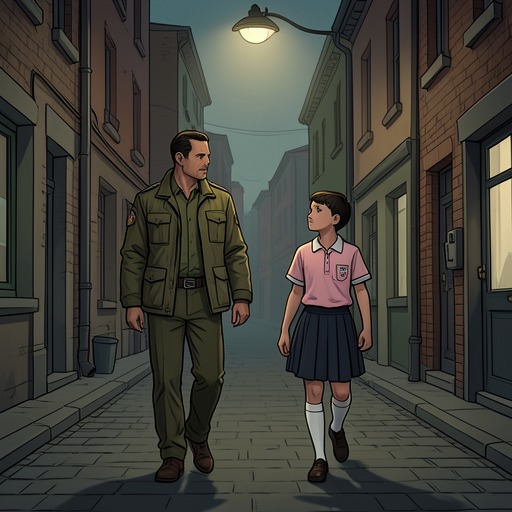
Five years after the divorce, March’s visits followed a settled but unspoken procedure. He parked outside Klara’s bungalow in Lichtenrade, sounded the horn twice, and watched for a movement behind the parlor curtain. The routine helped the adults avoid embarrassing encounters, but also made the visit feel like an obligation organized around distance. Under the strict provisions of the Reich Marriages Act, March saw Pili one Sunday in four when work allowed.
The birthday holiday briefly altered that pattern. Since 1959, children had received a week off for Adolf Hitler’s birthday instead of Easter, and March collected Pili at noon from Klara’s home during the school vacation. The ten-year-old emerged wearing a new Pimpf uniform, a crisp black shirt and dark blue shorts, and climbed into the car without speaking. March gave him an awkward hug and tried to begin with ordinary interest in his appearance and school. Pili answered only that school was all right.
A Visit Divided Between Them
The outing placed their private awkwardness inside the spectacle of the state. As the coach passed the immense Great Hall, Pili wriggled free of March’s grasp and moved toward the front. When the guide described the building, Pili bounced excitedly and asked whether they were going to see the Führer. March, however, had been staring out at a body in the mud and imagining how the dead man might have entered the lake. The vision broke when Pili spoke. March felt guilty, recognizing in the moment Klara’s old complaint that he could be physically present without really being there, and answered that he did not think they would see Hitler.
Later, in the crowded station, March tried to take Pili’s hand as they threaded through the crowds. The boy shook him off. They retrieved the car and drove in silence; only near Lichtenrade did Pili suddenly ask whether March was an “asocial.” The word was striking in a ten-year-old’s careful pronunciation. In the Party’s vocabulary, March explains, it marked someone one step below a traitor: a person who did not contribute to Winter Relief or join the many National Socialist associations.
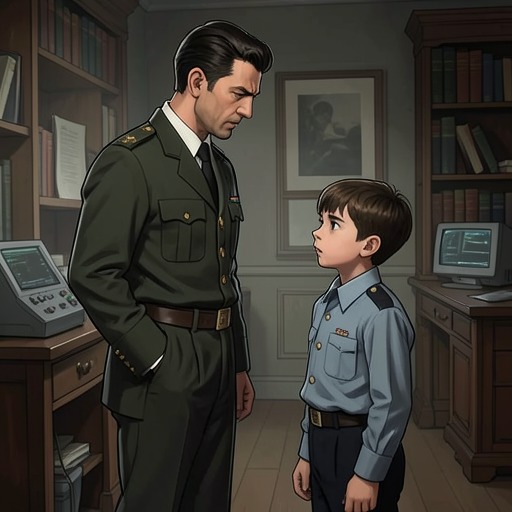
Pili’s accusation was not presented as his own discovery. He said that Helfferich claimed March failed to give the Führer salute and made jokes about the Party. When March asked how Helfferich knew, Pili said there was a file on his father at Party headquarters and that it was only a matter of time before March was arrested. The boy was nearly in tears with shame and said he thought Helfferich was right. March dismissed the claim as nonsense, but the exchange shows how political suspicion has entered the child’s understanding of his father and made their already uncertain bond a source of distress.
The Rupture at Klara’s Door
Outside the house, Pili told March, calmly and flatly, that he hated him, then got out of the car. March followed him up the path and called after him. Klara opened the door in her NS-Frauenschaft uniform, while March glimpsed Helfferich behind her in brown clothing. A young German shepherd bounded toward Pili; the boy pushed past his mother and went inside. March wanted to follow, but Klara stood in his way and ordered him to leave the boy and the family alone. She pulled the dog back by its collar, and the door shut on its yelping.
The scene leaves no reconciliation in view. Pili has heard an adult’s politically charged account of March, and March’s attempt to contest it cannot reach the boy before he disappears into the house. Klara’s intervention makes the separation concrete: March is not merely unable to get through to his son, but is also kept outside the domestic space in which Pili lives. The routine that had once avoided awkward encounters now ends in an explicit rejection.
The Dream and Its Meaning
That night, March dreams of the lakeshore and the body he had seen in the mud. He tries to pull it by the shoulder but cannot move it; when he turns away, the corpse seizes his leg and drags him toward the lake. As he struggles to hold on, the body’s face becomes Pili’s, contorted with rage and shame, repeating the words the boy had spoken at the car. The dream does not resolve the conflict or predict a specific outcome. Instead, it gives the visit’s emotional consequence a form: the dead body from March’s investigation and his living son become joined in an image of something he cannot release or save by force.
Pili matters to the novel’s portrayal of March not only as his son but as the person whose judgment he cannot dismiss. The boy’s accusation turns the state’s language of social conformity into a family wound, while March’s distraction shows how his solitary habits have costs even in the private life he cares about. Their relationship remains unresolved in these scenes, held between March’s concern, Pili’s shame and anger, and the distance that neither the custody routine nor a brief holiday outing can overcome.