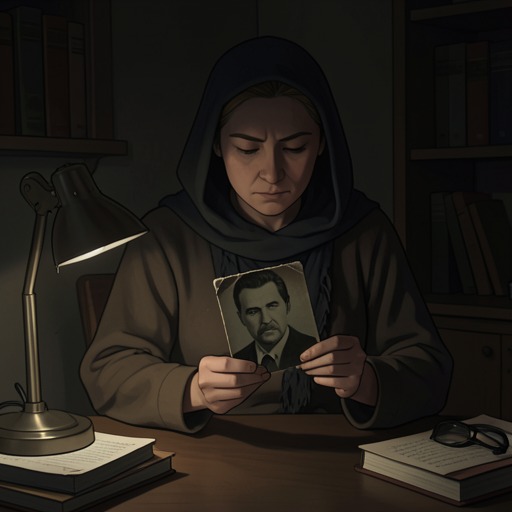
Josef Buhler—Elisabeth Trinkl
FatherlandJosef Buhler and Elisabeth Trinkl are siblings divided by decades of estrangement, and their relationship becomes visible only when Elisabeth is summoned to identify her brother’s body. Her account presents no reconciliation before his death: instead, it pieces together a history of childhood distance, a brief formal gesture of contact, and a brother who remained remote even as his life changed profoundly.
Family and Estrangement
Elisabeth, a seventy-two-year-old widow living in Fürstenwalde, was the only surviving sibling of Buhler. Xavier March traced her through the SS records bureau, which required even honorary ranks to provide next-of-kin information. She was brought to the morgue to identify him, where March explained that the police needed her confirmation before taking her home.
The identification was complicated by time and changed appearance. Elisabeth had not seen Buhler for ten years; he was heavier than she remembered and, without his spectacles, looked unfamiliar to her. Still, she confirmed that the body was her brother. The encounter made the estrangement concrete: she had been called into his life again only to establish his identity after his death.
Elisabeth said they had never been close, even as children. She was eight years older, and after Buhler’s wife Edith died, the siblings had nothing in common. She placed Edith’s death in the winter of 1953 and said it was caused by cancer. Their separation was therefore not described as the result of one dramatic quarrel, but as a longstanding distance that deepened after the loss of the person who had connected them.
A Formal Thread of Contact
Despite the years apart, Buhler had occasionally written to his sister. His last letter arrived on her birthday, two weeks before the morgue interview. It was written on thick, creamy stationery bearing an engraving of his house on Schwanenwerder; the copperplate handwriting and ceremonious tone made the message resemble an official receipt more than an intimate family exchange.
The letter offered birthday greetings and a conventional assurance that he hoped she was well, while declaring that he was well himself. It also included the Nazi salute. The letter is a trace of contact, but its polished form underscores how little intimacy it carried: it reported well-being without opening a conversation about either sibling’s life. March returned it to Elisabeth, and his observation that nobody had missed Buhler helps frame the letter as a rare, insufficient sign of connection rather than evidence of a close bond.
Money, Loss, and Resentment
Elisabeth described Buhler as financially comfortable. She said Edith had inherited a fortune during the war and that the couple had lived well. By contrast, Elisabeth had been widowed for twenty-four years. Her husband, a Luftwaffe navigator, had been shot down over France; she had not been left destitute, but her pension was small compared with the standard of living she had once known.
The contrast sharpened her judgment of her brother: in all those years, she said, Buhler had never offered to help her. She spoke with open dislike, telling March that few people thought well of him. Her testimony makes the siblings’ estrangement more than a matter of infrequent visits. In her account, Buhler’s wealth and his refusal to assist her stood beside one another, turning family distance into a remembered failure of care.
Her account of Edith adds another dimension to Buhler’s private life. Edith, Elisabeth said, was unhappy because Buhler was sterile, and she believed that this unhappiness contributed to Edith’s decline. She recalled Edith as someone who loved music and played the piano beautifully, while describing Buhler as cold. These are Elisabeth’s recollections, not an independent account of the marriage, but they show how she understood the household from which she had long been absent.
Injury and Withdrawal
Elisabeth also supplied the family account of Buhler’s missing foot. Edith had told her that in 1951, while Buhler was still serving in the General Government, his car was ambushed by Polish partisans on the road from Krakau to Kattowitz. A land mine killed his driver and cost Buhler a foot. Afterward, he retired from government service. Elisabeth’s knowledge came secondhand through Edith, since Buhler himself would not discuss the incident.
The injury and retirement preceded a marked change in his working life. Elisabeth remembered Buhler as intensely ambitious before the war, working eighteen hours a day throughout the week. Yet after leaving Krakau, he did not return even to the law. For more than ten years after Edith’s death, she said, he remained alone in the large house and did nothing. Her recollection links his departure from public service to a prolonged retreat, while stopping short of claiming that the injury alone explains it.
What the Testimony Reveals
The relationship is defined by what the siblings did not share: childhood closeness, regular contact, practical support, or an open account of Buhler’s experiences. The birthday letter and Elisabeth’s memories of Edith provide narrow points of connection, but both are marked by distance. Her evidence gives March a family history of Buhler that official records alone could not supply, while also exposing the limits of what his sister knew: the story of the ambush came through Edith, and the brother at the center of it had remained unwilling to speak.
Elisabeth’s role is consequently both intimate and incomplete. She can identify Buhler, recall his habits and his decline from ambition into withdrawal, and describe the cost of his indifference to her. But their long estrangement leaves the account without a final exchange between them. The relationship’s last act is not a reunion but a recognition at the morgue, followed by the return of a carefully worded birthday letter to the sister who had received it.