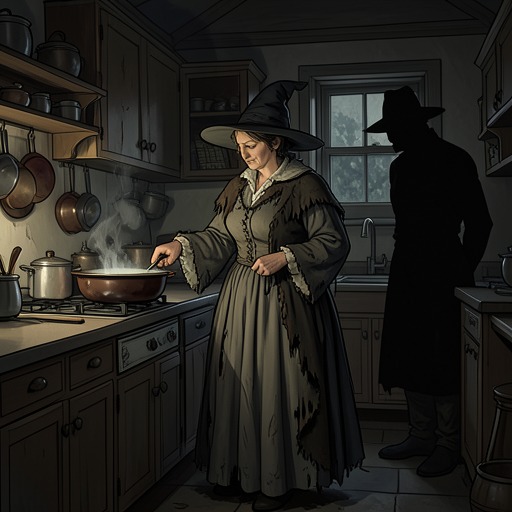
Witch Kitchen
FaustThe Witches’ Kitchen is a theatrical space of witchcraft where Faust confronts the strange apparatus of a rejuvenating potion and, after taking it, experiences a renewed orientation toward desire. Its cluttered, uncanny setting frames a change from skepticism about supernatural remedies to a readiness to pursue what Mephistopheles promises.
Setting and Stagecraft
The scene is identified as the Witches’ Kitchen and presented through a deliberately fantastic stage picture: a great cauldron stands over a fire, figures appear in its rising vapors, an ape tends it, and other apes sit nearby. Witch implements cover the ceiling and walls. These details make the room not merely a place to prepare a drink but a compact theatrical world of disorderly, uncanny activity.
The imagery immediately sets Faust at odds with his surroundings. He calls the signs of witchcraft repellent and questions whether an old woman’s concoction can restore him, asking whether Nature and a noble mind have no more potent remedy. The contrast between his appeal to nature and intellect and the kitchen’s supernatural equipment gives the scene its central tension: he distrusts the means even as he remains drawn to the promised result.
The Potion and Faust’s Change
Mephistopheles urges the Witch to bring the drink and assures Faust that it will not harm him, describing him as a man accustomed to many kinds of experience. As the Witch pours the potion with ceremony, a flame appears when Faust raises the cup to his lips. Mephistopheles tells him to drink, linking the act to warmth and renewed desire; Faust does so despite his earlier misgivings.
The drink’s effect is presented as a shift in orientation rather than as a detailed account of physical change. Mephistopheles directs Faust to move briskly so the potion’s power can take hold, and promises that he will soon feel Cupid stirring. Looking into a mirror, Faust responds to the beautiful female form he sees there. When he asks to look again, Mephistopheles turns him toward a living woman he says Faust will soon see. The kitchen thus marks the transition from Faust’s skepticism about rejuvenation to anticipation of a renewed erotic pursuit.
Dramatic Function
The scene stages a consequential bargain with the supernatural through concrete theatrical business: the cauldron, the ceremonial cup, the sudden flame, the mirror, and Mephistopheles’ instructions. The kitchen’s grotesque surroundings do not dispel Faust’s desire for transformation. Instead, his doubts coexist with his willingness to drink, making the potion a turning point in how he approaches the world beyond the room.
The mirror also bridges the enclosed setting and the prospect of action beyond it. Faust first sees an idealized female form in reflection; Mephistopheles redirects his attention to an actual woman he promises will appear. The sequence makes the kitchen’s significance both practical and dramatic: it supplies the potion and initiates the change in desire that carries Faust toward his encounter with Margaret.