Brocken
FaustBrocken is the mountain Faust and Mephistopheles climb during Walpurgis Night, a setting that brings together the noisy spectacle of the revel and the pair’s wish to separate themselves from the crowd. Its fires and gatherings make it a landscape of apparent freedom, while Mephistopheles’ choice of a quieter spot gives that freedom a more private, controlled edge.
The Climb and the Choice of Setting
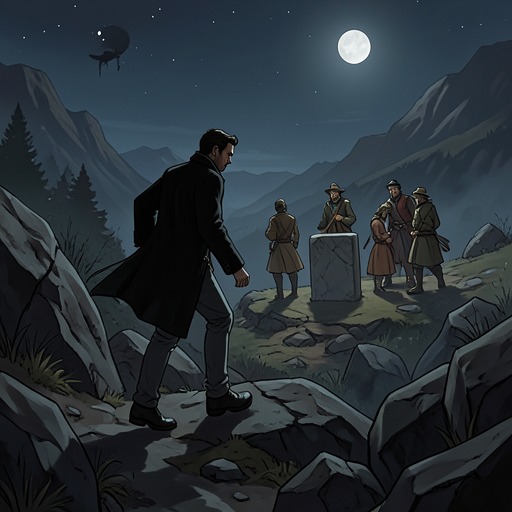
Faust recognizes that the ascent has been planned so that the two companions can isolate themselves on the mountain. He follows Mephistopheles, describing the plan as wise: reaching the summit allows them to set themselves apart from the throng. The climb is therefore not just movement through the revel; it is also a choice about where, and with whom, to take part in it.
The nearby spectacle first draws attention toward the larger gathering. Fires burn among the heather, and Mephistopheles points out groups assembled in smaller circles. Faust, however, sees further off a brighter concentration of light and smoke, where the crowd seeks the Evil One and where he imagines that many enigmas might be solved. The mountain offers both crowded curiosity and the possibility of withdrawal.
The Mountain’s Revel
Mephistopheles turns Faust away from the summit’s larger tumult. He argues that enigmas are knotted there too, and proposes that they settle in a quieter place instead. The contrast is not between danger and safety so much as between kinds of company: the multitude’s riot on one side, a bounded gathering on the other.
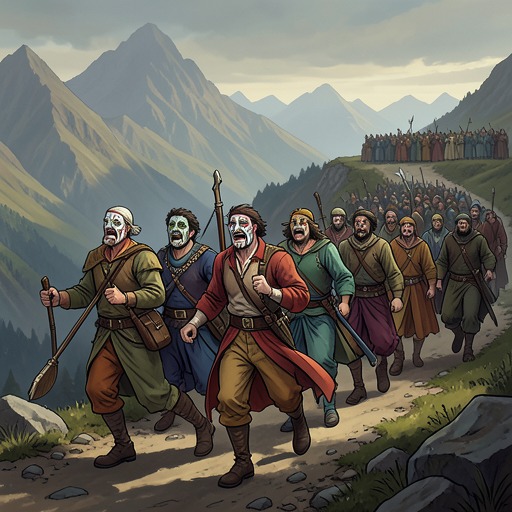
The scene presents the mountain as a patchwork of social circles. Mephistopheles describes young witches gathered openly and older ones concealed, while music-making, dancing, conversation, cooking, drinking, and courtship fill the surrounding space. A hundred fires burn along the ranks. The catalogue gives the revel the shape of an entire temporary society, lively and varied rather than a single undifferentiated crowd.
Mephistopheles as Guide
Mephistopheles knows the mountain’s customs and acts as Faust’s guide into its gatherings. He calls the practice of forming little worlds within the greater one an old, transmitted trade, then offers to introduce Faust to the company. His role is both practical and theatrical: he chooses where they go, explains what they will encounter, and presents himself as the one who can make the unfamiliar social world accessible.
The setting also returns in Mephistopheles’ later remark that Faust is in his proper place when they meet on the Blocksberg, another name for Brocken. That pointed identification links Faust to the mountain’s supernatural revel. The location is thus more than a dramatic backdrop: its mixture of crowds, concealment, and chosen solitude reflects the shifting terms on which Mephistopheles conducts Faust through the night.