Falk's body returned to the ATM
FirewallTynnes Falk’s return to the cash machine where he died transforms an apparently closed case into a disturbing, deliberate act. The body’s reappearance makes the original scene a message as well as a crime scene: someone has taken Falk away, altered him, and brought him back, though the purpose remains uncertain.
Discovery and the Scene
Late at night, just as Kurt Wallander was leaving the police station, an agitated caller reported finding a naked dead man in a car park in Ystad. The caller, Nils Jönsson, had stopped while travelling from Malmö toward Kristianstad and could not clearly identify his location. Wallander asked whether he could see a cash machine. When Jönsson confirmed that the body was lying on the pavement beside one, Wallander recognized the place as the Missunnavägen cash machine site, where Falk had originally been found. He sent for Martinsson and Nyberg and drove there himself, suspecting that Falk had been returned to the scene of his death.
The officers arrived almost together. Falk was lying face down, his hands tucked beneath his chest and his head turned to the left. Wallander ordered the area sealed and Jönsson’s statement taken, but expected little from the chance discovery: whoever had brought the body back had probably chosen a time when no one would see them. The tableau was unprecedented in Wallander’s experience. Instead of simply concealing a corpse, the unknown person or persons had reconstructed the death scene by placing the dead man back where he had first been found.
Position, Timing, and Forensic Findings
The body had not been restored to its original position. At Wallander’s request, Martinsson compared the scene with his memory of the first discovery: Falk had then been farther from the cash machine, with one leg bent. The security guard who had found him before agreed that the body now lay elsewhere. That discrepancy left two explanations open. Those who returned Falk might simply have failed to reproduce the earlier arrangement, or they might not have known exactly where he had been found. The return was plainly deliberate; its precise message was not.
The timing narrowed the opportunity without identifying whoever had carried out the act. A security guard reported that a vehicle had passed at about 11 p.m.; Jönsson said he found the body around 11:45, and the police were at the scene by 12:30. Wallander concluded that Falk could have been there for only about an hour and that whoever brought him back knew the guards’ patrol schedule. With few nearby homes and little late-night traffic, the prospect of finding a witness seemed slight. Wallander nevertheless planned to post an officer the following night and ask dog walkers and joggers whether they had noticed a car or anything unusual.
The return had also altered the corpse. When Wallander and Martinsson turned it over after Nyberg had photographed it, they saw that the index finger on Falk’s right hand and the ring finger on his left were missing. Nyberg observed that the cuts looked clean; Susann Bexell, the pathologist, later thought the fingers had been removed with pliers, though she could not say where. Nyberg was certain the cutting had not taken place at the cash machine. A police dog searched for the missing fingers but found nothing, and Wallander ordered another search for the next day, allowing that they might have been dropped farther away.
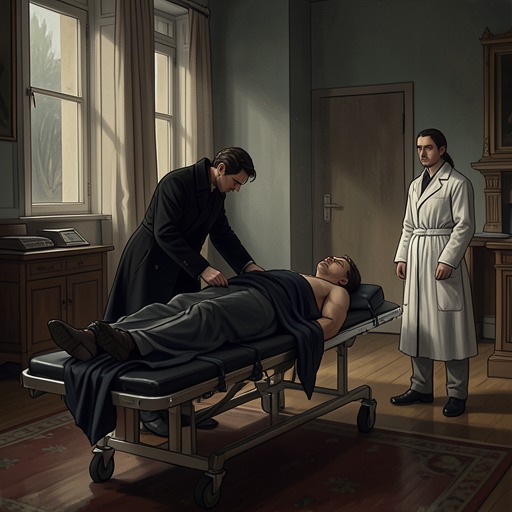
The mutilation made the return more than a macabre repetition of the first discovery. Someone had taken the body from the morgue, removed two fingers, and brought it back to the place where Falk had died, yet the body was not positioned exactly as before and the missing parts were not left nearby. Wallander could not tell whether the imperfect placement reflected carelessness or ignorance, and the investigators had no answer to the more basic question of why the corpse had been returned at all. The body was taken away again, with Wallander hoping it would remain in the morgue long enough to be buried.
The Return as a Clue
The meaning of the return depends on what the police first believed about Falk’s death. He had been found with a blood-spattered receipt showing that, at 12:02 a.m., he had checked his account balance at the cash machine. His wallet still contained money, and he had made no withdrawal; his previous withdrawal, on Saturday, had not been large. With no clear sign of a crime beyond the head wound, Nyberg considered a heart attack likely, and Wallander set the case aside pending the autopsy. Wallander did wonder whether Falk had expected to see a higher balance, but this was speculation, not an established explanation. The body’s later disappearance and return made that earlier decision look less like closure than a provisional judgment made with crucial facts missing.
The corpse’s journey also connected two cases that had seemed separate. After Sonja Hökberg’s body was identified at the Ystad power substation, Falk’s body was taken from the morgue and an electrical relay from that substation was left in its place. A diary and a framed photograph were also missing from Falk’s flat. In Wallander’s reconstruction, the relay was not an incidental substitution: it made the connection between Falk and Hökberg’s fate conspicuous, even as the theft concealed something about Falk’s life. He considered the possibility that Hökberg had been killed to prevent her from talking and that the removal of Falk’s body was meant to hide evidence. Neither suspicion, at that stage, identified who was responsible or what they were concealing.
The return further complicated the investigators’ effort to decide whether the corpse was evidence, a warning, or both. The deliberate handling of Falk’s remains suggested purpose, but the failure to reproduce the original position and the absence of the fingers left the intended message unresolved. The police could establish details about the act without securely interpreting it: the body had been removed, altered and brought back, while the reason for making the scene visible remained unknown. The episode thus turns forensic certainty into investigative uncertainty; every physical alteration sharpens the question of motive without answering it.
The cash machine also gains significance from its ordinariness. Earlier, Falk had used it simply to check a balance; later, during the search for Robert Modin, Wallander recognized that everyday cash-machine transactions might serve as a trigger for a larger event. The recurring device links a seemingly private death to the novel’s wider concern with routine actions and vulnerable systems. At the Missunnavägen site, a familiar piece of financial infrastructure becomes the fixed point around which a dead man’s unexplained history, a substation murder and a possible act of sabotage begin to converge.
Evidence and Unresolved Meaning
The second discovery did not supply a motive or identify the people who had handled Falk’s body. It did, however, change the status of the case: what had been treated as a death without a clear crime scene now included a stolen corpse, a deliberate return and mutilation. Wallander and his colleagues could distinguish what they had observed from what they only suspected. The body’s position differed from the first discovery, the fingers were absent, and the return had occurred within a narrow period; none of those facts, alone or together, explained why the body had been brought back. That gap between a growing inventory of physical details and an absent explanation is the event’s lasting investigative consequence. The scene was visible again, but its message remained unread.