Dyad Path
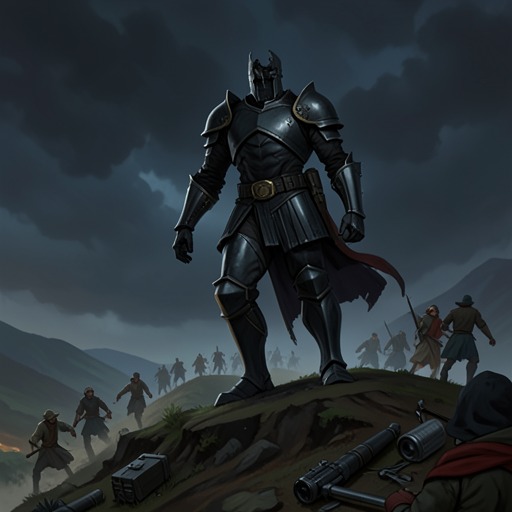
GunsoulThe Dyad Path turns relationship into a form of cultivation. Rather than requiring a pair to be friends, it draws power from partnership or opposition, making rivalry as structurally important as cooperation. Its central principle—duality expressed through division and union—shapes individual bonds, political alliances, and even the mechanics of combat. In its most extreme forms, two identities can share one body, while space itself becomes subject to division.
Foundations and Forms
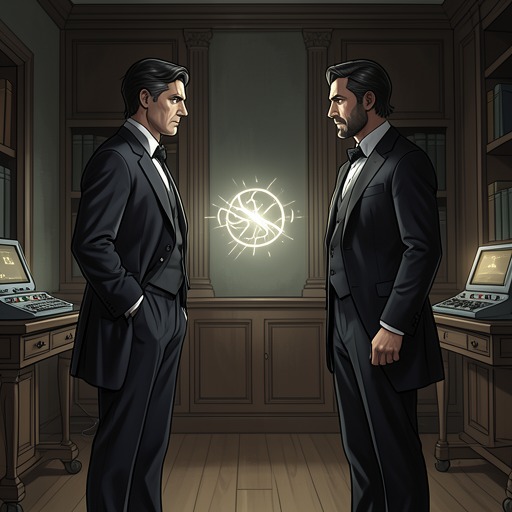
The path requires two cultivators to walk it together, but the nature of their connection can vary. Mel explains that its practitioners may be foes, rivals, or allies; Hardy describes the underlying bond through paired opposites such as Yin and Yang, reflections, eternal rivals, and master and student. The Dyad Path therefore does not resolve opposition by eliminating it. It makes the tension between two sides a basis for cultivation.
Mel and Hardy demonstrate a cooperative form. Their cores are intertwined, allowing them to fuel one another’s qi at will and combine their techniques. Their partnership is not merely emotional or tactical: it is built into their cultivation, so that each can contribute to the other’s power. Their example makes the path’s shared structure concrete without suggesting that every Dyad must resemble them.
The Yinyang Khan and Slash represent a more coercive and hierarchical pairing. Yuan infers that the two have formed a Dyad bond, which helps explain why the Khan trusts Slash with recovering the cube and why he would not permit Yuan to kill his right-hand, even if Slash agreed to fight. The bond thus has consequences beyond cultivation: it informs trust, authority, and the limits of another person’s apparent independence.
Bonds, Power, and Death
The connection can intensify as a pair advances. Mel says that the farther a duo progresses along the path, the stronger its bond becomes, until it may transcend death. The elders of Mel and Hardy’s sect can bring each other back from the Nowhere so long as one of them remains alive. This survival condition gives the relationship a stark practical consequence: destroying one partner may not be enough to ensure that the other is gone for good.
That possibility changes Yuan’s understanding of his conflict with Slash. After learning what the elders can do, he recognizes that killing the student permanently may require killing the teacher as well. The Dyad Path therefore makes a bond both a source of resilience and a complication for an opponent. A cultivator may have to confront not just an individual, but the other life sustaining or restoring that individual.
The path also operates on a larger scale than any one pair. Arc explains that Dyad cultivators feed on partnerships or opposition, and that the discipline resembles the Demigods of Ultraviolence’s method, though to a lesser degree. This connection makes the deaths on the History Road more than casualties of a race. Yuan suspects that the road’s landmarks serve a purpose beyond redirecting local leylines; Arc’s explanation leads him to realize that the deaths along the circuit empower the Yinyang Khan. The race’s apparent competition and its hidden cultivation function are therefore joined: conflict itself becomes nourishment for the authority of the Khan.
The Khan’s Embodied Duality
The Khan exhibits an unusual version of the path by containing both sides of the Dyad within himself. When Arc assesses him, she finds a powerful core and a second, smaller core associated with his weaker split personality. She reasons that keeping the cores conjoined within one person should at least double his qi reserves in a pinch, granting him the benefits of the path without its usual disadvantages. Her assessment marks a sharp contrast with pairs such as Mel and Hardy, whose intertwined cores belong to two separate cultivators.
The split is not only internal. During the confrontation involving Arc and Czar Zoa, the Khan’s Authority allows his two personalities to manifest physically in a single imaginary space. The manifestation changes the tactical situation: the Khan loses his lower hands and can no longer attack while maintaining his defensive mudra at the same time, but there are now two Khans, and the original’s qi reserves have not diminished. The scene makes the path’s duality visible as a trade-off rather than a simple increase in strength: division creates an additional combatant, while also changing what the original body can do.
The Khan’s defensive technique gives the principle an even broader expression. By performing a mudra sequence, he causes incoming attacks to slow and vanish before reaching him. Arc identifies this not as a Barrier but as an innate technique of the Dyad Path: at its apex, the Khan can divide timespace itself. When time and space are segmented into separate instants, an arrow cannot complete its journey to the target. His defense turns division into a limit on motion and cause-and-effect within the fight.
Maintaining that defense requires uninterrupted focus, but the path offers a way to divide attention evenly. Combined with the Khan’s extra set of arms, this lets him sustain the defensive sequence while managing multiple demands. Arc identifies a possible loophole, though exploiting it would cost her substantial qi. The episode shows that the discipline’s ideas are not ornamental: duality governs the technique’s operation, its cost, and the narrow conditions under which an opponent might resist it.
Significance
Across these examples, the Dyad Path makes relation an active force. A partnership can supply qi and techniques; rivalry can sustain a cultivator’s progression; a bond can carry power across death; and division can become a bodily or spatial technique. These are distinct expressions of the same organizing logic, not interchangeable versions of one ability.
The path also links private bonds to public violence. The Khan’s authority is reinforced by deaths on a competition circuit, while his paired existence with Slash helps explain both his trust in his subordinate and his refusal to treat Slash as expendable. At its most unsettling, the Dyad Path collapses the distance between connection and control: two cultivators may strengthen one another, yet a bond may also bind a subordinate to a ruler, survive death, and make the destruction of one partner insufficient. Its governing duality thus produces cooperation and conflict together, with neither side simply cancelling the other.