Horses
HarvestHorses in the village are working animals and mounts, but the narrative gives them significance beyond their practical use: their care exposes the labor behind travel, their reactions register the strain of the visitors’ presence, and their place in the departing procession makes visible the unequal burdens imposed on people and animals alike. The account contrasts them with the oxen used for plowing and with the village’s seasonal agricultural work, while repeatedly linking horses to movement, status, and the material costs of power.
Work, Travel, and Familiar Comparisons
The text places horses within a working countryside where survival depends on coordinated labor. At harvest, villagers reap, bind sheaves, and stack grain together; in the later account of plowing, oxen draw the plow while Walter Thirsk and Mistress Beldam’s husband guide the work. Horses are not presented as substitutes for those oxen or as the village’s central agricultural power. Their clearest role is instead in transport and riding, where they carry people and their possessions between the estate and the wider world.
Horses also provide a familiar measure for describing human behavior. At Charles Kent’s feast, the villagers’ drunkenness is likened to that of post-horses whose thirst is never satisfied. The comparison is a passing joke, not a report about particular animals, but it places equine endurance and thirst within the community’s everyday vocabulary. The image belongs to the same harvest setting in which food, drink, and the labor that secures them are closely bound together.
Willowjack is a named horse associated with Charles Kent. On Gleaning Day, Kent rides her toward the barley field, wearing a high hat decorated with two cloths inherited from his late wife. The detail places a horse at the center of a public village custom: Kent’s arrival on Willowjack accompanies the selection of the Gleaning Queen and the community’s return to the field. His mount also distinguishes his position from that of villagers gathered on foot.
The Jordan Party’s Mounts
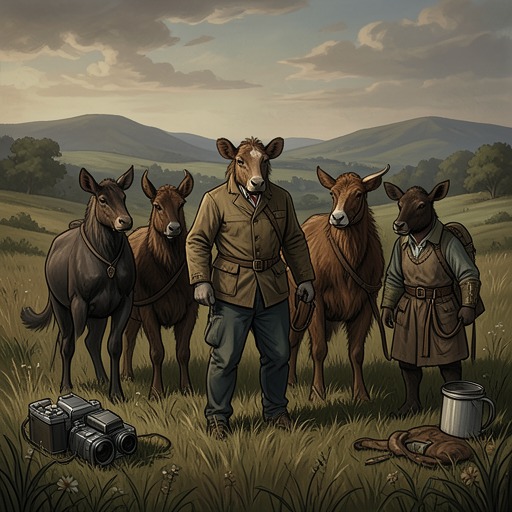
The visiting party’s horses require constant attention from Jordan’s Groom. His ordinary duties include feeding and grooming them, then allowing them to crop grass along the edges of the estate. Once these tasks are done, he has long stretches of idle time, which he spends wandering the village lanes and intruding on its inhabitants. The horses therefore define both his employment and the unstructured hours that bring him into conflict with the village.
During the party’s stay, the horses enjoy fresh hay and an abundance of apples. Walter observes that they have had more liberty than usual, and that the groom, had he been well enough to work, would have kept them away from the bitter codlings. Eating too many could cause fatal colic. Walter does not protect the strangers’ animals from that risk: he lets them continue eating, hoping that illness will make the party’s horses unfit to travel and force their masters to walk. His response makes the animals’ feeding a small act of retaliation, though the danger falls on the horses themselves.
The horses do not settle in the manor courtyard. They resist their saddles and remain restless in the remaining shade, while the straight, enclosed space of the manor unsettles them. Their preference for open air and the orchard’s trees contrasts with the confined courtyard and the preparations for departure. They are not simply background to the household’s arrangements: their unease gives physical expression to the interruption of their usual freedom.
Departure and Unequal Burdens
When the Jordan party finally prepares to leave, its horses are loaded for the journey. The groom, injured and unable to travel under his own power at first, is brought out on a matting litter and then lifted onto the smallest, least skittish mount. Walter expects the rough ride to be punishing for him. The episode shows the horse being selected according to its steadiness, while also making clear that the animal and its rider are being sent into a difficult journey under strain.
Two loaded horses follow. Lizzie Carr is secured among their luggage, while Kitty Gosse and Anne Rogers walk beside her, tied to the panniers with rope. The horses thus carry the party’s goods and a child, but the women are made to travel on foot beside the baggage. This arrangement turns the procession into a visible ordering of privilege and hardship: the mounted masters lead, while captives and attendants bear the journey’s discomfort in different ways. The animals’ practical role in carrying the party also helps expose the coercive system built around that travel.
The sidemen have lost their usual mounts to their masters and must walk behind the loaded horses. One periodically steps forward to switch the horses’ flanks; another carries a heavy stave taken from the village. Walter reads the procession as an enactment of power and suffering, with the horses caught within it as both carriers and targets of human discipline. Their presence does not soften the scene: it makes the distribution of burdens more concrete.
Narrative Significance
Horses connect the village’s agricultural rhythms to the wider movement of estate power. Willowjack carries Charles Kent into a communal harvest ceremony, while the visiting party’s mounts bring its retainers and later carry its baggage and captives away. The difference between these contexts is telling: one horse accompanies a local ritual, while the others serve a departure that divides the village and transports its people under constraint.
The narrative also refuses to treat the animals as effortless equipment. Their need for feeding and grooming, their exposure to harmful apples, their resistance to saddles, and the selection of a steady mount for an injured rider all mark the bodily conditions of travel. At the same time, the horses’ vulnerability is inseparable from human choices. Walter deliberately withholds care from the strangers’ animals in the hope of delaying their departure, and the departing party uses its mounts to carry people and possessions according to rank. Horses are therefore neither merely scenery nor independent agents who control events: they are living participants in a world where labor, mobility, and power determine how both people and animals are treated.