Cattle
HarvestCattle belong to the working order of The Village, where their value is practical and seasonal rather than ornamental. They are livestock, a source of traction, and participants in the post-harvest cycle; their place in that cycle becomes politically charged when Charles Kent’s dream of wool wealth threatens to replace the plow and the crop economy that sustains the community.
Agricultural Labor and the Village Economy
The narrative presents Cattle within a subsistence economy shaped by the demands of the land. Barley must be cultivated, harvested, and made to last through the year; the harvest is frugal, and the villagers know that favorable conditions cannot be assumed. Cultivation brings its own sequence of work: plowing and preparing the ground, broadcasting seed, watching the young crop through late rains and possible gales, and eventually cutting the grain. Cattle are part of the material infrastructure that makes this cycle possible, not a pastoral decoration set apart from human effort.
Their importance appears in the account of the village’s ordinary use of its fields. After the Gleaning Queen has taken the first step into the stubble and the villagers have gathered what grain remains, Charles Kent describes the livestock’s turn: Cattle are to be loosed into the barley field to reduce the stubble, followed by geese and then hogs, which root through the soil. This order places Cattle within a shared sequence of use, in which one harvest leaves resources for people and animals alike. The animals’ work is integrated with the community’s needs rather than isolated as a separate industry.
That agricultural arrangement is vulnerable. The village depends on weather, crop growth, and the labor required to bring grain to maturity. Cattle are therefore part of an economy whose continuance cannot be guaranteed by their presence alone: drought, late rain, wind, and other uncertainties threaten the harvest on which people and livestock depend. The narrative sets this insecurity against the more predictable fleece proposed in Charles Kent’s wool scheme.
Cattle, Oxen, and the Plow
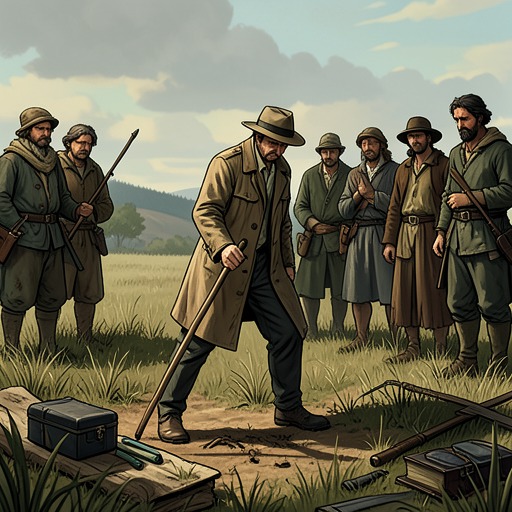
The distinction between Cattle as livestock and Oxen as working animals comes into focus through plowing. The villagers remember taking their Oxen to the barley field, fixing their sight on the treetops in the dell to keep the furrows straight. They return to flatten the ridges and remove surface stones before sowing. The animals thus belong to a disciplined practice requiring observation and skill: the straightness of a furrow depends on the plowman’s guidance and on maintaining a line across the field.
The later description of plowing makes that coordination concrete. A tapered oak above the hedgerow serves as the headland toward which the team will aim. The oak is valued as a steady point that neither ducks nor leans in the wind, while the plowman tries to make a matching straight course through the field. He imagines that the Oxen take their line from the tree, placing it between their horns. This is a human interpretation of the animals’ movement, but it also recognizes that successful cultivation depends on their physical participation. The plowman flicks them forward; together, animals, implement, soil, and human direction open the first cut.
The scale of customary work makes the later effort especially stark. Plowing the field’s stubble would ordinarily take twelve days, a team of four Oxen, and twenty strong men taking turns. In the described attempt, only two people set out to make a narrow scar: down the length of the field, around the headland, and back. The reduced undertaking does not erase the familiar agricultural method. It draws attention to its labor, and to the difficulty of sustaining it as the community’s circumstances change.
The Proposed Shift from Plowing to Sheep
Charles Kent’s proposal for wool recasts the future of both the land and its animals. He argues that farming leaves the villagers exposed to unreliable sun and rain, flattened crops, mildew, cattle disease, and crows. Wool, he says, is less dependent on weather and seasons. In the imagined prosperous future, the villagers would shepherd rather than plow, shear rather than reap, and turn wool into cloth at looms. Within that scheme, Oxen would give way to looms: the animals’ place in the agricultural order would be displaced by equipment serving textile production.
The proposal has a gentler face than its consequence. Charles Kent presents it as a promise of leisure and security, while the narrator recognizes that the dream disguises a major change in land use: the sheaf is giving way to sheep. The contrast is not simply between two kinds of livestock. It is between a mixed, labor-intensive community economy organized around fields, grain, and shared use, and a wool economy that treats land as pasture and makes plowing unnecessary. The village’s established relationship with Cattle and Oxen is one of the practices placed at risk by that conversion.
When Edmund Jordan later announces enclosure, he makes the implications explicit: the commons will be cleared and privately enclosed, the land turned to pasture, and there will be no further need for a plow. The speech leaves room for sheep-boys and shearers, but not necessarily for everyone who currently works the land. Cattle’s earlier place in Charles Kent’s post-gleaning order thus acquires a retrospective uncertainty. Their inclusion in the customary cycle belongs to an agricultural future that the enclosure plan intends to end.
Narrative Significance
Cattle and Oxen are not individualized characters in the narrative; their importance lies in their recurring, concrete place within village life. They help make visible how cultivation depends on cooperation between human labor, animals, tools, and a land that must be worked season by season. The plowing scenes resist the easy abstraction of agricultural reform by specifying the time, people, animals, and bodily skill required to maintain the field.
The animals also sharpen the contrast between the village’s existing economy and the promised wool future. In one account, Cattle move through a shared post-harvest sequence, following the people who glean and preceding other livestock. In the reformers’ vision, the plow itself becomes obsolete. Their narrative function is therefore both practical and structural: they show what the current community does with the land, and what stands to disappear when land is reorganized for sheep. The text gives them no independent speech or stated intention, but it does not reduce their significance to scenery. Their labor and place in the seasonal cycle register the material consequences of a transformation announced as prosperity.