Pigeons
HarvestPigeons occupy an uneasy place between the village’s food supply and the village’s customary claim to the harvest. The birds kept by Charles Kent are valuable enough that their loss matters, but when birds descend on the cut fields to eat fallen grain, the villagers see them as trespassers on food that should belong to gleaners. That conflict gives the pigeons a role beyond the dovecote: they make visible the struggle over who may take from the land, and who has the power to decide.
The Dovecote and the Estate
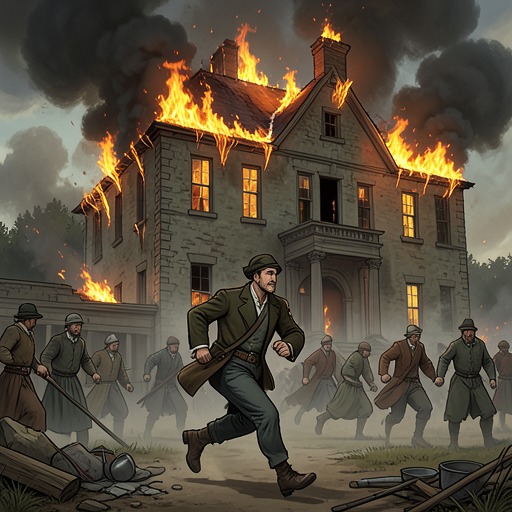
At Charles Kent’s estate, the pigeons belong to a recognizable domestic world. The painted dovecote stands among the stable buildings, and the birds are described as the master’s home-birds. Their white wings would ordinarily be a familiar sight above the yard; after the fire, the villagers look for them against the smoke and see none. The absence makes the damage legible before anyone has counted the loss: the dovecote has gone, and the birds that gave it life are missing.
The flock is also tied to the agricultural calendar. At the end of the harvest, when barley has been cut and carried away, pigeons and other birds descend on the stubble for fallen grain. Their feeding is not presented as an isolated nuisance. The villagers understand the gleanings as theirs by ancient right, so the birds’ presence turns a field already harvested into contested ground. The grain is at once the residue of communal labor and food still available to animals, and the villagers act as if protecting it is evidence of their continuing claim to the fields.
Gleaning and the Claim to Grain
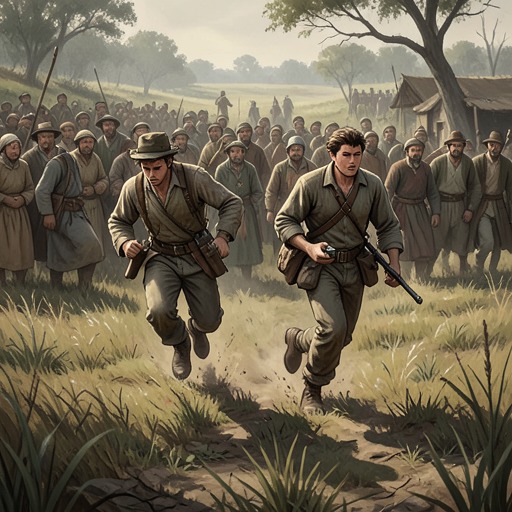
The response to the feeding birds is collective and conspicuous. Some younger men, already anxious about the future of the land, direct their anger toward the pigeons, rooks, and Doves in the stubble. Children are sent with slings or handfuls of grit, or told to cry out at the birds. The effort is not only about recovering scattered barley. The villagers want their actions to show that they still occupy and use the land, at a moment when Philip Earle’s surveying and the counting of the village have made them fear that the estate may be measured for sale.
The white Doves draw especially sharp attention. Their pale appearance marks them out among the gray and black birds, and the villagers regard them as particularly unwelcome consumers of grain they need for bread and ale. That description records the villagers’ view, not an independent measure of the birds’ greed: the Doves are feeding, while the people interpret that feeding through their own precarious claim to the harvest. The scene gives a small, concrete form to a larger insecurity. As the villagers wonder whether their fields will remain theirs, even fallen kernels become a test of belonging.
The Moonball Fire
The attack on the dovecote begins as an effort to drive the birds away, not as a plan to destroy the buildings. After finding Fairy Caps and a large Moonball in The Woods, Christopher and Thomas Derby and Brooker Higgs use the dry, hollow fungus as a source of fire. They intend to make smoke and frighten off the birds. Before dawn, they push the smoldering Moonball into the loft, where dry chaff and nesting material catch; the fire spreads from the roof timbers to the summer hay. The pigeons’ nesting place thus becomes the point where a prank, meant to repel birds, turns into a destructive blaze.
The men do not intend to kill the pigeons, or even to start a fire. Yet the birds are caught within the burning dovecote, and the morning’s aftermath makes the loss inseparable from the fire. The stable yard smells of meat, while the dovecote and its roofs have been destroyed. The episode does not grant the birds a clear escape or describe each fate; it establishes instead that their loss is among the consequences of the men’s act. The pigeons’ vulnerability is not incidental to the plot: their presence supplies the target, and the attempt to remove them sets the disaster in motion.
From Loss to Accusation
Once the fire is under way, Brooker Higgs helps direct suspicion away from himself and the Derby brothers. He presents the blaze as malicious and points toward strangers living near the edge of the woods. The missing pigeons make that accusation persuasive to people who are already alarmed, but they do not prove it. Charles Kent’s villagers go to the newcomers’ dwelling and find bird bones near the remains of their hearth. Christopher Derby identifies them as the remains of one of the master’s birds; John Carr’s inspection, however, suggests a dark-feathered bird with short bones and a yellow beak, more consistent with a blackbird than one of the white birds from the dovecote. The villagers prefer the accusation to that distinction and treat the bones as evidence against the strangers.
The discrepancy shows how the pigeons’ loss is made to serve competing purposes. The birds have genuinely been endangered by the fire, but the evidence offered against the newcomers remains uncertain. By letting a dubious identification stand, the villagers turn their own concealed responsibility into a charge against outsiders. Charles Kent sentences two men to a week in the pillory for dining on birds that did not belong to them, while the actual arsonists remain silent. The pigeons’ disappearance therefore has consequences beyond the ruined dovecote: it helps justify the punishment of people whose connection to the fire has not been established.
Narrative Significance
Pigeons recur at the intersection of subsistence and authority. In the fields, they consume grain the villagers regard as their due; at the estate, they are birds kept by Charles Kent; during the fire, they are the intended target of a plan whose consequences exceed its makers’ intentions. Their changing significance depends on who is looking: to the villagers in the stubble they are competitors, to the conspirators they are a problem to be driven away, and to the estate they are part of the loss caused by the blaze.
That shifting view also clarifies the difference between customary claim and possession. The villagers invoke gleaning rights against the birds, but the pigeons belong to the master’s dovecote, and the birds’ destruction damages his property. Meanwhile, the newcomers are accused on evidence that does not securely identify a dove at all. The pigeons do not speak or choose sides; their feeding, nesting, and absence instead reveal how quickly living creatures and material losses are drawn into human disputes over food, land, and blame.