Pigs
HarvestPigs are woven into the material life of The Village: they consume gleanings and scraps, share household ownership, and represent food worth settling disputes over. Their appearances move from ordinary husbandry to unsupervised foraging as communal routines fail. By the time they roam freely in Turd and Turf, their continued presence makes the village’s abandonment visible in practical, unceremonious terms.
Household Animals and Shared Value
Pigs belong to the village’s everyday economy, not to a separate world of livestock kept at a distance. Walter Thirsk expects to take home gleaned grain not only for ale and porridge but also for winter feed for George and Gorge, the pair of long, flat-sided pigs he shares with John Carr and his family. The arrangement makes their care a shared household concern: gleaning is one of the ways the community gathers what will sustain people and animals through colder weather.
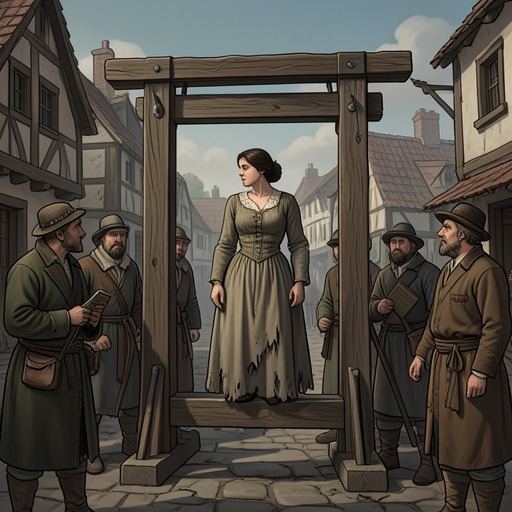
The value attached to pigs also appears in an older quarrel over ownership. Two cousins fought over the title to a pig, a matter the villagers take seriously because pigs are part of household life. After the cousins spent a night in the pillory, they divided the pork with painstaking fairness, portion by portion. Their dispute later became a source of village humor, but its comedy rests on something real: a pig was worth fighting over, and a share of its meat was worth carefully accounting for.
Foraging and the Harvest Cycle
The grain fields provide a second view of the pigs’ place in village life. After the final sheaf is gathered, loose barley bundles have fallen from wagons and barrows along the verges. Birds contest the scattered grain, while disturbed soil shows that pigs have been roaming and snouting for what has dropped. Harvest does not end with the crop safely stacked; the remains of the work continue to feed animals as well as people.
That foraging sits alongside a larger seasonal system. At harvest, villagers work together, and the custom of setting aside a share for the commons and another for gleaning leaves grain for later collection. The pigs are not described as participants in the human ritual, but their presence among the fallen barley connects household animal-keeping to the same landscape of labor, scarcity, and recovery. What is left on a field or roadside has use, and the village’s animals help make that use visible.
The Breakdown of Daily Care
Later, when the village’s ordinary work begins to lapse, the pigs register that change through neglected routines. Barley has spilled from a sack without anyone attending to it; animals wait for care, and the pigs have not received their morning scraps. The disorder is not simply a change in mood. Tasks that once maintained food stores, animals, paths, and buildings are going undone, and the pigs are among those affected by the interruption.
As the disruption deepens, the pigs are described as abandoned and free to forage in the mire at Turd and Turf. Walter passes through the area while trying to determine whether Mr. Quill is safe, but he is reluctant to search the ground near the pigs for evidence of what may have happened. The passage presents his fear as uncertainty, not confirmation: the pigs’ presence makes the possibility of remains difficult for him to face, but it does not establish that they have harmed anyone. Their movement through the mire instead marks how little human oversight remains.
Scavengers, Fear, and Narrative Significance
Pigs also enter the narrative through anxious speculation. Near the village’s church ground, a rustle could be a roaming pig, and Walter’s thoughts briefly turn to the possibility that it might feed on someone’s exposed legs. In later nightmares about Mr. Quill’s disappearance, he imagines pigs finishing the missing man. These are fears and imagined outcomes, not reported events. The distinction matters: the pigs acquire an unsettling association with what might be hidden or left unattended, while the story withholds any claim that they caused a death.
The same animals can be connected to ordinary use, communal argument, and alarm without ceasing to be animals in the village’s material world. A pig can be shared between households, fed from gleaned grain, and valued as food; once the village’s routines collapse, pigs can also roam without their keepers. Their appearances therefore trace a concrete change in the community’s relationship to its landscape: the familiar work of feeding and managing livestock gives way to unregulated foraging. In Turd and Turf, where Walter calls out for Mr. Quill and finds no answer, the free-roaming pigs belong to a wider scene of abandonment, but their fate beyond that scene is not specified.