Village Pillory
HarvestThe Village Pillory is an oak punishment device that the villagers have also made their cross, gathering place, and substitute for a church. Its return to penal use after years of neglect turns a familiar communal landmark into a site of humiliation and, ultimately, death. That reversal exposes the fragile boundary between the village’s customary justice and its capacity to acknowledge the suffering it has inflicted.
Construction and Place in Village Life
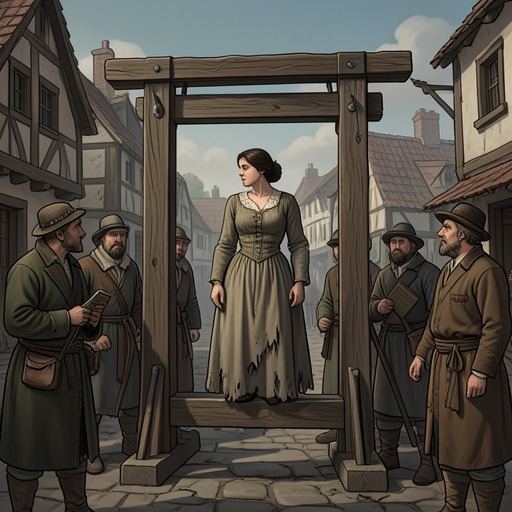
The pillory stands slightly taller than an ordinary man at the unbuilt entrance to The Unbuilt Church Ground. Its hinged boards extend wider and longer than the upright, giving it two stations for prisoners and making it broader and more imposing than a conventional, narrow crucifix. Openings that could restrain a prisoner’s neck and wrists have, in less punitive use, held prayer rosaries and flower-made love chains. The villagers have not removed or replaced the structure; they have layered other meanings onto it.
That double identity fills a gap in the village’s religious and civic life. The church ground contains graves, a pile of stones intended for construction, and a foundation block, but no church. In its place, the pillory serves as the village cross. Charles Kent conducts marriages and baptisms there, gives eulogies for the dead—including those for his wife and Walter Thirsk’s wife—and comforts mourners. Villagers also gather at it to consecrate seed corn, give thanks for the harvest, and bless the plow. A device built to expose offenders thus becomes the community’s most important public setting, without losing the threat built into its shape.
Neglect and Earlier Punishment
Before its use against the newcomers, the pillory had stood idle for roughly ten harvests. Its iron bolt key, kept by Charles Kent with other keys on a bronze chain in his parlor, was rusty and had broken wards. The previous prisoners were two related Saxton cousins who fought over ownership of a pig. Their quarrel was treated as serious: pigs were valued members of the village household economy, and half a dozen young men were needed to restrain the cousins.
The cousins spent one night confined. By morning they had settled their dispute by dividing the pig, carefully portioning it from snout to tail, including the trotters, liver, and heart. The episode became a comic village legend. The men were remembered as favorite rascals, and they continued to claim that the pillory itself had not been cruel, even as they complained of being shut in together. Their brief confinement ended in shared meat and reconciliation. That remembered outcome makes the pillory’s later use more disturbing: the village’s familiar device no longer contains a quarrel that can be settled by dividing its spoils.
The Newcomers’ Sentence
When two of Mistress Beldam’s men are punished, Charles Kent orders a week in the pillory for dining on fowl that did not belong to them. Their two longbows are to be snapped, and their heads shaved to mark them as suspicious travelers. The sentence follows a tense confrontation in which the newcomers had displayed their bows and warned villagers to keep away. The narrator judges the punishment modest, while also recognizing that it leaves the men exposed and keeps Mistress Beldam on the estate, separated from her companions. The pillory’s use is therefore presented not simply as a response to theft but as an assertion of local power, with consequences for the whole group.
The structure’s communal associations do not soften the spectacle. Walter Thirsk first sees the prisoners’ shaven heads hanging at the village cross, their wrists and necks fixed in the wooden vice. In a later storm, he approaches them while they remain bound beneath the rain. Their arms are pinioned and their necks caught; the elder man has to stand on tiptoe to avoid being throttled. Walter recognizes that his earlier acceptance of the sentence—his willingness to let the newcomers bear the blame—was a failure of courage and honesty. He wants to shelter them beneath a church canopy that does not exist and tries to bring the older man a stone to stand on. His injured hand begins to hurt as he works, and he cannot manage the stone easily. The wish to help arrives after the punishment has already become a sustained bodily ordeal.
Death and the Pillory’s Reversal
The older prisoner is found dead before the week is over. His wrists and throat are bruised purple, and a pig has gnawed parts of his foot and calf. Walter, Charles Kent, and Philip Earle carry the body to the manor house porch, cover its wounds, and wrap it in baling cloth. The younger man’s anger and despair remain visible even while he is still fastened in the pillory. What had been announced as a fixed term of punishment has become a fatal confinement.
Walter cannot establish exactly how the older man died. He considers that the prisoner may have slipped from his stretched toes and broken his neck, perhaps because of the rain; that he may have struggled against a hungry hog; or that his heart may have stopped. Whatever the immediate cause, the pillory leaves him restrained and exposed, and his death gives the earlier sentence an irreversible consequence. Walter’s account also makes room for culpability beyond the person who ordered the punishment: Charles Kent and Philip Earle look guilty, and villagers who had used scythes and sticks against the newcomers may have reason to regret their actions. No magistrate, doctor, or priest has been called to settle the facts. The village must confront the death through its own imperfect judgment.
Communal Symbol and Moral Measure
The pillory holds together two versions of village order. As a cross, it marks births, marriages, grief, seasonal labor, and shared hope; as a punishment device, it exposes bodies to humiliation and harm. Its transformation is not a change in the object but in the people’s use of it. Flower chains and rosaries cannot erase the neck restraints, just as the cousins’ comic recollections cannot guarantee a harmless outcome when outsiders are confined there.
That tension is sharpened by the village’s unfinished church. The pillory occupies a gateway to a religious building that has never been built, and the villagers’ civic rituals take place beside a structure whose penal function remains ready to return. When they punish the newcomers, the cross ceases to be only a symbol of communal gathering; when the older man dies, the community must reckon with what its customary authority has done. The Village Pillory is therefore both the village’s shared landmark and an uneasy measure of its justice: a place where solidarity is enacted, but where belonging can be withheld and punishment can outlast the judgment that imposed it.