Fairy Caps
HarvestFairy Caps are mushrooms associated with intoxication, vivid perceptions, and reckless behavior in Walter Thirsk’s account of the events surrounding the fire at Charles Kent’s estate. They link Walter’s own youthful experience in the woods with the Derby twins’ and Brooker Higgs’s later actions: remembered as a powerful encounter, they become part of the setting for mischief, concealed guilt, and the destruction of the dovecote and stable roofs. The mushrooms do not themselves ignite the fire; that work is done by a dry Moonball, and the distinction matters to the account’s chain of cause and consequence.
Appearance and Place Among the Gathered Objects
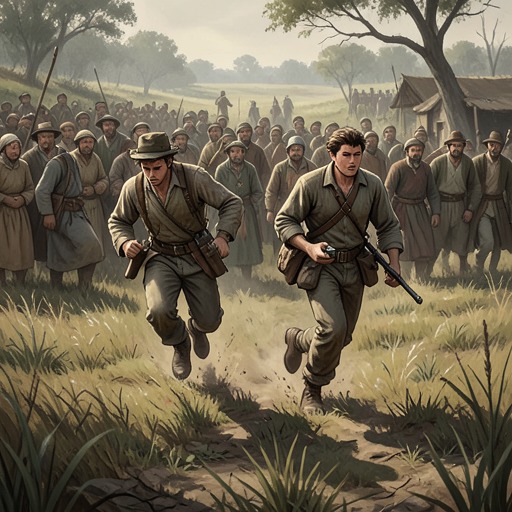
The Fairy Caps enter the narrative as part of the spoils brought back from the woods by Christopher and Thomas Derby and Brooker Higgs. The three unmarried men return without the fowl, rabbit, or fuel that might have justified their trip. Instead, they carry a bulky, nearly weightless sack, and their laughter and stained fingertips suggest that they have already eaten some of the mushrooms raw. Walter recognizes this combination of evidence because he has encountered Fairy Caps himself.
When Walter inspects the sack, some caps remain, apparently kept for another revel. The sack also contains golden shawls and a giant Moonball, but these are distinct objects with different reported uses: the Moonball is dry enough to carry flame, while the Fairy Caps are connected with intoxication and the men’s altered state. The separation prevents the mushrooms from becoming a catch-all explanation for what follows. Their presence helps account for the bachelors’ behavior; the fire’s immediate material means is the Moonball.
Walter’s Earlier Encounter
Walter’s recollection places his own encounter in his first summer of settlement, roughly a dozen years before the events he is recounting. He remembers being less cautious then, and says he ate Fairy Caps in the woods with John Carr after the final sheaf of that year’s harvest had been cut. The pause in labor gave him time to sleep off the experience. The moment belongs to the interval between harvest work and the next communal activity, but Walter describes it as a personal excursion rather than setting out a formal village practice.
The memory remains vivid in its effects. Walter recalls dancing lights, rippling motion, halos, and trails that seemed to follow movement, alongside a sense of fearlessness that did not erase the fear that lasted afterward. He also remembers the moon appearing dark blue and then red. The recollection is not presented as a detached description of a mushroom’s properties: its force comes from Walter’s continued response to it, including his wish that he had been brave enough to seek that moon again. The caps are therefore associated both with exhilaration and with an enduring unease.
That remembered experience gives Walter a basis for interpreting the younger men. When he encounters them the morning after their return, he sees not merely a suspicious sack but signs of an intoxication he knows from experience. The parallel is close in circumstance: both excursions follow the cutting of the last harvest sheaf, and both involve eating Fairy Caps. Yet Walter’s earlier episode ends in sleep and memory; the bachelors’ episode is entangled with anger toward the birds and the destructive prank that follows.
The Bachelors and the Fire
The men have collected caps for later, but their plans also concern the Doves in Charles Kent’s dovecote. Walter connects their resentment to the birds’ theft of village bread and ale and to the efforts of children to drive them away. He reckons that the bachelors wanted to retaliate by frightening the birds, not to kill them or burn the estate buildings. Their scheme uses the dry Moonball as a lantern: pushed into the loft before dawn among dry nesting litter, it smolders until the fire spreads through the roof structure and reaches the stored hay.
The mushrooms thus belong to the circumstances of the fire without being its physical instrument. Walter’s account connects the men’s earlier consumption with their state of mind and their schemes, while giving the Moonball, the dry loft contents, and the spreading flame their own causal roles. The result is far beyond the intended scare. The Doves are lost, and the fire consumes the stable roofs and hay lofts; Willowjack is rescued from the burning area. When Charles Kent comes to watch the blaze, the men make an conspicuous effort to help put it out, carrying water and using spades. Their eagerness to appear loyal only makes their guilt more visible to Walter.
The contrast between Walter and the three men is not that he treats Fairy Caps as harmless. He remembers their extraordinary effects and the fear that endured after his own experience. Rather, he has learned how a person might be tempted by them and still recognizes that the later scheme has its own choices and consequences. His account distinguishes the altered state from the men’s responsibility: the caps help frame their mischief, but do not absolve them of having set events in motion.
Later Speculation and Narrative Significance
Fairy Caps recur when Walter tries to assess who might have killed Willowjack. He considers whether the Derby twins and Brooker Higgs could have eaten the remaining mushrooms and, in anger, attacked the mare. He rejects the idea. By this point the men have been skulking about, afraid that their earlier role in the Dove-baiting will be exposed, and Walter judges them frightened rather than newly emboldened. In his reckoning, no mushroom is powerful enough to make them kill the horse. This later reference does not establish that they did eat the remaining caps; it marks the possibility Walter considers and then dismisses.
Across these appearances, Fairy Caps serve as a recurring but limited explanation. They are linked to a remembered, disorienting encounter; to the bachelors’ conspicuous intoxication; and to Walter’s subsequent effort to distinguish suspicion from proof. The mushrooms help create a bridge between experience and interpretation, since Walter reads the younger men through what he remembers happening to himself. At the same time, the narrative keeps their influence bounded: the caps are not the Moonball, the fire, or a conclusive explanation for Willowjack’s death. Their significance lies in how a potent encounter with the woods shapes conduct and judgment, while leaving human responsibility and the causes of later harm unresolved.