Moonball
HarvestThe Moonball is a large, dry growth found in the woods and picked by the Derby twins and Brooker Higgs. Too dry to cook, it proves useful for another purpose: its hollow, tinder-like material can carry a flame from one place to another. In the episode at the estate, this practical property makes it more than an odd woodland find. It becomes the instrument through which an intended nuisance escalates into a destructive fire.
Appearance and Material Properties
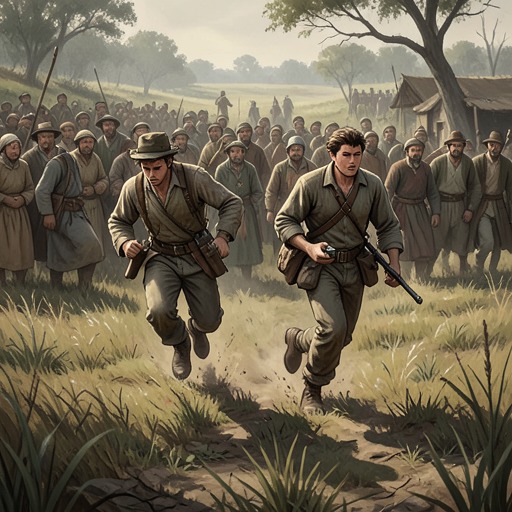
The Moonball is described as giant, larger than a blacksmith’s head, with a soft outer surface likened to kid leather. Its spores are already issuing from it when Walter Thirsk inspects the sack carried by Christopher and Thomas Derby and Brooker Higgs. Though it is among their spoils from mushrooming, its size and dryness make it unsuitable for the pot.
Its importance lies in the contrast between its apparent uselessness as food and its capacity to take and transport fire. Walter recognizes it as a dry, hollow growth that can serve as a means of carrying flame. The Moonball’s material condition, rather than any elaborate device, enables the men’s plan and helps determine how far its consequences reach.
Use in the Dovecote
The Derby twins and Brooker Higgs have been angered by birds taking food, including the Doves from Charles Kent’s cote. They do not set out to kill the birds or burn the buildings. Their intention is to make smoke that will drive the Doves away, and they use the Moonball as a kind of lantern to bring fire into the loft before first light.
The loft contains dry chaff and nesting litter gathered by the birds. The Moonball’s smolder catches in this material, and the fire spreads along the undersides of the roof beams before reaching the summer hay stored above. Flapping birds further fan the flames. A growth chosen as a portable source of smoke thus helps create conditions in which the fire escapes the men’s intended limits.
Consequences and Significance
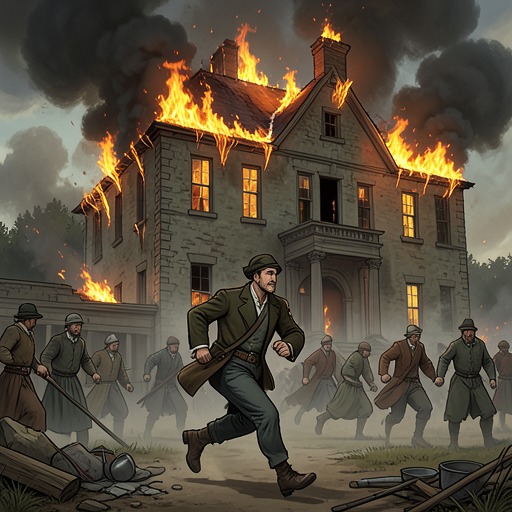
The fire kills many of Charles Kent’s Doves and burns the stable and dovecote, with the hay also lost. The Moonball is therefore central to the episode’s reversal: the men mean only to displace the birds, but the object they use turns that limited act into serious damage to the estate. The morning aftermath confirms that the result is not merely a failed prank but a loss for the household and its animals.
The episode presents the Moonball as an ordinary natural material whose usefulness is inseparable from risk. It does not act alone: the men select and carry it, the dry loft provides fuel, and the birds’ movement helps the fire spread. Yet the Moonball’s capacity to smolder and transfer flame gives it a consequential part in the chain of events, showing how an object intended for a small act of retaliation can redirect human plans toward outcomes its users did not mean to cause.