Joanna Southcote's second resurrection experiment
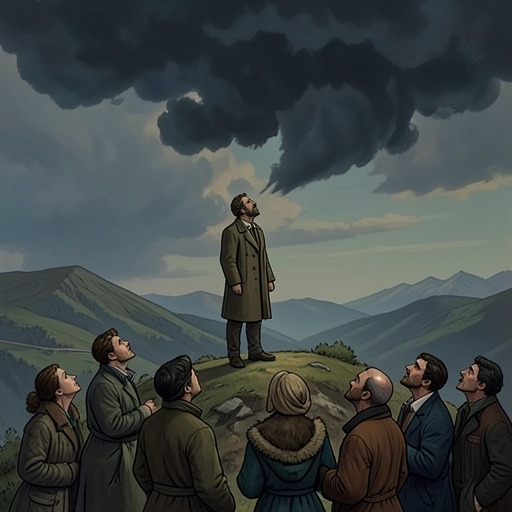
HomunculusThe second resurrection experiment brings Ignacio Narbondo’s corpse-reanimation method into direct collision with Shiloh’s religious ambitions. Using a fresh corpse, a carp gland, and a misting apparatus, Narbondo briefly animates the remains of Joanna Southcote, Shiloh’s mother. The result is neither a coherent return to life nor the public miracle Shiloh wants: the remains move in fragments, and he leaves with only the cranium contained in a jar. The scene makes the experiment’s failure visible while showing how readily scientific ambition and religious spectacle turn a dead body into contested material.
Background and Stakes
The experiment belongs to a longer chain of illicit research. Sebastian Owlesby’s recovered notebooks describe how his work on corpse animation became entangled with Ignacio Narbondo’s influence and his own decline. Owlesby wrote of needing a carp and a fresh gland to keep a cadaver from decomposing before an experiment could be attempted. His notes also record that, in late May 1861, the research had crossed into the murder of a living man for his brain. The project’s materials were therefore never merely theoretical: its repeated demand for bodies and animal organs bound experimentation to grave-robbing and violence.
Bill Kraken’s recollection supplies another piece of this history. He described driving a wagon during a nighttime raid on the oceanarium, where he and Sebastian took roughly half a dozen carp. Sebastian cut them up on Baker Street, and the fish were later sold at Billingsgate Market. Kraken treated the sale as a way that some good came of the affair, but his account also establishes the practical supply chain behind Narbondo’s experiments: fish were stolen, their useful organs extracted, and the remaining bodies disposed of or sold. The research’s supposed promise of defeating decay depended on ordinary criminal labor as much as on scientific apparatus.
By the time of the second experiment, Narbondo has already demonstrated the method to Theophilus Godall, who watched him revive what appeared to be a corpse. Godall suspects that Narbondo and Kelso Drake may have discussed supplying Drake with reanimated workers, while Shiloh hopes to make an animated body serve his own religious claims. These possible uses give the experiment stakes beyond whether the procedure works. Its success could provide leverage, labor, or converts; its failure threatens to expose the gap between animation and restoration.
Procedure and Unstable Materials
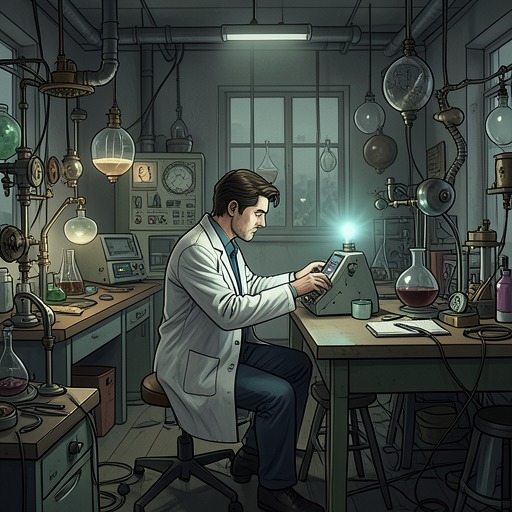
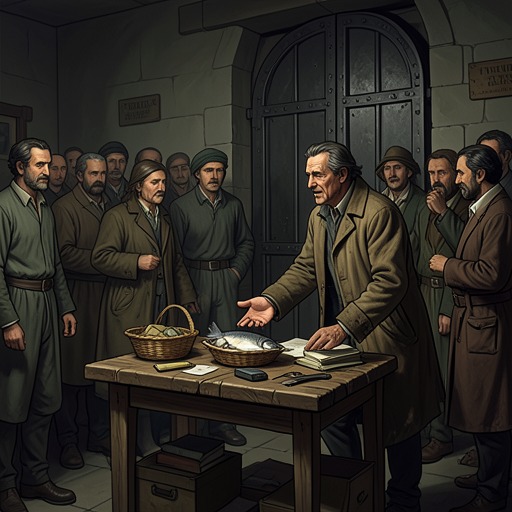
Narbondo prepares the experiment around a slab and a gurney. He and Willis Pule bring in a fresh cadaver, while Narbondo retrieves a sluggish carp from beneath a jar of yellow fluid. His actions are quick and practiced, but his strained concentration suggests that the procedure is difficult even for him. A gland is removed from the fish and used alongside the misting apparatus; the scene confirms that the animal organ is not incidental equipment but a necessary part of the attempt.
Shiloh’s attention is divided between the box on the piano and the remains before him. When the box is moved, the bones and winding sheet on the slab seem to settle, abruptly drawing his attention back to the fact that the body is his mother’s. He asks where her hands are, and Narbondo turns to Pule to search for them. The missing parts expose a basic problem in the experiment: the researchers are not working with an intact subject, but trying to assemble and animate remains whose parts have been separated and misplaced.
The hands make this instability active rather than merely visible. Joanna’s skeletal hands appear at the piano, moving across the keys and then twitching on the floor. Narbondo uses tongs to retrieve them and places them beside the body. As he continues spraying the remains, he wires the hands to the wrists, but Shiloh notices that they have been attached incorrectly. Their movement thus supplies no evidence of restored identity or control. Instead, it produces a practical and grotesque dispute over whether Narbondo has assembled the body properly.
Partial Animation and Failure
Narbondo declares the phenomenon a form of alchemy and continues the procedure. The corpse stretches and its joints move; its neck rises slightly. He works simultaneously on a second cadaver, using tubing and an air-filled bladder as part of the process. The experiment is therefore presented as a combination of chemical treatment, animal-derived material, mechanical assistance, and human handling. No single element can make the body whole, and the activity around the slab becomes increasingly difficult to control.
Joanna’s remains rise from the mist, but the apparent triumph lasts only briefly. She moves in an unstable, puppet-like manner before falling apart again. Her hooting is the only sound attributed to the animated figure; it does not speak with the voice Shiloh expects from his mother. The remaining parts continue to move separately, while Narbondo’s attention shifts from directing the procedure to containing what it has set in motion. The experiment has generated motion, but motion proves radically different from a recovered person.
This distinction is the central result of the event. Narbondo can prompt dead tissue and separated remains to move, yet the movement does not restore speech, memory, or an integrated body. Shiloh had hoped for a revelation that could command belief; what appears instead is a disjointed spectacle that neither man can fully govern. The apparatus and the remains shape the scene as forcefully as the participants’ intentions: the piano, box, mist, fish gland, and displaced bones redirect attention and interrupt the procedure. Animation is possible, but the material process remains precarious and incomplete.
Aftermath and Significance
Narbondo eventually contains the moving cranium in a glass jar. Shiloh cradles it and mourns the failure of the larger experiment, imagining the converts and public astonishment that a successful resurrection might have brought. Yet he immediately begins considering how the cranium might be made to speak, perhaps by supplying a voice from elsewhere. His response preserves the gap between what the experiment has achieved and what he needs it to mean: unable to present his mother as a restored person, he considers constructing the appearance of a speaking sacred object.
The experiment therefore ends not with resurrection but with a change in the scale of Shiloh’s ambition. He leaves with the cranium and continues to treat the project as something that must go forward, despite its failure to produce the miracle he wanted. Narbondo’s procedure offers no comparable religious consolation; its demonstrated result is partial, unstable animation. The scene sharpens the novel’s distinction between reactivating a corpse and restoring a life, while showing how both scientific and religious authority can claim the same remains for different purposes.