Narbondo’s laboratory
HomunculusNarbondo’s laboratory is a concealed room in a neglected part of Pratlow Street, the setting for Ignacio Narbondo’s experiments and several encounters that expose how vulnerable his work is to intrusion. Its clutter of chemical equipment, aquaria, specimens, and secret access routes gives the room a practical function as a workshop, while the Keeble box and the remains of Joanna Southcote bring the novel’s conflicts over scientific ambition and control into the same enclosed space.
Setting and Access
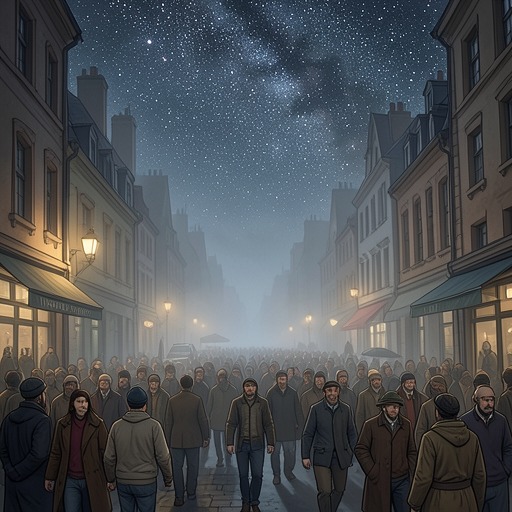
The laboratory is embedded in a street marked by neglect. On the stretch of Pratlow Street between Old Compton and Shaftesbury Street, shutters hang crooked across dark windows, paint peels from a storefront, and broken glass lies among the cobbles. Doors and windows are in such poor repair that entering by a window can seem more practical than using a door. The setting is not a remote stronghold but part of an urban environment where ordinary boundaries are already compromised.
The laboratory is glimpsed from a room looking across an empty courtyard toward another house. Fog intermittently clears the view of a lit room in which a stooped figure studies a wall chart with a scalpel in hand. This oblique introduction makes the laboratory visible without making it immediately accessible: it is a room observed across an intervening space, within a cityscape of obscured sightlines and neglected buildings. Later scenes establish a street entrance and a concealed route through a downstairs closet and a panel into the laboratory. The hidden passage lets Willis Pule approach the room without using its ordinary entrance, and allows Bill Kraken to escape when the laboratory becomes dangerous.
Equipment and Experiments
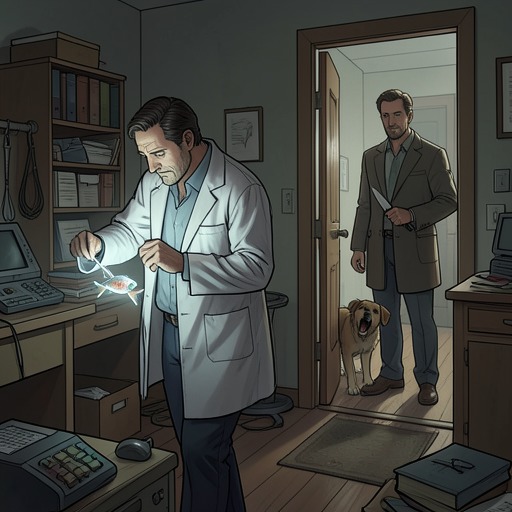
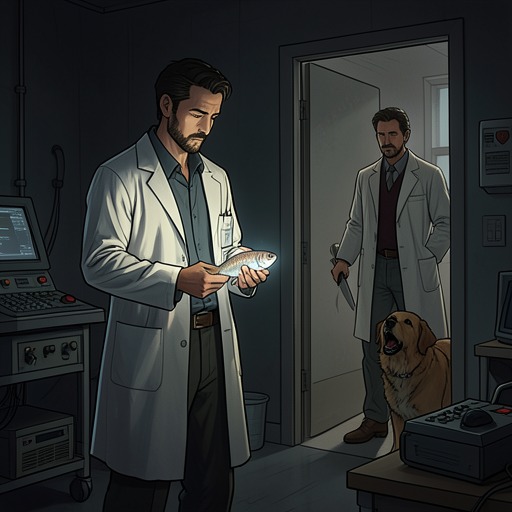
The room’s contents make its purpose legible. Along one wall stand coils, beakers, bell jars, and heavy glass cubes containing liquids or specimens, including the floating head of an enormous carp. A brass chain suspends a human skeleton in a corner, while bottles on a shelf hold preserved fetuses. Across the room, aquaria contain aquatic plants and large koi. The assortment connects chemical apparatus, animal life, and human remains within one working space rather than separating experimental materials from their setting.
Narbondo’s work proceeds through close observation and handling. Faced with a corpse that has been dead for two weeks, he considers whether animation would accomplish anything beyond frightening people, or whether Shiloh might present the walking subject as a religious miracle. He then attends to the aquaria, feeding worms to the fish and watching one carp that does not feed and repeatedly struggles at the water’s surface. He removes that fish from the tank, prepares it on a board, and places a small gland in a vial of amber liquid. The sequence presents corpse animation not as an abstract theory but as a procedure dependent on equipment, animal specimens, and material gathered in the laboratory.
The Keeble Box and Contested Possession
The laboratory also becomes a place where the significance of a box is tested and disputed. William Keeble had made an emerald box for Sebastian Owlesby; it was almost identical to the lead-lined cube used to contain the homunculus. Because the two boxes could be confused, their appearance alone could not reliably establish which one was present. Their shared design brings the laboratory’s experiments into the larger plot of inheritance, concealment, and mistaken identity.
When Shiloh visits, he says he knows where a hidden box is and has known for ten years. He then picks up the Keeble box from atop an aquarium, prompting Narbondo to snatch it away and place it on the piano. The brief exchange makes the object’s importance visible through competing claims: Shiloh treats it as leverage in a bargain, while Narbondo refuses to let him handle it freely. The box is not merely stored among the laboratory’s apparatus; its possession is part of the power struggle conducted there.
Intrusions and Disorder
The room’s concealed layout does not keep it secure. Bill Kraken enters intending to take the Keeble box from the piano, after first wedging a chair beneath the door latch to delay anyone following him. In the dim room he sees the remains of Joanna Southcote and watches them appear to gather and rise before falling back into a heap. The sight interrupts his attempted theft with evidence that the laboratory’s experiments have consequences he cannot control. He escapes through a moving panel into a cold, dusty passage as Willis Pule forces his way into the room; gunfire and shouting follow on the other side of the concealed wall.
The scene ties the laboratory’s contents directly to its architecture. A panel, a passage, a closet, and a barricaded door determine who can enter, who can pursue, and who can get away. Pule later returns to the downstairs closet and locates the spring latch behind the panel, showing that access depends on knowing how the building is constructed. The hidden route is therefore more than a secret feature: it makes the laboratory vulnerable to both planned entry and sudden escape.
Narrative Significance
Narbondo’s laboratory concentrates the novel’s collision of experimental practice, religious performance, and criminal rivalry. Shiloh arrives to bargain over a box while Narbondo continues his work; Kraken seeks the same object and encounters reanimated remains; and the Keeble box links the room to a separate question of whether the object associated with the homunculus has been confused with the emerald box. Inside the laboratory, the materials of experimentation and the objects sought by competing characters occupy the same cramped interior.
Its decayed surroundings and concealed passageways also make the room part of a larger urban network of hidden movement. The laboratory offers neither complete isolation nor reliable control: its contents can be approached, its objects can be contested, and its routes can be used by people with conflicting aims. That instability gives the setting its narrative force. It is at once a site where Narbondo attempts to impose procedure on life and death and a space repeatedly disrupted by the human claims and secrets surrounding his work.