the oceanarium
HomunculusThe oceanarium is the London aquarium that becomes the scene of Willis Pule’s nighttime attempt to steal a carp for Dr. Ignacio Narbondo. A place of tanks, nets, and aeration equipment, it supplies the animal the men believe necessary to their plan involving Joanna Southcote. But the theft turns the institution’s quiet, ordered interior into a slippery obstacle course, and Pule’s escape leaves the fish injured and the success of the scheme in doubt.
Setting and Physical Character
The episode begins while Langdon St. Ives is reading Sebastian Owlesby’s manuscript to the Trismegistus Club at Captain Powers’ shop. At the same time, Dr. Ignacio Narbondo and Willis Pule travel by dogcart along Bayswater Road toward Craven Hill. Their destination appears through an unsettled late-April night: whirling clouds obscure the sky, intermittent drops sweep the road, and the oceanarium’s dome lies among the oaks like the outline of a humped beast. The darkness is practical as well as atmospheric, concealing the men as they approach a building where a groundskeeper may still be awake.
The aquarium is an aged stone structure, its window banks marked by long brown streaks from rusting iron sashes. Vines have climbed the walls and been trimmed around the windows, with new leaves just beginning to appear. No lights show inside, but Pule assumes someone is making rounds with a candle and may have a dog nearby. The contrast between the building’s substantial, weathered exterior and its hidden nocturnal activity gives the setting two faces: an apparently inert public institution and, within it, a guarded collection of living animals and working apparatus.
The Planned Entry and the Tanks
Narbondo stops the horse some twenty yards from the building, keeping the dogcart within the trees’ shadows. Pule, rather than his companion, has to test the windows and find a way inside. A broad double casement finally opens with a creak and a spray of rust, but the sill defeats him at first. He scrapes his palms, falls back, and resents both the physical labor and Narbondo’s comfortable position on the cart, where he can flee if trouble begins. Pule nevertheless believes the carp indispensable: without it, he thinks, Joanna Southcote will be reduced to dust and bone, while the man they hope to persuade will have little reason to part with his half-crowns if their attempt fails.
Once inside, Pule’s entry remains awkward. His coat catches on the hinge, and the objects in his pocket clatter onto the stone floor; his half-candle rolls beneath an aquarium before he can retrieve it. The room is damp and close with the smell of tanks and water weeds. Leaking aquaria drip, bubbles move across the otherwise still water, and salt has crusted the glass lids. Taking shelter behind a stone support for a bank of aquaria, Pule strikes a match on the granite and fixes his candle in a brass holder. The small flame gives him enough light to cross the room, but it also makes the glass glare as he searches the dark tanks.
The interior is not wholly unfamiliar to him. During the previous month, he has walked through this same room repeatedly, learning the arrangement of aquaria and locating closets containing nets, siphons, and buckets, as well as the large rubber bladders that feed air into the tanks. That prior reconnaissance lets him find a broad square net and a step stool, then identify a long, low tank holding the fish he wants. He removes the glass top and sets it carefully on the floor; he also pulls out tangles of weed so they will not snag the net. In the dim water, he chooses a mottled koi about a foot and a half long, judging it sufficient for the purpose.
The Theft and Escape
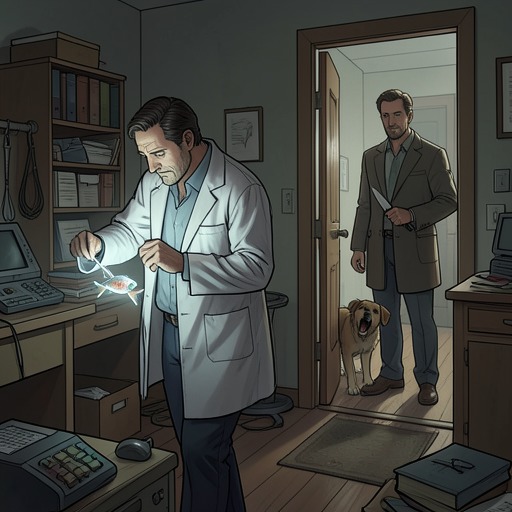
Pule lowers the net into the tank, unfurls its corners, and sweeps it over the sleeping fish’s tail. The carp wakes and thrashes before he can secure it by the gills. As Pule lunges to cradle it, the stool begins to cant beneath him. A light is being trimmed behind him, and a dog is barking: the watchman has discovered the intrusion. Pule and the fish topple sideways into sodden weeds. The dog catches his trouser leg, while its master, an old man with a game leg, limps in after it. Pule’s attention remains fixed on getting the fish out and on the hope that Narbondo will bring the cart close enough for him to escape.
Unable to climb through the window while holding the carp, Pule thrusts it outside and feels it taken from his hands. He then struggles through after it, with the dog still barking behind him. The drop proves greater than he expected. He tumbles into the mud between the building and the dogcart’s wheel as Narbondo curses and urges the horse onward. Pule grabs the cart’s sideboard, tries to haul himself aboard, and falls face-first into the fish. Even in flight, the relationship between the two men is openly hostile: Pule imagines turning the carp against Narbondo, but postpones revenge and concentrates on escape.
Significance and Aftermath
The oceanarium’s equipment makes the theft possible, but its architecture and contents frustrate the clean execution Pule had planned. The casement, sill, stool, tank cover, weeds, and net each impose a physical task; the alarm then turns the route back through the window into a dangerous scramble. The scene’s comedy of mishaps does not erase its stakes. Pule has entered for a specific animal because the conspirators regard it as necessary to their attempt involving Joanna Southcote, and the watchman’s arrival threatens both the acquisition and their escape.
The fish is carried away, but it is badly damaged. In the dogcart, Pule places the heavy carp in a half-keg with barely enough water to cover it and moves it back and forth in an effort to revive it. The fish is half crushed, and the water quickly becomes clouded with blood and scales. Thus the oceanarium’s role extends beyond providing a setting for a burglary: the condition of what leaves it immediately complicates the men’s purpose. The aquarium’s living collection has been treated as a resource in a human experiment, but the escape makes the animal’s vulnerable body—and the cost of extracting it—impossible to ignore.