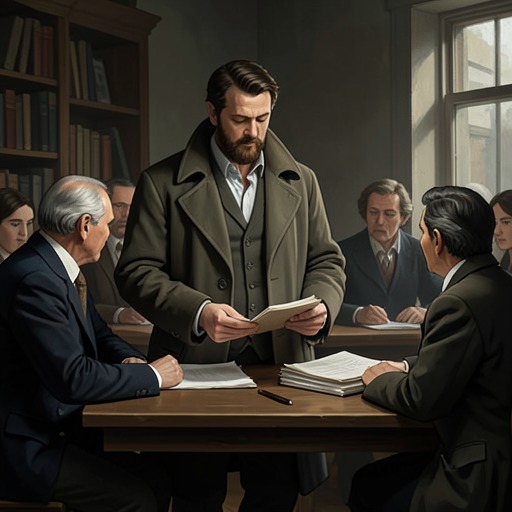
St. Ives’s manor
HomunculusSt. Ives’s manor is both a secluded base for Langdon St. Ives’s scientific work and a vulnerable extension of the conflicts he hoped to leave behind in London. Its rooms hold private papers and a concealed manuscript; its grounds shelter a spacecraft whose presence is unknown to the surrounding community; and its riverbank offers an intruder a route of escape. The estate’s apparent distance from London proves temporary: a search of the house and the arrival of curious locals draw the hidden struggle into the open, while the manor becomes the staging ground for St. Ives’s departure.
Setting and Spatial Arrangement
The manor’s importance lies in the way its distinct spaces support different kinds of secrecy. In the study, papers and books are kept among the furnishings and drawers; in the library, Sebastian Owlesby’s manuscript is concealed behind a copy of Squires’ Complications. The hiding place is not a separate vault but a gap behind an ordinary, stout volume, making the library’s familiar order part of the manuscript’s protection. When St. Ives learns that a prowler has been through the study, he crosses the lawn and goes directly to that concealed volume. The movement from a visibly ransacked room to the library’s still-undisturbed hiding place turns the manor’s interior into a practical map of threat and preservation.
Beyond the house, the grounds extend that arrangement of concealment. A silo stands on a meadow, out of sight from the household’s lit windows, and has held a launchable spacecraft. A carriage house provides another enclosed place: after the spacecraft is retrieved, it is driven there under cover of darkness. The River Nidd, meanwhile, marks an exposed edge of the estate. When Hasbro fires at a prowler, the intruder escapes through the open window and away along the riverbank, leaving the grounds as quickly as he entered them. House, library, silo, carriage house, lawn, and riverbank form not simply a backdrop but a chain of spaces in which secrets are hidden, searched for, moved, or threatened.
Intrusion and the Search for the Manuscript
The manor’s rural quiet does not keep the London conflict at a distance. A prowler breaks into the study, scatters papers, empties drawers, and damages the room in a search that St. Ives identifies as an attempt to find Sebastian Owlesby’s manuscript. Hasbro catches the intruder in the act, but the man gets out through an open window before Hasbro can stop him. Two shots ring out near the River Nidd; Hasbro, rifle in hand, searches the riverside foliage after the escape. The noise brings the danger into the open, but it does not resolve who sent the prowler or what the manuscript is wanted for.
St. Ives’s immediate response makes the manuscript’s importance tangible. He hurries through the damaged study, takes down Squires’ Complications in the library, and reaches behind it. The manuscript remains undiscovered. His relief is inseparable from a changed understanding of his position: he had supposed that the London underworld’s villainies could be kept at a remove, but someone has now followed the trail to Harrogate and searched his private rooms. The vandalized study deepens that breach. The smashed plaster bust of Kepler and the broken Waterford decanter lie amid the disorder, evidence that the intruder’s work has exceeded a careful search and included reckless destruction. The house protects the manuscript this time, but its concealment has exposed how vulnerable the household is.
The Silo, the Spacecraft, and Public Alarm
The silo concentrates the manor’s most extraordinary secret. St. Ives knows that the spacecraft had been moored there, but when he returns from the river by rowboat, the silo is dark and silent. Its rooflessness is hidden in the night, while the house is brightly lit; the contrast makes the domestic building visible and the scientific structure difficult to read from outside. St. Ives fears that the approaching torchbearers may be a hostile mob, a plausible fear after rumors about his experiments, the craft’s construction, and its unusual components have circulated. Yet the villagers are frightened rather than accusatory. An old farmer, McNally, arrives with his sons alongside people from the post office and the bakery, among a larger group drawn by reports of a strange flying creature.
The public encounter threatens to attach the spectacle to St. Ives. Old Binger begins describing what he saw, and St. Ives tries to prevent the story from revealing the source of the commotion. Hasbro intervenes by shouting about Binger’s boat, interrupting him and sending him after it. St. Ives then ushers Binger away with conversation, ale, and five pounds, leaving him with a memorable tale but not an explanation of the scientific business behind it. These actions reveal the manor’s porous boundary: the villagers do not know about the spacecraft, but its passage has brought them close enough to demand an account. Secrecy here depends on managing not only doors and hiding places but also what witnesses are able to say.
Departure and Narrative Significance
The spacecraft’s return to the estate changes the manor from a laboratory refuge into a temporary embarkation point. Three hours after falling asleep, St. Ives wakes to the sound of a wagon on the drive and sees the craft’s dark bulk being carried past into the carriage house. Before dawn, Hasbro hauls suitcases out of the front door. The two leave for Harrogate and the London express as the sun rises. The sequence is brisk and practical: the extraordinary vehicle is secured, luggage is brought out, and the pair set off toward the city whose danger has reached them even here.
St. Ives’s manor therefore functions as a refuge that cannot remain outside the plot’s expanding hazards. The manuscript survives because its hiding place is missed; the intruder nevertheless proves that the estate can be penetrated. The spacecraft is concealed from the villagers, but its flight produces a local story that must be redirected. Finally, the craft’s recovery and the departure before dawn make the manor a point of transition rather than a lasting retreat. St. Ives leaves with a clearer recognition that he is entangled in the London underworld’s affairs, and the estate’s sequence of breached rooms, hidden objects, and contested public knowledge gives that realization a physical setting.