Captain Powers’ Pipe and Tobacco Shop
HomunculusCaptain Powers’ Pipe and Tobacco Shop is both a working tobacco shop on a dark London corner and a gathering place where characters meet, exchange news, and deliberate. Its broad windows give it a view of the streets outside, but its deeper narrative function is almost the reverse: people drawn into its warmly inhabited interior bring distant troubles and investigations together. The shop’s mix of observation, friendship, tobacco, and eccentric invention makes it a practical refuge within the novel’s unsettled world.
Setting and Street Front
The shop stands at the corner of Jermyn and Spode, with long mullioned windows on its south and east sides. From a Morris chair behind the counter, Captain Powers can survey people approaching along either street simply by turning his head. On the night of April 4, 1875, however, the windows offer little advantage. Clouds and rain make the darkness nearly complete; the two visible gaslamps cast only thin circles of light, and illumination from nearby houses barely escapes the windows. The Captain hears footsteps before their owners appear in those small pools of light, then hears them recede again into darkness. The shop is therefore a lookout whose view is continually interrupted: it faces the street, but cannot master what passes through it.
The contrast between the Captain’s clear vantage point and the poor visibility outside gives the shop an apt place in a story of surveillance and uncertain knowledge. Its windows frame brief appearances rather than complete explanations. The surrounding houses belong to genteel residents, some of whom come in for tobacco or cigars, but the shop’s importance extends beyond ordinary trade. It is a place where people can watch for arrivals, shelter from the street, and talk over matters that reach far beyond the counter.
Captain Powers and the Shop’s Inventions
The shop’s proprietor has spent much of his life at sea. Captain Powers went to sea at twelve and lost his right leg in a skirmish below Alexandria, when his sloop was destroyed by desert thieves. His pension helps sustain the business, while a surviving piece of his ivory fortune has an unusually visible afterlife: William Keeble, the toymaker, fashioned it into a replacement leg. The Captain values it because it fits without chafing the small remainder of his leg, but Keeble’s workmanship also turns it into a concealed practical device.
The hollow ivory leg holds a pint of liquor and two ounces of tobacco. A button at its tip moves a hidden plate to expose a pipe bowl; a tube runs up inside the Captain’s trouser leg and coat, allowing him to walk and smoke at the same time. He has tried this only once. His reserve and insistence on dignity make him reluctant to display the contrivance in public, even though friendship keeps him from telling Keeble that he would rather not be seen smoking from his prosthesis. The object captures the shop’s character: mechanical ingenuity is not an abstraction but something built into the everyday lives of its friends, and its marvels can sit awkwardly beside conventional manners.
Keeble’s house stands opposite the shop. From inside, the Captain can see the lamp in the attic workshop and lights in rooms that may belong to Keeble’s wife, Winnifred Keeble, or his daughter, Dorothy Keeble; Jack Owlesby’s bedroom is also visible. This view makes the shop more than a commercial premises. It faces the home of the man who made the Captain’s leg and places the characters’ domestic lives within sight of their meeting place, while leaving some details of the household uncertain.
A Gathering Place for the Club
Langdon St. Ives has always felt at home in the shop, although he cannot readily explain why. The welcome contrasts with his childhood household, where his parents rejected tobacco and liquor and his father publicly argued against meat and intemperance. The shop’s sociability and ordinary indulgences thus mark a different kind of home for him: not a family household, but a place of companionship and conversation.
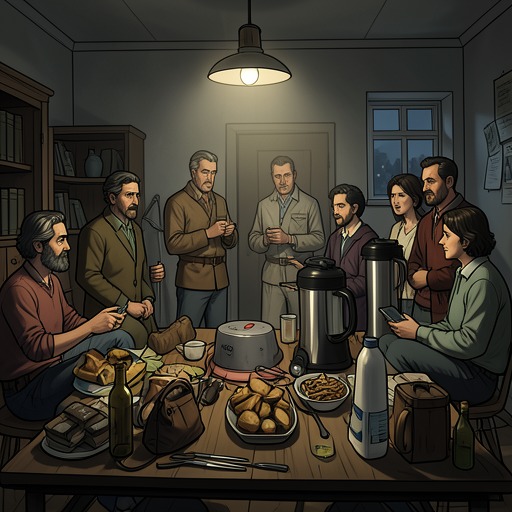
The shop accommodates an informal network of visitors as well as its proprietor. On one occasion, Theophilus Godall arrives carrying beer; Captain Powers brings out bottles and glasses; Bill Kraken accepts a drink; and Jack Owlesby enters behind Godall. Langdon St. Ives’s man Hasbro is already there, reading the Peloponnesian Wars and sipping port. The assortment of people is significant not because they all share the same purpose, but because the shop can hold them together despite their different circumstances. Kraken appears pale and disheveled, his hand shaking until a drink steadies him, while St. Ives watches him closely. Hospitality and suspicion occupy the same room.
The shop also hosts meetings of the Trismegistus Club. On a later evening, tobacco smoke fills the premises while the members wait for Godall. St. Ives has received part of Sebastian Owlesby’s notebooks, but has not yet told the others about the manuscript discovered by Dr. Birdlip; rather than repeat the account to each member separately, he brings the news to the gathering. At eight o’clock, the members come to order by mutual nod. The scene shows how the shop’s familiar social life becomes a mechanism for collective inquiry: information arrives through the post, is introduced to the group, and alters the atmosphere before its implications have been fully aired.
Narrative Significance
The shop joins the novel’s private relationships to its public mysteries without ceasing to feel like a lived-in business. Its street-facing windows make it a place of watchfulness; its bottles, pipes, and conversation make it a place of ease; and its use by the Trismegistus Club turns that ease into a setting for investigation. The Captain’s ivory leg condenses the same combination of affection and invention on a smaller scale: a practical gift from William Keeble is also a hidden device the Captain hesitates to show.
Smoke becomes a measure of the shop’s changing intensity. In the club gathering, Langdon St. Ives reads the dense tobacco haze as an index of the night’s serious business, while Captain Powers’s steady puffing forms clouds around his head. The smoke does not disclose the contents of the discussion, but it makes its weight visible within the room. Against the rain-dark streets, where passersby materialize only briefly beneath gaslamps, the shop offers a more sustained kind of attention: people can remain, observe one another, and assemble scattered knowledge. It is this combination, rather than any single piece of furniture or machinery, that makes the shop a recurring center of fellowship and investigation.