London
HomunculusLondon is more than the setting for the novel’s discoveries and pursuits: its scale, crowds, and buried passageways repeatedly shape what characters can see, hide, and reach. The city first appears beneath a mysterious dirigible in 1870, its nighttime skyline transformed into a public spectacle. In 1875, the same urban landscape becomes a network of laboratories, streets, sewers, and gathering places where secrets move almost as readily as people. London’s contrasts—open sky and enclosed rooms, busy markets and concealed routes—give its mysteries their material form.
The city from sky to street
In 1870, an oval shadow drifts southeast from Iceland toward Greater London. Before dawn, the wind sweeps through Battersea Park and along the Chelsea shore, where a ragpicker sees a great dirigible overhead. Its passage briefly draws the eyes of the city upward: as it crosses above the market and the Victoria Embankment, the gondola becomes visible against the moon, carrying a rigid, skeletal figure secured to its wheel. The craft continues east, its hum and mechanical sounds making an otherwise ordinary night seem charged with portent.
At dawn, the dirigible is sighted over Billingsgate. The surrounding market remains busy with carts, handbarrows, shellfish, and eels; a seller watches the craft pass, then returns to his work. Later, in Petticoat Lane, the airship still attracts pointing and turned heads, but the market’s activity diminishes its earlier mystery. The contrast makes London feel both vast enough to contain an unexplained apparition and preoccupied enough to absorb it. For one missionary, however, the blimp is an omen, and the sighting brings a dozen converts before sunrise.
Streets, crowds, and encounters
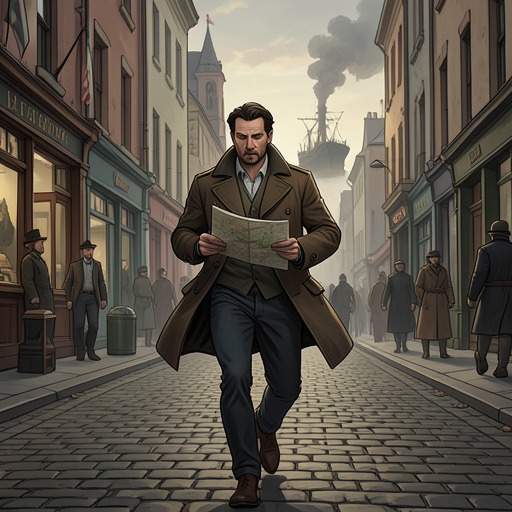
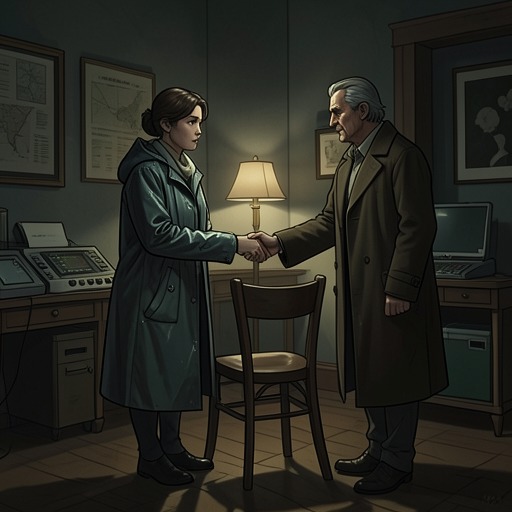
The novel’s later London is encountered at street level through movement and delay. On April 4, 1875, Langdon St. Ives waits in rainy Leicester Square after a dinner with the Royal Academy of Sciences. His rendezvous is already overdue, and the damp cigar and wet clothes place him in a city where even a short wait has its frustrations. London’s weather and streets do not merely frame the meeting; they shape its atmosphere of uncertainty.
The city also offers refuge and companionship amid that uncertainty. After years of wandering abroad and a difficult return to London, Nell finds a measure of safety with Captain Powers. She moves through nearly empty streets after midnight under a cloak and umbrella, but thinks of the Captain as a dependable shelter. His shop and his collection of curious objects stand for a domestic eccentricity sharply different from the dangers surrounding them. That security is fragile: Nell is later seized in an alley and carried away in a brougham, unable at first to understand why she has been taken. London’s darkness and scattered streets make abduction possible without immediately revealing its purpose.
Public space can become a theatre as well as a place of private threat. When Langdon St. Ives leaves a meeting, he finds a crowd filling the street, with people perched in trees and on carriages to hear an evangelist. The crowd parts in a narrow avenue before the man, and St. Ives is pressed forward among strangers. What begins as an urban gathering takes on the atmosphere of a religious spectacle; the city’s dense population lends the performance force, while making any individual observer difficult to distinguish from the multitude.
Hidden rooms and underground routes
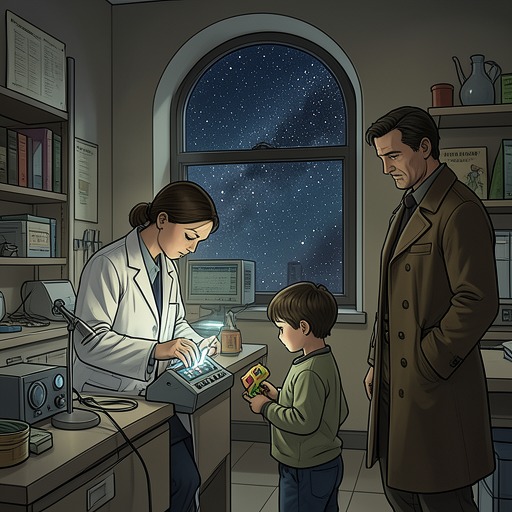
London’s buildings and infrastructure provide the practical means for concealment. Above Pratlow Street, Dr. Ignacio Narbondo keeps a laboratory where experiments depend on material taken from carp. When he returns with Willis Pule, he finds Shiloh waiting in the room, dissatisfied with the state of Joanna Southcote’s remains and with the failed prospect of a convincing demonstration. The laboratory is a private space in the middle of the city, yet its arrangements connect scientific ambition to religious expectation and bargaining.
The concealed routes beneath the streets are still more consequential. In the Kermit Street sewer, a collapsed section of old brickwork opens a way between a cellar and the drainage system. Billy Deener and an accomplice use this breach to pass unseen below the surface and approach a house on Wardour Street. The sewer is not an incidental underground setting: its low water, unstable footing, and accumulated refuse make it difficult to traverse, while its connection to courtyards and houses gives it covert access to the city above. Deener has also used the network to dispose of evidence of earlier crimes; the hidden system helps suppress the distinction between missing persons and presumed accidents.
Other characters turn concealment into a means of entry or escape. Bill Kraken enters Dr. Ignacio Narbondo’s laboratory to take the Keeble box, finding it atop a piano. When the remains of Joanna Southcote appear to stir, he flees through a moving panel in the wainscot into a passage hidden behind the walls. The secret architecture links rooms and levels while keeping its users out of sight. Later, Langdon St. Ives and William Keeble reach a house on Wardour Street by way of the sewers, discovering that access through the hidden route is easier than their earlier effort to enter by another plan. London’s architecture repeatedly rewards knowledge of spaces that ordinary occupants do not see.
Urban systems and plot consequences
The city’s crowds can obstruct movement as thoroughly as its concealed routes enable it. On an exceptionally crowded day in Regent’s Park, streams of people and vehicles clog the Parkway and Seven Sisters Road. The press of pedestrians repeatedly sends travelers into the roadway, forcing wagons and coaches to stop. Theophilus Godall moves among them in a deliberately altered, worn-looking outfit, using the crowd as cover. London’s public scale gives him anonymity, but the congestion also makes travel erratic and slow.
The city’s circulation of people, property, and suspicion complicates attempts to seek official help. Captain Powers and Theophilus Godall consider recovering an emerald associated with Jack Owlesby and conclude that involving the police would expose Nell and invite questions about the jewel’s ownership. The object’s concealed history could draw suspicion onto innocent people and bring other secrets into view. Their plan instead depends on watching Dr. Ignacio Narbondo’s premises and entering the laboratory themselves. In London, the density that might offer protection also multiplies witnesses, rumors, and risks.
Narrative significance
London is constructed through contrasts in access. Its open streets and public gatherings make events visible to crowds, while its alleys, private rooms, sewers, and wall passages allow people and objects to disappear. The city’s traffic and markets continue around extraordinary events: the airship crosses above working traders, and a strange performance draws a multitude into the street. This ordinary activity does not resolve the mysteries; it places them within a living urban environment that can look away, gather to watch, or inadvertently shelter those moving through it.
The repeated descent beneath the surface gives London a particular narrative structure. The sewer network, cellar breach, and concealed passage turn the built city into a second map, one that connects locations while bypassing their public entrances. That hidden geography enables escape, intrusion, and the movement of stolen objects, but it also traps characters and exposes them to danger. London’s importance therefore lies not only in being where the plot happens, but in how its visible crowds and invisible routes determine which actions can be witnessed, concealed, or carried out at all.