the silo
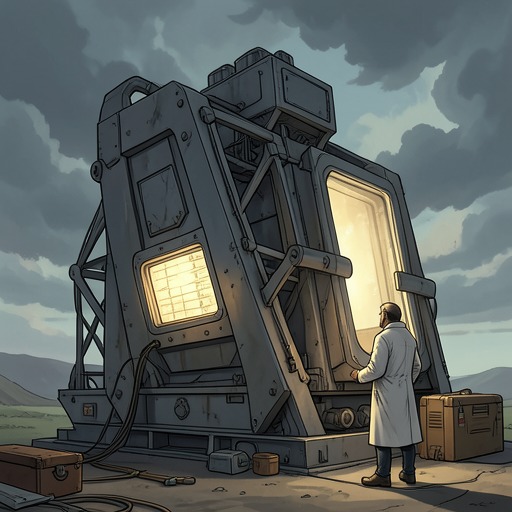
HomunculusThe silo is the enclosed launch site for Langdon St. Ives’s spacecraft, where careful preparations for an unmanned test are overturned by Billy Deener’s intrusion. Built around the possibility of opening its domed roof and issuing the craft into the sky, it concentrates Langdon St. Ives’s hopes for controlled flight—and, when Deener interferes, makes the consequences of that control failing visible across the surrounding countryside.
Design and Purpose
Langdon St. Ives spends a day testing the aerating device and preparing his spacecraft inside the silo. The craft is a spherical iron shell, its surface crosshatched with rivets, mounted on a structure that resembles an enormous rocket to an untrained observer. A pulley-and-chain system is meant to draw back the silo’s dome and clear a path for launch. Arched, batlike wings hug the craft’s hull; exhaust and motivator tubes project from their bases, while heavy-glass windows encircle the spacecraft beneath the conical hatch lock.
The arrangement joins an experimental vehicle to the architecture around it. The silo is not simply storage: its height, retractable roof, and access machinery are all part of the launch plan. Langdon St. Ives climbs a spiraling wooden stairway to reach the hatch and checks the cabin from above. He has filled it with potted orchids and begonias, intended to help the Keeble box supply oxygen. The plants and the box make the sealed cabin a space prepared to sustain life, even as the experimental craft is intended to travel unmanned.
Testing makes the preparations concrete. Langdon St. Ives breathes onto a gas-sensing device, watches its needle move, and presses the tester button on the securely anchored Keeble box. Green chlorophyll dust sprays into the cabin on a mixture of helium and oxygen; the gauge briefly responds before the oxygen disperses. Carved hippos and apes grin from the box’s rosewood top, a distinctive piece of William Keeble’s workmanship set among instruments and launch machinery. The test reassures Langdon St. Ives about the cabin’s air, but not about the flight: an untested craft might be lost at sea or crash into the suburbs. He regards sending it aloft without a passenger as the safer risk.
Deener’s Intrusion
The silo’s separation from the riverbank briefly protects what is inside. Billy Deener sees a bandaged figure fleeing while two men pursue it, then recognizes that their distraction gives him a chance to enter the silo unseen. He climbs from a willow and runs to the building, out of sight of the pursuers. The pursuit therefore functions as cover: while attention is fixed on the strange runner, Deener reaches the spacecraft.
Inside, the vehicle’s unfamiliar scale and machinery excite his appetite for destruction. He regards it as something worth meddling with and smashing, and imagines taking the box for Kelso Drake while getting revenge on Langdon St. Ives and his associates. The silo’s stairway and hatch, designed to give access to the spacecraft, also give Deener a route into it. He twists the conical lock until the hatch opens, lights matches and then the cabin’s gaslamps, and descends into the vehicle. In that moment, a protected experimental interior becomes the setting for an intruder’s attempt to seize or damage what it contains.
The Launch and Its Failure
Deener’s attempt at destruction does not end with the spacecraft broken on the silo floor. After throwing a prybar, he raises the box as if to smash it, then lowers it when thoughts of Kelso Drake return to him. He rushes down the stairs and wrenches at the bank of levers on the rocket’s smooth side. One lever snaps off; he hurls it into a clapboard wall, where it remains impaled and audibly vibrating. The scene turns on a practical object made suddenly conspicuous by violence: a control meant to belong to the launch system is broken in Deener’s hand, and the machinery around it ceases to be a passive backdrop.
A growing hum and rushing roar interrupt his efforts. Heat surges from the rocket’s base, and Deener retreats across the green with the box and his hat. The silo then bursts open: its domed roof breaks outward in shingles and wooden fragments as the rocket rises amid sparks. From a distance, the ascent appears uncertain. The rocket struggles to gain height and threatens to dip toward the ground; Deener watches from the grass before running for the trees. The opening intended to release the craft has become a violent breach, with the roof itself scattered into the air.
The launch separates the spacecraft from its failing rocket. The rocket stops and shudders, while the dark sphere at its top—the spacecraft—pops free and flies north over the willows beside the River Nidd. Its motivator tubes send out small jets of smoke and fire; its gaslamps are still lit, and its hatch hangs open. It travels several hundred yards toward town before disappearing beyond trees and crashing at a distance. The rocket’s remains fall across the meadow and its small fires go out. Deener watches from the edge of the wood, visibly satisfied, tosses the box into the air and catches it, then walks through the trees toward Kirk Hammerton.
What the Silo Reveals
Langdon St. Ives witnesses the same failure from across the willows. For him, the sparks and falling shingles first frame the launch as the apparent success of the rocket, until the vehicle’s weak, nearly stationary rise and the spacecraft’s sudden separation reveal that the test has gone disastrously wrong. The years of work embodied in the craft have not produced a controlled ascent: the spacecraft has escaped the silo and rocket, but its destination and the extent of the damage remain uncertain. A distant crash sharpens Langdon St. Ives’s fear that a manor house or its inhabitants may have been struck.
The silo’s function consequently reverses. It began as an engineered enclosure intended to make launch possible under observation; after Deener enters and handles its controls, its roof becomes debris and its craft vanishes beyond the trees. Langdon St. Ives initially blames Willis Pule, imagining that his enemy doubled back to launch the rocket out of spite. The reader has seen Deener enter and meddle with the machinery, so the scene’s crossed lines of sight create an irony: Langdon St. Ives’s immediate suspicion does not match the observed intruder. The silo is left behind as the site where a carefully managed experiment became an uncontrolled departure, and where the conflict over the Keeble box was entangled with the destruction of the launch plan.