Castle Hill
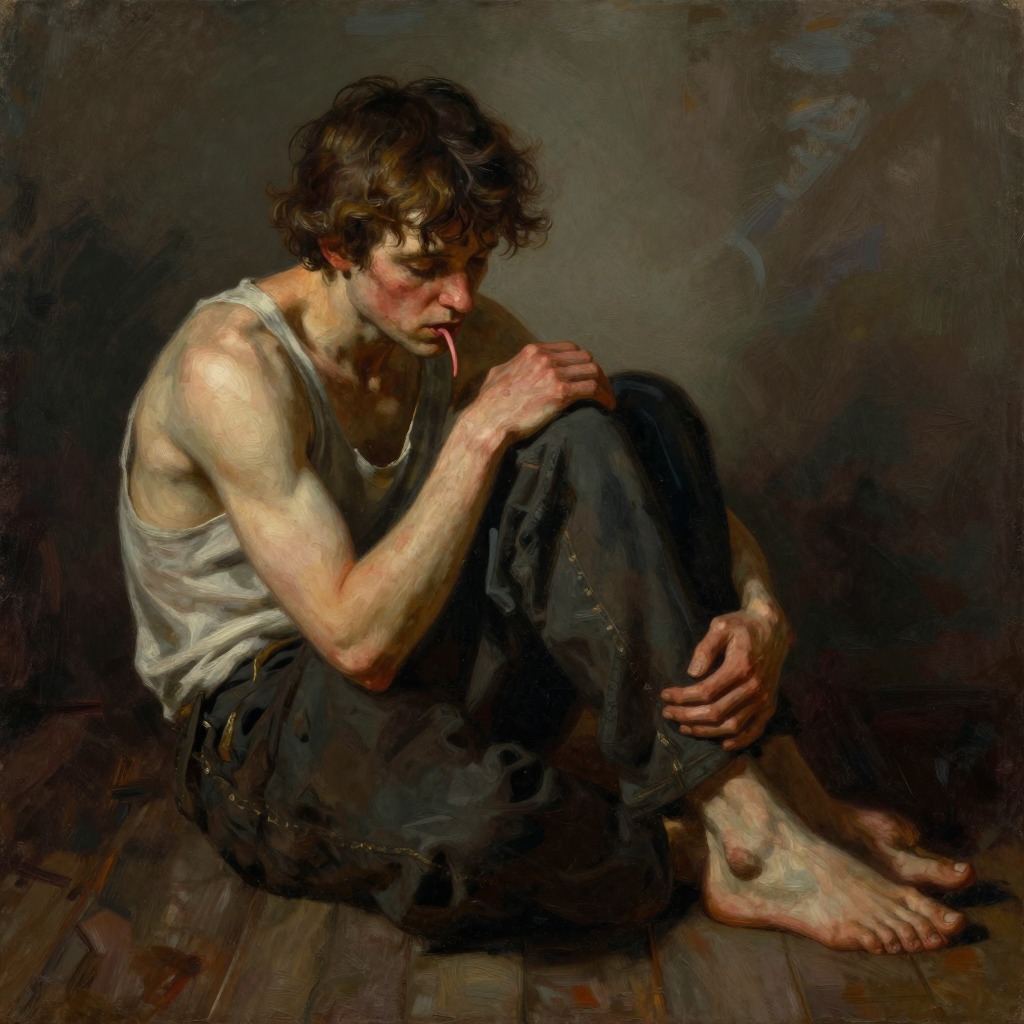
HungerCastle Hill (Castle Hill) is a recurring location in Knut Hamsun's Hunger, a park in Christiania where the unnamed protagonist often goes to write, eat, and wrestle with his deteriorating mental and physical state. It is one of the few places he can sit undisturbed, and it becomes a stage for his most intense inner conflicts—between hope and despair, inspiration and madness, faith and rebellion.
Identity and Setting
Castle Hill is a public park in Christiania, described as having benches, paths, and a view of the city. The protagonist first goes there after pawning his waistcoat to buy bread and cheese, finding a bench to himself and beginning to eat greedily. The park is quiet, with nursemaids trundling perambulators near the Queen's arbour, and the atmosphere is one of autumn stillness—"the tender, cool time of the year, when all things change their colour, and die." It is a place of relative solitude, where the protagonist can be alone with his thoughts, but also where the encroaching cold and the presence of other people remind him of his isolation and poverty.
A Space for Writing and Inspiration
The protagonist repeatedly goes to Castle Hill to write articles for newspapers, hoping to earn money. After his meal, he feels a surge of creative ambition, deciding to write a treatise on "Philosophical Cognition" in three sections, intending to "crush pitiably some of Kant's sophistries." However, he discovers he has forgotten his pencil in the pawned waistcoat, and the inspiration collapses. Later, he tries again to write, but is distracted by flies and mosquitoes sticking to the paper, and by the sound of clarionet notes from a bandstand. The park, meant to be a place of concentration, instead amplifies his nervous sensitivity and the fragmentation of his thoughts. He writes mechanically, filling corners with the date 1848, and eventually gives up, folding the paper and putting it back in his pocket.
Encounters and Conflicts
Castle Hill is also the site of a bizarre and revealing encounter with an old man. The protagonist notices the man holding a newspaper parcel, and his curiosity becomes an obsession—he imagines it contains "dangerous documents stolen from some archive" or a "secret treaty." He invents an elaborate lie about a man named Happolati, a Persian minister and inventor of an electric psalm-book, and his daughter Ylajali, a princess on a couch of yellow roses. The old man accepts every lie without suspicion, which enrages the protagonist, who then verbally abuses him until the man flees. This episode illustrates the protagonist's volatile mental state, his need to assert control through fiction, and his inability to tolerate the ordinary. Later, he sees the same old man eating from the opened parcel, but feels repelled by the sight of food and passes by without speaking.
Decline and Despair
As the day declines, the protagonist's mood on Castle Hill darkens. He feels the autumn as a "Carnival of Decay," and sees himself as "a creeping thing on the verge of destruction, gripped by ruin in the midst of a whole world ready for lethargic sleep." He tries to write again, but his thoughts become disordered, and he feels his brain "snap" and his head become "light, buoyant, and void." He cries out, "Lord, my God and Father!" repeatedly, but no words follow. The park, which had briefly offered a sense of possibility, becomes a place of existential terror. He leaves as it gets chilly, buttoning his coat to his throat, and goes on his way. Castle Hill thus encapsulates the novel's central dynamic: a space of potential creativity and solace that repeatedly collapses into frustration, madness, and the gnawing reality of hunger.