Wallpaper Newspaper
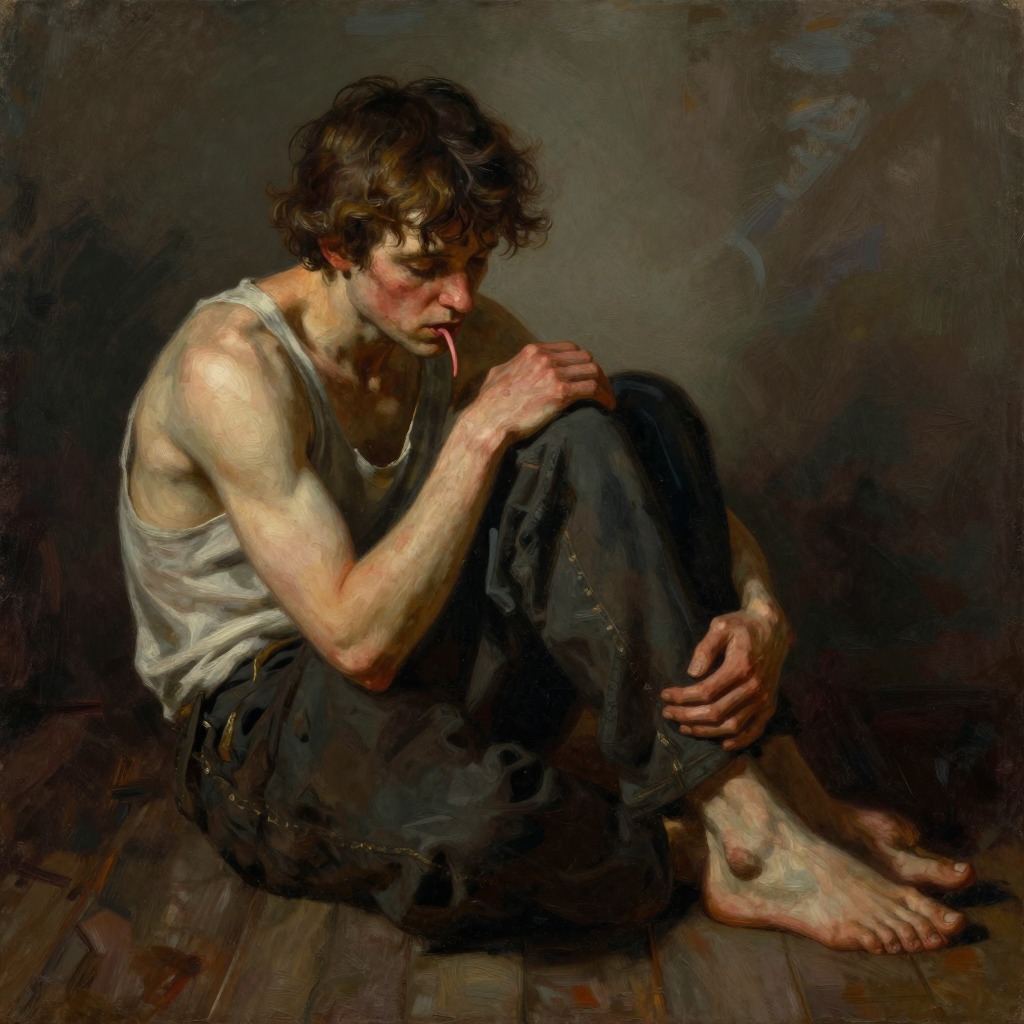
HungerThe Wallpaper Newspaper is the Morgenbladet issues pasted on the wall of the narrator's attic room in Christiania, serving as both a material record of his poverty and a recurring motif of his deteriorating mental state. It is the first thing he sees each morning and the last thing he reads at night, a constant companion in his isolation that transforms from a mundane advertisement sheet into a symptom of his unraveling mind.
Identity and Material Presence
The narrator's attic room is papered with old numbers of the Morgenbladet, a Norwegian newspaper. From his bed, he can distinguish clearly a notice from the Director of Lighthouses and, a little to the left, an inflated advertisement for Fabian Olsen's new-baked bread. On the right of the door, he can make out the grinning lean letters of "winding-sheets to be had at Miss Andersen's." These specific advertisements become landmarks in his visual field, the only fixed points in a bare room where the floor rocks up and down with every step and there is no proper fastening to the door. The newspaper is not merely decoration; it is the room's only readable surface, and the narrator studies it obsessively. When it blows hard and the door below stands open, eerie sounds moan up through the floor and from out the walls, and the Morgenbladet near the door is rent in strips a span long. The newspaper thus participates in the room's decay, its physical disintegration mirroring the narrator's own.
A Record of Poverty and Desperation
The newspaper is intimately tied to the narrator's financial ruin. He lies awake and reads the advertisements by force of habit, thinking if he has anything to rejoice over that day. He has been hard-up lately, one after another of his belongings taken to his "Uncle" (the pawnbroker), and he has grown nervous and irritable. The newspaper's presence is a constant reminder of his inability to pay rent; a few days have elapsed since his rent fell due, and he has no longer anything wherewith to raise it. The advertisements for bread and winding-sheets become cruel ironies—he is starving and, in his darkest moments, contemplating death. Later, when he is homeless and sleeping in a guard-house, he gives a false name, Andreas Tangen, and claims to be a journalist for the Morgenbladet. This lie, told to the guard, is a desperate attempt to borrow the newspaper's respectability. He knows Friele, the editor, could show his teeth when he liked, and he feels ice run down his back at his own boldness. The newspaper, once a fixture of his room, becomes a prop in a performance of social standing.
A Symptom of Mental Decline
As the narrator's hunger and madness deepen, the newspaper becomes a trigger for his disordered thoughts. When he tries to write an article in the park, he cannot concentrate; everything influences and distracts him. Flies and tiny mosquitoes stick to the paper and disturb him; he blows at them to get rid of them, but they throw themselves on their backs, make themselves heavy, and fight against him until their slender legs bend. The newspaper's physical texture—the commas and unevenness of the paper—becomes a battlefield. Later, when he is in the guard-house, the memory of the newspaper returns. He lies in the dark cell and thinks of the Morgenbladet, and the word "Kuboa" springs into his mind, a word he imagines he has discovered. He sits with open eyes, amazed at his own find, and laughs for joy. The newspaper, once a source of information, has been internalized as a fragment of a shattered psyche. In his final days at the lodging house in Vaterland, he stares at the wall where Christ hangs in an oleograph, and his thoughts drift to "winding-sheets to be had from Miss Andersen's, on the right of the door." The newspaper's advertisement, memorized in his attic, surfaces as a memento mori, a final, bleak punctuation to his suffering.
Narrative Significance
The Wallpaper Newspaper is a masterful example of defamiliarization. By pasting a mundane newspaper on the wall and forcing the narrator to read it obsessively, Hamsun transforms a common object into a symbol of entrapment, poverty, and mental fragmentation. It is a constant, unchanging presence in a life of radical instability, and its specific advertisements—bread, winding-sheets, lighthouse notices—become a lexicon of the narrator's despair. The newspaper is not just a prop; it is a character in the room, a witness to the narrator's decline, and a thread that runs through the entire novel, from the first page to the last.