Gershom Wald–Shaltiel Abravanel relationship
JudasGershom Wald and Shaltiel Abravanel’s relationship is a friendship shaped first by vehement political disagreement and then, decisively, by the death of Wald’s son, Mija. Wald disputes Abravanel’s warnings against Jewish statehood, but the two men share a home and a deepening silence after Mija is killed; their bond persists as a form of companionship that cannot restore what they have lost or reconcile their opposing convictions.
An invitation and an argument
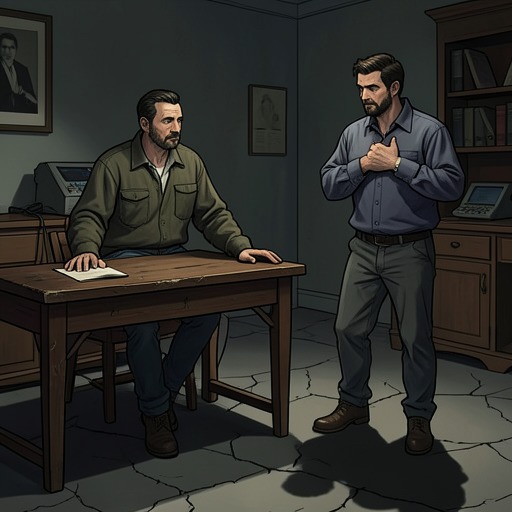
In 1946, a few weeks after Mija married Atalia Abravanel, Shaltiel invited Wald to leave his small apartment on Azza Street and live in the family home. Wald was then a history teacher at Rehavia High School, nearing retirement. He brought only the novels in his bedroom; the library was Shaltiel’s, and in it the older man paced between the walls, windows, door, and kitchen’s beaded curtain while explaining his political vision. He called the state, any state, a predatory dinosaur, and argued instead for a group of communities.
Shaltiel’s opposition to statehood was not a passing objection. He foresaw that declaring an independent Jewish state after the British Mandate ended would bring a bloody conflict with the Arab world, potentially extending across the Muslim world. Even a series of Jewish victories, he warned, would deepen Arab fear and make the struggle one of generations. He imagined a shared home for Jews and Arabs, not a sovereign state established at the expense of a neighboring people.
Wald did not share this outlook. He later recalled arguing with Shaltiel fiercely and dismissing his beliefs as a Manichaean division between an imagined paradise and hell. Wald regarded David Ben-Gurion as a clear-sighted leader who understood that Jews could not count on Arab acceptance or outside protection, and that what they did not secure for themselves would not be freely given. He did not believe Ben-Gurion aspired to rule the Arabs. The difference was fundamental: Shaltiel read state-building as a dangerous messianic project; Wald saw self-defense as an unavoidable political necessity.
Political isolation and private loyalty
Shaltiel’s dissent increasingly isolated him from his colleagues. He believed Jewish aspirations to a homeland were justified, but that the homeland should be shared with Arabs. In the 1940s he began voicing disagreement in meetings of the Jewish Agency and the Zionist Executive. In 1947 he opposed the United Nations partition plan and Israeli independence. Some called him a traitor, alleged that he had sold himself to the Arabs, and mocked him in Hebrew newspapers with names such as the Muezzin and the Sword of Islam. He was given two hours to choose between resigning and expulsion; after resigning, he said nothing publicly.
Wald continued to argue with him until the night of April 2, 1948. He did not accept Shaltiel’s political conclusions, but their disagreement did not prevent them from sharing a household or from remaining bound to one another. Wald later said that after Mija’s death all their arguments ended forever: tragedy silenced the dispute. In his account, the arguments simply stopped; they were not replaced by agreement. He also recognized that Shaltiel’s position had no practical opening in a country where, as Wald saw it, the Arabs would not accept Jewish presence even if Jews renounced statehood.
Mija’s death and the end of debate
Mija was killed in the fighting at Bab al-Wad on April 2, 1948, on the road between Tel Aviv and Jerusalem. He had been an orphan, raised by Wald alone; Wald later described himself as the man who had led his son to sacrifice. The loss remade the relationship between the two older men. Wald imagined Shaltiel asking whether any of it had been worth the price, though Shaltiel never asked him. The question hurt Wald as if a knife were repeatedly driven into his throat, and it became part of the silence between them.
In the weeks after the death, neither man resumed their former arguments. Their conversations dwindled to household matters such as repairing roof tiles or buying a refrigerator. Wald said that everything seemed to have vanished. Shaltiel’s unspoken challenge did not bring Wald to his side, and Wald’s convictions did not undo the grief that connected them. Their shared loss left the political disagreement intact but deprived it of speech.
The household’s isolation reinforced this change. After Mija’s death, Shaltiel was branded a traitor, and few people came to the house. A small number arrived to offer condolences in the first days, then stopped. Letters reached him from Beirut or Ramallah through European contacts, but he did not answer; he also ignored a French journalist’s request for an interview. Wald and Atalia remained among the very few people close to him. The men’s silence thus belonged both to private mourning and to Shaltiel’s withdrawal from a world that had repudiated him.
Living together in silence
For roughly two years after Mija’s death, Wald, Shaltiel, and Atalia lived together in the house, as if enclosed in a submarine. Wald described himself and Shaltiel as the two grandfathers of the child he would never have. He cared for them while working several hours a day at a real-estate office on Straus Street. Wald needed to talk; Shaltiel was comfortable with silence. After the tragedy, their contrasting temperaments no longer produced the old exchanges. Wald believed the silence probably caused him pain, but he could not make Shaltiel speak.
Their companionship took small, practical forms rather than renewed political discussion. In his final months, Shaltiel grew weak and apathetic, and he would not eat unless Atalia stayed with him, coaxed him, and told him stories. Wald sometimes sat with him in the library. They might remain there for half an hour or an hour: Wald said little, while Shaltiel listened—or appeared absorbed—bending a paper clip and trying to straighten it again. Wald could not tell whether Shaltiel was listening. The uncertainty matters: their late closeness offered presence, not a recovered understanding.
Shaltiel’s withdrawal became a voluntary confinement. After the war he cut contact with the outside world, did not answer letters, refused the telephone, and never left the courtyard, not even to go to the shop or stroll at the end of the street. He spoke neither to Wald nor to Atalia about the establishment of the state, the victory, the expulsion of Arabs, the arrival of Jewish immigrants, or bloodshed along the new borders. Wald first thought Shaltiel was punishing himself; he later concluded that Shaltiel was punishing the world. Their shared residence endured, but political and emotional speech had contracted almost to nothing.
Death and the relationship’s aftermath
Shaltiel died alone in the kitchen, two years after Mija. His familiar routine was to sit there each evening after the seven o’clock news, drink coffee, and read the newspaper. One day his head fell onto the cup, overturning it; the right lens of his glasses shattered, and coffee spread over the newspaper, table, chest, legs, and floor. Atalia found him with his face on the floral oilcloth, his forehead and hair in a pool of coffee. The ordinary domestic scene made his isolation palpable: the man who had shared a home with Wald died in the room where he had sat alone day after day.
Wald’s account holds affection and judgment together without resolving them. He had vehemently opposed Shaltiel’s politics and even mocked his worldview, yet he lived beside him through bereavement and withdrawal. After Mija’s death, the silence did not heal their difference; it became the shape their relationship took. Shaltiel died hated and slandered, perhaps even by himself, while Wald remained with memories of the arguments, the question never asked, and the years in which the two men could no longer answer one another.