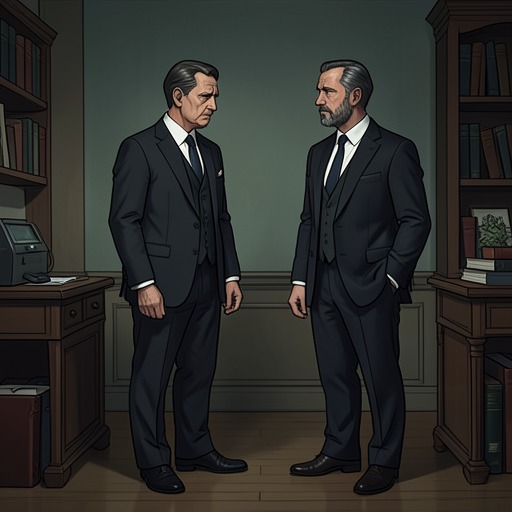
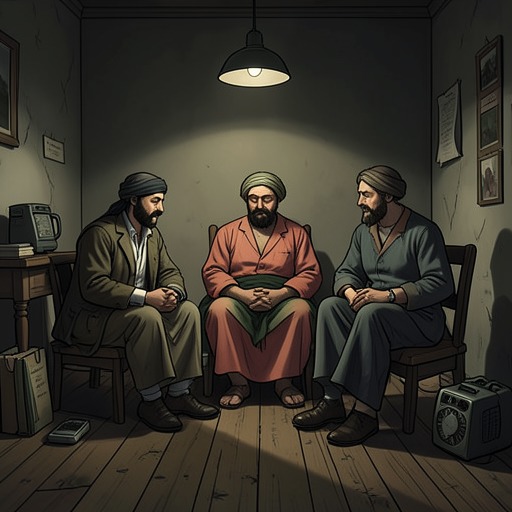
Shmuel Ash–Gershom Wald relationship
JudasShmuel Ash and Gershom Wald form an unlikely household companionship that grows through argument, practical care, shared grief, and the long conversations of winter. Wald’s sharp skepticism challenges Shmuel’s revolutionary hopes, but their exchanges change them both; by the time Shmuel prepares to leave, the older man calls him close, kisses his forehead, and names the loss he fears as the loss of another son.
An intimacy built in conversation
Shmuel’s growing attachment to Wald is first described as a feeling of kinship: he feels close to the old man, as though he had known and loved him since childhood. Yet this intimacy also brings a belated recognition that their long talks on winter afternoons have missed something essential. Their relationship is not simply a meeting of minds; it has accumulated tenderness and unspoken history, and Shmuel senses that the conversations have not reached what they truly needed to discuss.
Their closeness takes shape in ordinary routines as well as debate. During one intense conversation, Shmuel becomes so agitated that he forgets to feed the colorful fish in the aquarium and to give Wald his pills. The lapse makes visible how completely the discussion has absorbed him, while the forgotten tasks also recall the everyday responsibilities through which Shmuel cares for the older man. When Shmuel later returns home after waiting beneath a streetlamp without knowing whom he is waiting for, he goes straight to the library to ask Wald whether he needs tea, biscuits, or an orange peeled. The small offer restores their familiar pattern of attentiveness after Shmuel’s uncertain pause outside.
Wald, in turn, treats Shmuel’s company as part of the daily shape of his life. He expects to see him in the library the following afternoon and looks forward to hearing another speech about how to put the world right, Fidel Castro, and other political subjects. Their companionship is sustained by repetition: the same room, the same conversations, the same gestures of care. That routine matters because both men inhabit a house shadowed by departures and bereavement.
Argument, influence, and political difference
The two men do not share a political outlook, and their conversations depend on that difference. Shmuel says that Wald’s ideas contain something the heart would like to accept, but that they are ultimately too sweetened. Shmuel instead argues that the Arabs may have been drawn less by fear of Jewish power in the future than by the vulnerability of Jews in the present. Even in disagreement, the exchange moves without ceremony between political interpretation and domestic care: Shmuel asks whether they should have tea and biscuits, and reminds Wald to take his syrup and two pills.
Wald’s influence is visible in Shmuel’s changing account of himself. Shmuel tells him that their nighttime conversations have taught him to doubt a little. He attributes to that influence a loss of revolutionary certainty: he may never become a true revolutionary, he says, but only a revolutionary of the café. The self-mocking phrase does not mean he has stopped thinking politically; it registers a new awareness of cracks in the large dreams that once seemed whole. Shmuel’s skepticism is therefore not simply a rebuttal of Wald. Their relationship has altered the terms in which he understands his own convictions.
The intellectual exchange is reciprocal in its emotional force, even when Wald’s answers remain teasing or combative. He can challenge Shmuel’s ideas while inviting him back for the next day’s talk, and Shmuel can reject the sweetness he hears in Wald’s thinking while continuing to tend to Wald’s medication and meals. The relationship allows disagreement to become a form of continued attention rather than a reason to withdraw.
Grief, inheritance, and departure
Wald’s warning that Shmuel should hurry after Atalia carries the expectation that their companionship will end. He tells Shmuel to put on his best shirt and go, insisting that he should not worry about Wald, who will remain among his books and notebooks until dawn and then make his own way to bed. At the same time, Wald imagines the house after Shmuel’s departure: it will be empty, no stranger will stay, and Shmuel too will soon be forced to leave. His permission is therefore also a disclosure of attachment. He urges Shmuel onward while naming the loss that lies ahead.
That fear is set against the earlier deaths that have shaped the household. Wald’s son Mija died in the mountains near Jerusalem on the night of April 2. After Mija’s death, Wald and Shaltiel Abravanel ceased arguing; grief tied their tongues, and silence settled over the three people left in the house. The account of this bereavement makes Wald’s later response to Shmuel more than a routine farewell. Shmuel has entered a family space already defined by the absence of a son, and Wald recognizes the possibility of another separation within it.
When Shmuel packs to leave, Wald comes into the room leaning on his crutches and fixes his gaze on the full duffel bag resting on the sofa. His physical presence fills the room, but his attention is fixed on the sign of departure. He tells Shmuel that he has already lost one son, asks him to come closer, and kisses him on the forehead with strong, cold lips. The gesture gives their bond its clearest familial expression. It does not undo Shmuel’s departure; instead, it makes the separation legible as another loss for Wald.
A relationship made of care and contradiction
Their bond joins intellectual challenge to practical dependence without reducing either man to a single role. Wald is Shmuel’s formidable older interlocutor, physically disabled and reliant on crutches, yet still eager to summon him back to the library and resume their arguments. Shmuel is both the younger man whose political ideas Wald teases and the person who remembers his pills, prepares food, and asks what else he needs. Their exchanges move repeatedly between claims about history and the intimate logistics of tea, medicine, and supper.
Wald’s parting advice also holds affection and resignation together. He doubts that Shmuel’s flirtation with Atalia will lead anywhere and predicts that she will remain lonely, while telling him to go to her all the same. He imagines himself left alone after Shmuel is gone, but does not ask him to stay. The farewell thus repeats the relationship’s defining tension: attachment is expressed not by agreement or possession, but by frankness, permission, and the recognition that each person’s path can carry them away from the other.
The relationship’s significance lies in the change it makes possible without reconciling the men’s differences. Wald’s conversations loosen Shmuel’s confidence in revolutionary answers; Shmuel’s company, meanwhile, gives Wald a daily companion after a history of bereavement and isolation. Their last embrace gathers the book’s recurring movement between debate and silence, care and loss: a political and intellectual companionship ends not with a final argument, but with a kiss on the forehead and the admission that another son has already been lost.