Shmuel Ash and Atalia Abravanel’s relationship
JudasShmuel Ash and Atalia Abravanel’s relationship develops in the narrow space between employment and intimacy: he comes to her house for paid companionship to Gershom Wald, while she offers moments of warmth without promising emotional access. Shmuel’s attraction intensifies as he tries to turn her kindness into a bond; Atalia, who has already lost her husband Mija Wald, remains self-directed and difficult to reach. Their brief gestures of closeness—coffee, conversation, a walk, a film, and an arm around her shoulders—make the relationship significant less as a settled romance than as an encounter between his loneliness and her guarded compassion.
An arrangement built around limits
Shmuel arrives at the house after his parents lose their savings, his research stalls, his university career is interrupted, and his former girlfriend Yardena marries her previous boyfriend, Nesher Shereshevski. The job offers modest pay, lodging, and several hours each day spent keeping Gershom Wald company; the rest of Shmuel’s time is free. Atalia is part of the household that offers this refuge, but from the beginning her presence also unsettles him: whenever she leaves a room, he feels a small disappointment. He senses a gap between her sparse, often sharp words and the warmth of her voice, and that contrast becomes a pattern in their relationship.
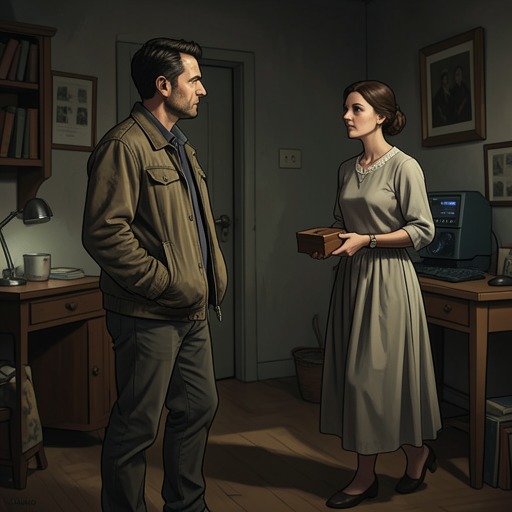
When she explains the household rules, Atalia draws a firm line around her private life. Shmuel must not come to her for company or loneliness; if he needs something, he is to leave her a note on the kitchen table. She warns that the house seems to make its previous lodgers lonely, but insists she has nothing to offer in that regard. He must keep their arrangement secret, may not bring visitors, and is not to involve himself in matters that are not his concern. These instructions define intimacy as something she will not provide on demand. Shmuel is welcome in the house as an employee, but the boundary between his work and her private self is hers to enforce.
That boundary does not make Atalia indifferent. When Shmuel’s loneliness becomes visible, she recognizes it before he explains it: after only three weeks, she says, isolation is already beginning to oppress him. He admits to a difficult period and a personal failure, but her smile trembles as though she would rather he stop. Then, changing course, she takes a long, sharp bread knife from the drawer and offers it to him. The bread goes forgotten; what matters is that her smile changes into one of affection and compassion, and she invites him to speak. Her kindness is real, but it arrives as a moment of chosen attention, not as a reversal of the limits she has set.
Confession, sympathy, and withdrawal
Shmuel uses that opening to tell Atalia about Yardena’s sudden decision to marry her former boyfriend. He then makes a generalizing remark about women’s mysterious preferences, apparently trying to keep the conversation going or provoke a response. Atalia’s smile disappears. She rejects his assumption that she can explain why couples come together or separate, and refuses the role of expert on either women’s or men’s preferences. Instead, she suggests that Gershom might be the person to discuss it with. The exchange reveals a difference in what each wants from their conversation: Shmuel reaches for personal consolation and a way to prolong their encounter, while Atalia will not let sympathy turn into a claim that she can interpret women for him.
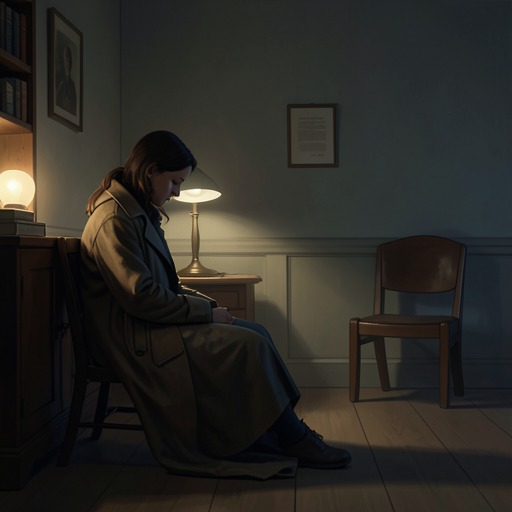
Even as she prepares to leave, Atalia gives him a less guarded kind of reassurance. The house, she says, may gradually anesthetize him so that his pain hurts less; its walls are accustomed to absorbing pain. Yet she also tells him not to wait for her, then lightly revises the instruction and says he may wait if he has nothing better to do. The moment holds her characteristic ambivalence in view: she acknowledges his need and makes room for his company, but refuses to make that room a promise. Her compassion neither erases his loneliness nor guarantees that she will be there when he wants her.
Later, when Shmuel is considering whether to leave, he understands that Atalia may be proposing that he stay. She asks whether he does not already love her. He answers that perhaps he loves only a little—the shadow of her, not her. Her reply, that he lives among shadows like a slave longing for one, turns his half-confession into a recognition of the distance between an imagined Atalia and the woman herself. Shmuel’s attraction is bound up with absence: what he longs for may be less a mutual relationship than the possibility of being comforted by someone who remains partly inaccessible.
A shared evening and its limits
On a winter walk through Jerusalem, Atalia tells Shmuel that he is full of questions and gives him three chances to ask. He asks whether Gershom has said that she is a widow. Atalia answers directly: she was married for a year and a half to Mija, Gershom’s only son; Mija died in the war, leaving her and Gershom alone. Gershom is her former father-in-law. She then moves the conversation on to their immediate plan: they are going to see a French suspense film starring Jean Gabin at the Orion cinema. The disclosure gives her reserve a history, but she does not dwell on it or present her loss as an invitation to intimacy.
Shmuel puts an arm around her shoulders over their coats. Atalia allows it, but does not put her own arm around him or lean against him. During the film, he tries the gesture again; when the trailers end, she changes position and uses the movement to remove his arm as if nothing has happened. The pattern is precise: permission is not reciprocation, and a shared outing does not dissolve the limits she has set. For Shmuel, the film sharpens the contrast. He admires Jean Gabin’s ironic severity and persistence, and asks whether Atalia would want a man like him. She says she wants none of that for herself. Men, in her view, are often childish and depend on a constant stream of success and triumph; without it, they become bitter and weak. Shmuel hears the answer as a sign that she is inaccessible to him.
The walk to and from the cinema makes the small physical gestures carry more weight. Atalia has interlaced her arm with Shmuel’s as they cross the cold city, and he is struck by how long it has been since a woman—or any living being—touched him. Later, after she pays for their meal and declines arak in favor of coffee, they walk home through mist around the streetlamps. Shmuel says that he sometimes speaks nonsense instead of saying what he means, then puts his arm around her and presses his shoulder against hers. The thick coats make the contact barely a contact. Atalia does not remove his arm; instead, she slows her pace slightly. Shmuel cannot find anything more to say, and in the lamplight her face seems to him steeped in melancholy. The exchange offers no declaration or resolution, only a restrained adjustment of pace that leaves him trying to read a feeling she does not name.
Asymmetry and significance
Shmuel’s approach to Atalia is shaped by recent rejection and by his wish to escape isolation. He seeks openings in conversation, tests whether a touch will be accepted, and sometimes tries to provoke a response when ordinary confession does not secure her attention. Atalia can be tender, as when she invites him to speak and recognizes his pain, but she also corrects him, redirects him, or withdraws from physical contact. The difference is not simply that one is warm and the other cold: her compassion is visible precisely because it coexists with a deliberate refusal to become responsible for his emotional needs.
The relationship is also formed by an uneven knowledge of loss. Shmuel’s separation from Yardena is fresh enough to dominate his account of himself; Atalia’s marriage to Mija and Mija’s death in war are part of an older grief that she states plainly but does not elaborate for Shmuel’s benefit. He is drawn to her voice and to the warmth he senses beneath her sharpness, yet those qualities do not grant him access to her past or her desire. Their closeness remains composed of partial permissions: a sympathetic smile, a walk, her arm linked with his, a shoulder not immediately rejected. Each gives Shmuel grounds to hope, but none cancels her independence or turns hope into a mutual commitment.
As a result, Shmuel and Atalia’s relationship functions as a study in the gap between contact and intimacy. The house can absorb pain, Atalia suggests, but its capacity to shelter a lonely person is not the same as her willingness to belong to him. Shmuel’s phrase about loving her shadow recognizes how much of his attachment is directed toward what he cannot reach. Their encounters leave that tension unresolved: tenderness is present, but so are boundaries, grief, and the disparity between his desire for reassurance and her refusal to make reassurance into a promise.