Cosmic Egg
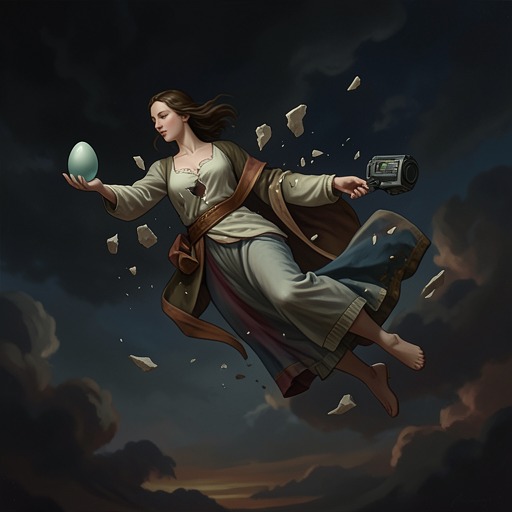
KalevalaThe Cosmic Egg is the creation image through which the poem turns a nest’s fragile clutch into the structure of the world. Six golden eggs and a seventh of iron fall into the ocean when the nest is shaken; their fragments do not perish, but come together again as the lower and upper vaults and as features of the visible sky. Creation thus unfolds through breakage and recomposition rather than through the preservation of an intact egg.
The clutch and its fragile shelter
The creation sequence begins with a nesting bird finding a place suited to safety and building a humble dwelling. Inside it, she lays six golden eggs and then a seventh, made of iron. The difference in material gives the clutch a marked contrast: six eggs share the gleam of gold, while the last is distinguished by iron. The poem states their number and materials before any account of the world’s formation, making the eggs’ particular, physical presence the starting point for the cosmic transformation.
The bird sits upon the eggs to hatch them and quickly warms them on her knee-cap. This is an intimate act of incubation, set against the immense consequences that follow. The world does not begin in a detached, empty expanse: its material origin is held in a nest, and the first described work of making is the bird’s bodily tending of the eggs. Yet the shelter proves vulnerable. When the bird shakes her members in succession, the movement shakes the nest from its foundation. The eggs’ fall follows from that physical disturbance, linking the cosmic event to the instability of the small structure that contains them.
The fall and breaking
The eggs drop into the ocean and dash into pieces on the bottom of its deep, boundless waters. The scene gives the creation materials a moment of apparent destruction: the eggs that had been gathered and warmed in the nest are no longer whole. Their fall also shifts the setting from a secure dwelling to the vastness of the sea floor, making the break a change in scale as well as condition.
But breaking does not end their role. The poem explicitly distinguishes the fragments from things that perish in the sand: the pieces in the ocean survive. The change of state is decisive. The eggs cease to exist as eggs, yet the matter they contain remains available for a new arrangement. Their damage is not undone by restoring the original clutch; instead, the broken pieces themselves become the basis for the world. The creation image therefore makes instability productive: the fall disrupts the nest’s order, but it also begins a larger formation.
Reassembly into the world
The fragments come together again in wondrous beauty, forming two pieces, one upper and one lower, equal to each other. From one half, the lower, grows the nether vault of Terra. The other is identified as the upper half remaining, establishing the complementary structure of the world above and below. The poem’s account turns the remnants of the broken eggs into a paired cosmic architecture: division follows recombination, and the former contents of the clutch acquire a new, encompassing form.
The same transformation distributes the egg’s colored parts across the sky. The yellow part becomes sunshine, the motley part starlight, and the dark part cloudage. These correspondences make creation at once structural and particular: the fragments provide not only the world’s vaults but also distinct elements of the heavens, differentiated by color. The account does not treat the egg as a single, undivided symbol after its fall. Its several parts matter, and the world emerges through their different contributions.
Narrative significance
The Cosmic Egg gives the creation episode a material chain of causes: a bird lays and warms eggs; bodily movement shakes the nest; the eggs fall and break; surviving fragments gather into the world. Each transition depends on the preceding physical event. The bird’s action is not presented as a deliberate act of world-making, but the movement of her body alters the nest’s stability, and that disturbance sets the transformation in motion. Creation is thus narrated through relations among living body, fragile shelter, eggs, water, and the fragments’ new forms.
The episode also holds destruction and formation together without making them identical. The eggs are genuinely broken, and the world is not described as their simple return to wholeness. Instead, the fragments become a new whole, divided into upper and lower parts and differentiated into sun, stars, and clouds. The contrast between the eggs’ sheltered beginning and their oceanic rupture gives the origin account its turning point; the contrast between breakage and renewed assembly gives it its resolution. As the days and years speed onward after the sky’s elements have been formed, the Cosmic Egg stands at the threshold between a bounded act of incubation and the continuing passage of time in the world that follows.