Ilmarinen’s golden bride
KalevalaIlmarinen’s golden bride is an artificial maiden made of gold and silver, whose exquisite appearance cannot supply the capacities of a living companion. Ilmarinen forges her in the hope of finding a bride and comfort in old age, but the finished figure cannot walk, speak, or see. Her story turns a triumphant act of craftsmanship into a failure of creation: the metals can be shaped into the image of a person, yet the image remains unable to live the human life for which it was made.
Forging the Maiden
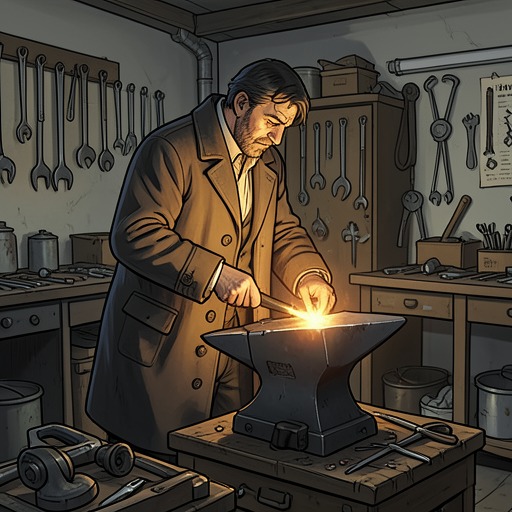
The project begins in the furnace, where workmen fan the flames while Ilmarinen, a master smith, labors at his forge. Their work is strenuous and extended: he works unceasingly to mold a golden image and to form a bride from gold and silver. The account first reports that the workmen fail their master, then carries the making forward to the emergence of a maiden from the fire. The sequence distinguishes the difficulty of the undertaking from its eventual material success. A figure does take shape, but its production does not resolve the more fundamental question of whether metal can become a living bride.
The maiden’s appearance initially seems to promise just such a transformation. She rises from the fire golden-haired and silver-headed, beautiful in form and feature. Ilmarinen continues to work on her through nights and days, forging feet, hands, and arms from the same precious metals. This continued labor makes her less a simple ornament than a constructed likeness: her body is assembled piece by piece, as though the completeness of its outward form might bring it closer to life. Yet the finished features remain evidence of workmanship, not proof of animation.
A Form Without Human Capacities
The distinction between the maiden’s appearance and her abilities becomes decisive as soon as her parts are tested against ordinary human functions. Her feet are not for walking. Her mouth, though described as magical, is speechless, and her eyes are not for seeing. The language gives her the outward equipment of a person while denying the actions that would make those features usable. She is recognizable as a maiden, but cannot move through the world, communicate, or perceive it.
Her physical condition is not merely a list of missing functions. The account also describes an unevenness within the body: one side is warm while the other is lifeless, turning into ice from coldness. The contrast gives the artificial figure a divided presence. Warmth suggests a possible approach to life, but the cold, lifeless side prevents that suggestion from becoming a transformation. Her precious materials make a striking surface, while the body beneath that surface cannot sustain the reciprocal activity implied by marriage or companionship.
Ilmarinen’s Failed Purpose
Ilmarinen recognizes the gap between a beautiful figure and a partner capable of sharing a life. He wonders whether the maiden could speak wisely, but the possibility is immediately undercut by her speechlessness. Her beauty and costly materials do not answer the practical and relational needs that prompted the project. He had sought a bride and life-companion, someone who might offer comfort in his old age; instead, he has made an image that cannot speak or see and whose feet cannot carry her.
The episode therefore makes the success of the forge deliberately incomplete. Ilmarinen can shape gold and silver into a convincing body, and he can refine that body through prolonged labor, but he cannot forge the capacities that would make it a companion. The failed purpose is not that the maiden lacks beauty: the account emphasizes her beauty. It is that visual perfection and precious substance cannot substitute for speech, perception, movement, or a living relationship. The object’s name preserves the intention behind its making, even as the story shows that the intention has not been achieved.
Transfer and Proposed Fate
Disheartened, Ilmarinen takes the maiden to Wainola, on the plains of Kalevala. Bringing her before Wainamoinen shifts the episode from private craftsmanship to judgment by another figure. Wainamoinen calls her a virgin and addresses Ilmarinen as a wonder-forger, acknowledging the marvel of the workmanship while refusing to treat the result as a viable bride. He advises Ilmarinen to throw the figure back into the furnace and forge a thousand trinkets from her.
That instruction proposes a change in the maiden’s status: instead of remaining an unsuccessful human likeness, she would be remade as many ornaments. The contrast is sharp. The first forging concentrates gold and silver into the form of one bride; Wainamoinen’s proposed remaking disperses that precious material into a multitude of decorative objects. The available episode ends with his direction, not with an account of Ilmarinen carrying it out, so the maiden’s eventual fate is left unconfirmed. What is settled is the failure of the original purpose: the beautiful metal figure cannot serve as the living companion Ilmarinen sought.