Great Oak
KalevalaThe Great Oak is a cosmic obstruction whose growth turns fertile renewal into darkness, and whose felling restores the sky to view. It begins as an acorn that has not yet sprouted, rises rapidly from ash into a tree of extraordinary scale, and finally falls beneath Wainamoinen’s hatchet. Its brief but consequential arc joins two opposite powers of the natural world: the capacity of damaged ground to produce new life, and the danger that unchecked growth can eclipse the conditions of life around it.
Identity and Beginnings
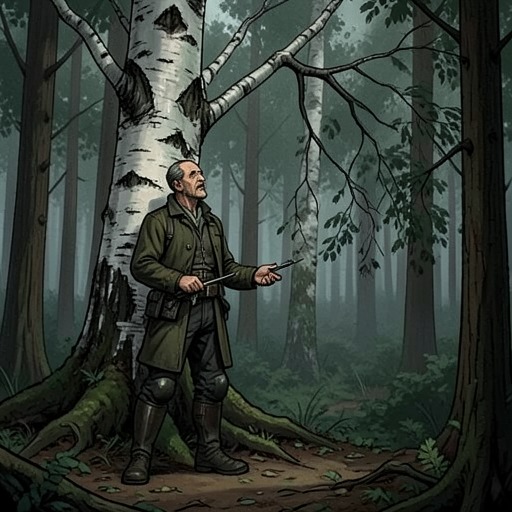
At first the oak exists only as a possibility contained within an acorn. The young trees have spread thickly and the forest is rising in beauty, but the oak itself has not sprouted; the tree of heaven is still sleeping inside its seed. This contrast makes the oak’s absence conspicuous before the story reveals its eventual scale. The woodland is already flourishing, yet the particular tree that will dominate the sky remains latent.
Its emergence is linked to a landscape of aftermath. After grasses have been raked together, only ashes remain in their place. In those ashes the giant lays tender leaves, and within the leaves plants the acorn. It sprouts quickly, drawing on ground enriched by the ashes and newly raked by the water-maidens. The tree therefore does not appear in untouched soil: its beginning follows clearing and burning, and its first nourishment comes from what remains. The sequence gives its extraordinary growth a material setting, joining destruction, cultivation, and renewal rather than presenting the oak as suddenly created without preparation.
Growth and Eclipse
From the planted acorn, the oak becomes tall and stately, then spreads many branches and rounds itself into a broad crown. Its scale is measured against the sky: it raises that crown above the storm clouds. The poem’s successive images make growth feel like an escalation. Seed becomes sprout, sprout becomes a high trunk, and the spreading branches acquire a reach that ordinary forest growth cannot contain.
That ascent changes the meaning of the tree. The oak’s abundant crown hides the sunlight, its leaves conceal the moonbeams, and its branches extinguish the starlight in heaven. The same fullness that first made it an emblem of vigorous growth becomes a force of enclosure. The forest’s beauty and the oak’s imposing form are not denied, but their consequences have become untenable: the tree occupies so much of the visible sky that daylight, moonlight, and stars can no longer be seen. Its obstruction works across the whole cycle of celestial light, not just at one hour or under one kind of weather.
This reversal gives the oak’s size its central tension. A tree can be stately and flourishing while also preventing the world from receiving light. The poem does not describe the oak as evil or give it a human motive; instead, its sheer expansion produces the crisis. What began as life emerging from enriched earth becomes excessive when the branches and leaves overtake the sky.
Wainamoinen Fells the Tree
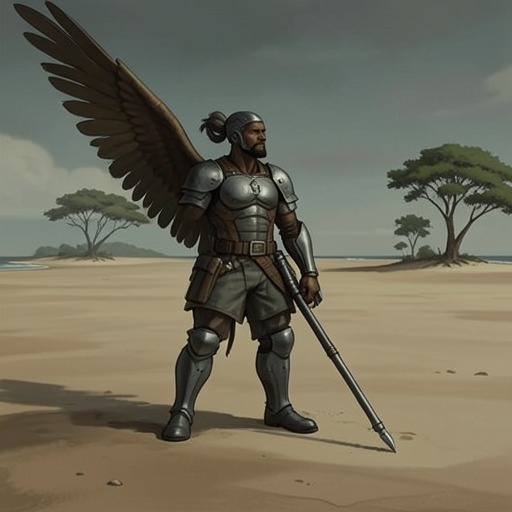
Wainamoinen pauses and considers the situation before acting. He then reaches the branches with his third step firmly planted and strikes the trunk with a sharpened hatchet. The cutting is presented through measured blows: he swings once, then a second time, and the oak yields before the axe descends for a fourth. The compact sequence gives the fall the force of a decisive physical act while preserving the sense of the tree’s immense resistance and scale.
When the Great Oak falls, the event shakes earth and heaven. Its trunk extends far eastward, while its treetops fly far to the west. The directions and enormous span make the fall commensurate with the tree’s earlier reach: an obstruction that had risen above the clouds cannot simply vanish in an inconsequential collapse. Its vast horizontal reach is the counterpart to its former vertical ascent, and the description makes clear that this is no ordinary tree brought down in a forest clearing.
The outcome reverses the condition that prompted the felling. With the oak’s hundred branches gone, the North can see the sunshine and the gentle gleam of moonlight, while the clouds can keep their courses. The relief is expressed not only as the return of light but as the reopening of the sky to movement. The tree had hidden celestial bodies and occupied the space through which clouds travel; its removal makes those separate features visible and mobile again.
Function in the Narrative
The Great Oak’s episode is shaped as a rise and reversal. The account first delays its appearance by showing the seed still asleep, then accelerates through planting and rapid sprouting into a crown that dominates the heavens. Once that growth has become a blockage, the action narrows to Wainamoinen’s considered approach and the successive hatchet blows. The fall then expands the scale again, shaking earth and heaven and stretching from east to west. This movement—from hidden seed to sky-filling tree, and from measured blows to a world-shaking fall—makes the oak’s changing scale a principal feature of the episode’s form.
The oak also connects two different kinds of order. Its growth depends on the ash-enriched ground and the water-maidens’ work, so its rise belongs to a world where natural renewal follows clearing and care. Yet its crown disrupts the larger order of light and weather by obscuring the sun, moon, and stars and hindering the clouds’ courses. Felling it does not negate the fertility of its beginning; it answers the harm caused by its final, excessive reach. The restored view of sun and moon, and the clouds’ renewed courses, mark the Great Oak’s narrative significance: it is both the product of renewed earth and the temporary barrier that must be removed for the sky’s order to return.