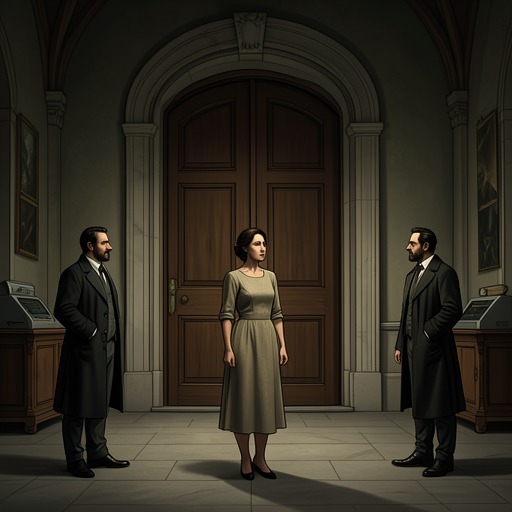
Casa Camin
LeilaCasa Camin is the home of Girolamo Camin and a setting where private family affairs become entangled with money, paternal authority, and the management of Lelia’s future. Its significance lies not in a public event but in what the house conceals: Gorlago is secretly staying there, although others have been told she has left Girolamo, and the house is later proposed as the site of a deliberately arranged encounter with Lelia.
Household and Family Authority
The house is linked to Girolamo’s position as Lelia’s father, but their relationship is strained by her independence and the inheritance she has received. When Marcello Trento’s will is opened, Lelia is named universal heir; a telegram from Girolamo, sent from Padova, declares his paternity and announces his imminent arrival. Lelia acknowledges that she is his daughter and states that she is twenty years and a few months old, correcting the age Marcello had believed her to be.
Girolamo’s approach to his daughter is shaped by the approaching point at which she will come of age. He intends to make as much use as possible of the movable assets in the estate during the remaining months of his authority, then seek a substantial allowance from Lelia once she is an adult. He also plans to appear humble and contrite to improve his position with his creditors. His visit to Donna Fedele’s home shows how cautiously he handles Lelia’s guardians and supporters: he asks, haltingly, to see his daughter rather than invoking the paternal rights he had asserted with Francesco Molesin. His financial calculations give the family home a wider significance as the centre of interests that compete with Lelia’s control of her inheritance.
Gorlago’s Concealed Presence
Casa Camin shelters Gorlago while Girolamo’s relationship with her is under strain. Don Emanuele knows she is in the house, despite the public announcement that she was going to Lombardy and separating from Girolamo. He regards the continuing affair as not only culpable but reckless, and fears that it will discredit the ecclesiastics associated with Girolamo. The house thus holds a private reality at odds with the account circulated outside it.
The concealment becomes tangible when Siora Bettina Fantuzzo is announced to Girolamo. He is writing to Gorlago, addressing her with a string of affectionate and teasing pet names and complaining that, without her, he feels he is dying of boredom. On hearing Bettina arrive, he turns the note over, leaving its blank side visible, and hastily buttons his coat and raises its collar. The hurried concealment and his disordered clothes expose the domestic secret more clearly than his formal manner can contain it.
The Proposed Visit
Don Emanuele seeks to use Casa Camin as part of a plan to shape Lelia’s choices. After Lelia says that she must obtain her father’s permission before agreeing to a proposed pilgrimage and journey, he instructs Bettina to approach Girolamo directly for permission to take her to Monte Berico and onward to Castelletto. The plan then changes: after the pilgrimage, Bettina is to tell Lelia that they will go to Padova to hear Mass, and afterward persuade her to stop at Casa Camin on the pretext of showing regard for her father and checking whether letters or other papers have arrived.
The intended purpose of the stop is not the stated family courtesy. Don Emanuele insists that Lelia must meet the person who is secretly in the house: Gorlago. This is a plan, not a narrated account of the meeting itself. Its manipulation depends on Casa Camin’s double character—as a father’s home where Lelia might reasonably expect to visit, and as the hiding place of a relationship she has not been told about. Bettina is troubled by the deception and by the possibility of a confrontation, but Don Emanuele presents his instructions as a duty under Providence and presses her to obey.
Narrative Significance
The house gathers together conflicts that are otherwise carried through letters, plans, and private calculations. Girolamo’s concealed note to Gorlago, the discrepancy between public claims and her actual presence, and Don Emanuele’s proposed visit all make Casa Camin a point where secrecy may be exposed and Lelia’s decisions redirected. Meanwhile, Girolamo’s plans concerning the inheritance show that the question of where Lelia belongs is inseparable from who may influence or benefit from her property.
Casa Camin is therefore more than a family address: it is a contested domestic space in which the language of paternal care, religious guidance, and personal attachment can serve competing purposes. The planned visit makes that tension especially sharp. Lelia would be sent there under one explanation, while those arranging the journey know that its real object is to confront her with Gorlago.