Milano
LeilaMilano is a city of estrangement and passage in the novel: Massimo Alberti encounters there the consequences of public suspicion and feels alienated from its urban life, while Donna Fedele later passes through it on her journey toward Valsolda. For Massimo, Milano’s streets stand in stark contrast to the quiet landscape of Velo d’Astico; for Donna Fedele, its station and hotel mark a brief, consequential meeting with Don Aurelio during her final travels.
Massimo’s Arrival and the City’s Hostility
Massimo reaches Milano after leaving Arsiero at six in the evening and arriving shortly after six the next morning. No one is waiting for him at San Spirito: his uncle, the engineer, has been slightly unwell and is still resting. The cook and his wife greet Massimo with unusual warmth, having come to regard him as an ally against what they suspect are Don Santino’s attempts to obtain money from the engineer. Their welcome makes clear that Massimo’s arrival is understood within a household already anxious about its own security.
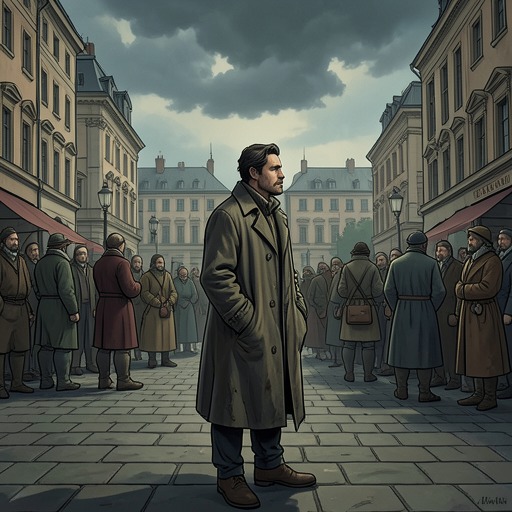
Before visiting the friend of Don Aurelio, who lives near Porta Magenta, Massimo walks slowly through the city, thinking of Velo’s chestnut woods, meadows, and the deep sound of the Posina. He thinks of Lelia while trying not to think of her. The close-set faces of the buildings and the press of other people intensify his distress; he feels that even the stones of Velo’s solitary paths had seemed to understand him, whereas the stones of Milano’s streets carry a spirit of rejection. The contrast makes the city more than a change of setting: it gives physical form to his sense of exclusion and to his longing for the quiet he has left behind.
That feeling is sharpened by a letter Massimo has read repeatedly on the journey from the Montanina. Its writer reports hostility from several quarters: Catholic Intransigents, members of the Catholic Modernist Movement, and the skeptical social world. The Società di San Vincenzo de' Paoli has voted to expel Massimo after he nearly defended Italian religious dissenters of the sixteenth century; Catholic booksellers have been forbidden to sell his lectures; and a clerical household has alleged that he and Don Aurelio intend to publish a modernist periodical. A friar has attacked Massimo’s work from the pulpit, and a clerical newspaper has described him as an unhappy man. The letter also records rumors about his relations with a married woman. Massimo finds that particular accusation amusing because the woman described is, in his judgment, entirely unlike the idealized figure the gossip implies.
The report does not present Milano’s social world as a single, unified opposition. Modernists criticize Massimo as timid and too bound to tradition, while the skeptical elite fault him for indecision and women in those circles accuse him of both hypocrisy and cowardice. The letter’s account of a defender who may not wholly believe his own defense adds uncertainty even to the support Massimo receives. In Milano, then, he is caught between groups that demand incompatible positions and judge his reluctance to conform as a failure.
Bereavement and a Refusal to Return
Massimo’s stay in Milano also brings news that changes his immediate choices. Around midday, Donna Fedele sends a telegram announcing the death of Marcello Trento. Massimo is stunned and grieved, and discovers that his affection for Marcello was deeper than he had acknowledged. He goes to tell his uncle, and the message briefly relieves the strain of their usually uncomfortable silences by giving them a subject they can discuss without entering their disputed opinions.
Asked whether he will go to the funeral, Massimo hesitates. The desire to answer yes rises in him, but he says no, deliberately trying to bind himself against what he fears may be a moment of weakness. His uncle offers to have the cook send a telegram; Massimo declines, saying he will take care of it himself. Alone in his rooms, he imagines Lelia grieving by herself in the darkened villa, reaches for his pen to prepare the message, and then throws it aside in anger at his own refusal. Milano is thus the setting for a choice in which distance from Velo does not quiet his attachment: the city makes the separation sharper, even as he tries to enforce it.
Donna Fedele’s Stop in the City
Later, Milano becomes a way station on Donna Fedele’s journey. Before leaving, she has told Don Aurelio of her intention to travel to Torino, though she has only vaguely described the purpose. She expects to telegraph him the time she will pass through Milano, hoping to greet him at the station. Her correspondence also includes arrangements for her treatment at the Mauriziano hospital, where a room is ready and a professor is expected to examine her after her arrival.
The journey is already taxing when Donna Fedele reaches the city. During a two-hour wait at Vicenza station, after the uncomfortable tram ride and changes between forms of transport, she experiences a cold tingling, dimmed vision, and a frightening fear that she may not reach her destination. She drinks a small glass of cognac and recovers, but the fear persists as she considers whether to hurry onward or rest. She is comforted by the prospect of seeing Don Aurelio, yet also believes it important that Massimo and Lelia should see her arrive almost alone and near collapse. Her journey is therefore not simply a passage toward medical care: she is trying to reach the two young people at a moment when she believes they need her.
Don Aurelio meets Donna Fedele as she leaves the Milano station. Although he would prefer to tell her that rooms are ready and return home, she insists that he accompany her to the Terminus hotel and keeps him in its empty, dim sitting room. She tells him about her journey but withholds both the seriousness of her condition and the doctor’s prognosis, so he believes she can continue the next day. He recommends the route through Porto Ceresio and promises to return the following morning. Their meeting gives Donna Fedele a chance to consult the priest she trusts, while her concealment prevents him from understanding how precarious the journey is.
A Junction for Parting and Reunion
The city also brings news of Massimo’s religious crisis. Don Aurelio tells Donna Fedele that Massimo has arranged the practical matters for the transfer of Benedetto’s remains from Roma to Oria, including burial in the cemetery at Albogasio, but has written that he will not speak at the coffin because he no longer feels himself to be a Catholic. Don Aurelio has accepted the priestly duty of accompanying the remains from Milano onward, in part to protect the funeral from conduct that would dishonor the dead and in part because the journey will give him an opportunity to see Massimo. Milano is consequently a meeting point for two journeys shaped by Benedetto’s death: the physical conveyance of his remains and the effort to reach a living man in spiritual distress.
Donna Fedele delays her departure from Milano by three hours, saying she wants greater comfort, though she is exhausted and cannot eat at breakfast. She walks to the station rather than take the omnibus for the short distance, then boards with her cousin, Cugina Eufemia. She jokes with the older woman about not losing her way in the large station, but the teasing accompanies a real farewell: Donna Fedele closes her eyes to avoid seeing the country she is leaving without hope of return. From Milano she continues toward Porto Ceresio and Valsolda, carrying both her concern for Massimo and Lelia and the knowledge of her own failing strength. The city’s role in the novel is therefore double: it isolates Massimo from the landscape and attachments he longs for, yet briefly gathers the people and messages whose paths will converge beyond it.