Lago di Velo
LeilaLago di Velo is presented through its mountain approaches, its small churches, and the parish community gathered around Don Aurelio. The locality is both a physical refuge from the social and intellectual pressures Massimo Alberti has left behind and the setting for a sharp collision between pastoral attachment and ecclesiastical authority. Its importance lies less in civic description than in the lives and obligations concentrated there: a priest’s bond with his parishioners, a community’s esteem for him, and Lelia Camin’s constrained choices about returning to the Velo area.
Mountain Approach and Rural Setting
Massimo reaches the region after a journey of nearly eight hours from Milan, then walks uphill from the station at Arsiero. The approach is nocturnal and mountainous: clouds obscure the moon, mist hangs over Priaforà and Monte Summano, and the road turns from the dust of the journey to the smell of mud. From a bend, the wooded heights open into view, with chestnuts below a dark crown of firs. The scene presents the countryside as a marked contrast to the city Massimo has left, although the road itself is not silent of nature: he hears streams falling through ravines.
A local man, Cioci, carries Massimo’s luggage and asks whether he is bound for Velo, Sant’Ubaldo, or Montanina. Massimo answers that he is going to Don Aurelio at Sant’Ubaldo. His destination establishes the close relationship between the parish and the surrounding localities: Lago di Velo names the curacy, while the approaching route leads him toward the priest’s church and home. As they pass Santa Maria ad Montes, a woman calls to Cioci from above, briefly bringing human voices into the otherwise sparsely inhabited night landscape.
Parish and Community
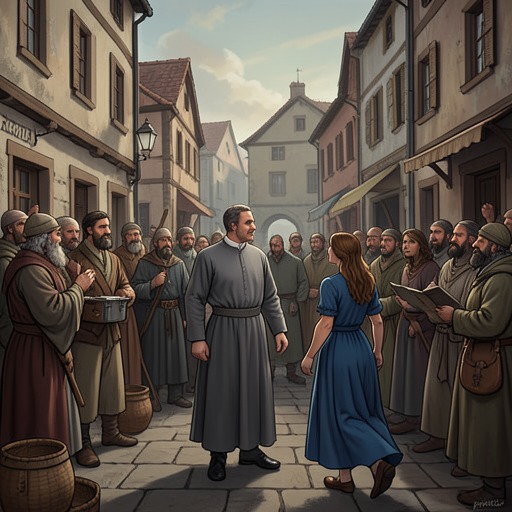
The local attachment to Don Aurelio is conveyed through Cioci’s response when Massimo asks about the curate. Rather than offering a measured description, Cioci struggles to express his admiration and sums it up by calling him a great leader. The colloquial exchange gives the parish’s regard a distinctly local voice: Don Aurelio’s standing is not introduced through formal praise but through the affectionate certainty of a resident.
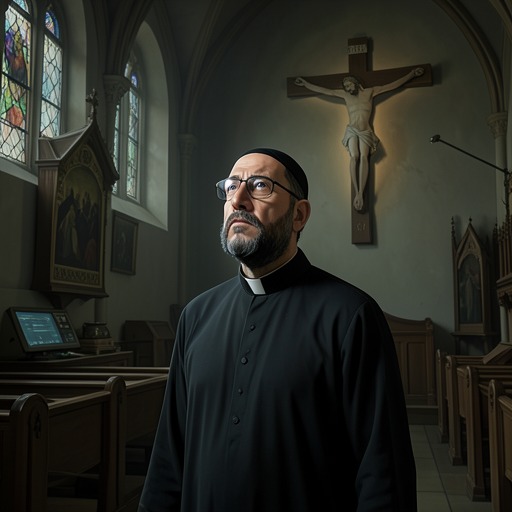
At the small church of Sant’Ubaldo, Massimo and Donna Fedele Vayla di Brea arrive during a service celebrated by Don Aurelio. Only two other people are present: an elderly woman in the last pew and Marcello Trento, kneeling at the front. When Marcello rises with difficulty to approach the communion rail, Donna Fedele watches him with grave tenderness. The sparse congregation and the intimate act of worship make the church a setting in which private histories and religious practice meet without ceremony.
The Curacy and Ecclesiastical Conflict
Lago di Velo’s parish is also the institutional home from which Don Aurelio is ordered to depart. A message brings him a letter from the Vicenza Curia dismissing him from the curacy within fifteen days. The archpriest’s accompanying note requires the house to be cleared of both furniture and people so that Don Aurelio’s successor can move in with his mother and sister. The administrative language turns a pastoral home into a space subject to official transfer.
For Don Aurelio, the order means more than losing a post. He is being separated from the small community he loves and does not know where he will find shelter or food. The wording about clearing the house of people takes on an especially painful force in the circumstances, though he cannot be sure that Ismaele’s case is the reason for his dismissal. After the first shock, his thoughts turn away from his own hardship toward finding the Bible seller and considering a grave conversation Marcello has had with him. The contrast between the impersonal notice and Don Aurelio’s continuing concern for others defines the parish as a place of service as well as a position within a hierarchy.
Velo, Inheritance, and the Question of Home
The wider Velo setting also bears on Lelia Camin’s uncertain place within her family. After Marcello’s death, his will is opened at Schio, and an agent’s letter dated at Velo d’Astico reports that Lelia is the universal heir. The same account relays a telegram from Girolamo Camin declaring himself her father and announcing his arrival. It also records a discrepancy: Girolamo calls her a minor, while Lelia says she is twenty and a few months old. The report ties inheritance to age, paternal claims, and the practical question of who may decide her future.
Later, when Lelia is staying in Valsolda, Donna Fedele Vayla di Brea insists that she cannot remain there and must leave with her. Lelia resists the prospect of returning to Velo, which she says she abhors, and points out that only months remain before she will be of age. Donna Fedele ultimately agrees to take her toward Turin and arrange for her to stay with a cousin at Santhià, subject to the circumstances of the journey. Velo thus signifies not simply a place of return but the unresolved claims of family and residence against Lelia’s wish for independence. Across these different stories, the locality is shaped by the same tension: home can offer belonging and shelter, yet it can also be governed by authority that decides who may remain.