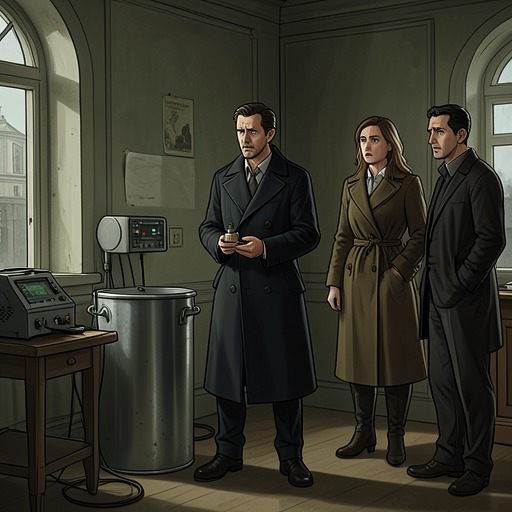
Antimatter-containment magnetic monopole bubble
Mickey7The Antimatter-containment magnetic monopole bubble is a device for isolating antimatter from ordinary matter, and its importance rests on a dangerous double use: the same containment principle that stores the Drakkar’s fuel also makes antimatter weapons feasible. By holding annihilation at bay until the bubbles are deliberately released, it converts antimatter from a difficult-to-handle hazard into a portable energy source—and a potential instrument of mass killing.
Structure and Containment
Jemma explains the bubble as a knot in space-time: its interior and exterior effectively belong to separate universes. Antimatter enclosed within it can therefore be carried without touching the normal matter around it. The protection is conditional rather than absolute; as long as the bubbles remain intact, their contents cannot interact with the people handling them. The container’s integrity is what separates safe possession from catastrophe.
That separation matters because antimatter behaves much like ordinary matter while isolated, but contact between antimatter and normal matter produces violent effects. The interaction does not always convert all mass directly into energy. Depending on the particles, their energy states, and their surroundings, it may produce gamma rays or a flood of subatomic particles moving at a significant fraction of the speed of light. The bubble makes it possible to keep that reaction dormant until a chosen point of use.
Fueling the Drakkar
The technology first appears as part of the Drakkar’s ordinary operating system. The ship stores its fuel inside antimatter-filled monopole bubbles. Under acceleration, a steady stream passes from containment into the reaction chamber, where those bubbles meet bubbles holding normal matter. In pairs, the opposing contents are released; annihilation supplies the energy that drives the ship onward.
This sequence makes the bubble more than a passive container. The ship’s propulsion depends on controlled transfers and timed release: containment preserves the fuel, while the reaction chamber turns it into power. The same basic mechanism can thus serve a routine industrial purpose or a military one. What changes is not the underlying physics, but how the bubbles are delivered and what is allowed to happen when they open.
From Propulsion to Weapon
Once magnetic monopole bubbles existed, antimatter could be packaged for use as a weapon. A Bubble bomb packs multiple antimatter-filled bubbles into a delivery device. When the device bursts above its target, the bubbles disperse, driven apart by their mutual magnetic repulsion and carried by the wind. After a fixed delay, they pop and release their contents.
The delay and dispersal are essential to the weapon’s effect. Depending on how widely the bubbles spread and what kind of antimatter they contain, the result can range from a blast that tears a hole through the stratosphere to lethal radiation and particle exposure across a target area. In the latter use, the attack can kill living things down to the viral level while leaving buildings and other infrastructure standing. That selectivity gives the weapon a grim military appeal: it can devastate life without producing the widespread physical destruction associated with a large thermonuclear exchange.
Strategic Consequences
The contrast with older weapons clarifies why the technology changed antimatter’s military role. Thermonuclear arsenals could threaten apocalyptic destruction, but their fallout and lingering environmental damage made a decisive strike liable to poison not only its intended victims but surrounding populations and, ultimately, the attackers themselves. Before magnetic monopole bubbles, antimatter lacked a practical way to remain isolated until use. The bubble solved that containment problem and made a more targeted form of mass killing possible.
The device therefore links technological ingenuity to a widening capacity for violence. Its utility as a propulsion system does not erase its military function; rather, the same reliable isolation and controlled release support both. The antimatter weapon’s apparent precision is also a form of selectivity, not restraint: an area can be sterilized while its structures remain, leaving the physical setting intact but its living inhabitants gone.
The Bubbles in the Colony
The danger returns to the foreground when Mickey tells Nasha that the antimatter in the bubbles is effectively in another universe while their shells remain intact. He says their contents cannot touch the people nearby, and she immediately asks what happens if any bubbles are not intact. The exchange makes the technology’s safety legible through its failure condition: reassurance depends entirely on containment holding.
The stakes are practical as well as theoretical. After two devices are produced, Marshall points out that the work has made a dangerous dent in the colony’s remaining antimatter supply. No replacement fuel is expected in the foreseeable future, and the colony depends on the power plant continuing to run. The bubbles thus connect a weapon-making decision to the infrastructure of survival: antimatter can be diverted into devices, but every such use draws on stores the colony cannot readily replenish. In the object’s central contradiction, the means of keeping antimatter safely available for propulsion also makes its conversion into a weapon possible—and places both uses within the same finite supply.