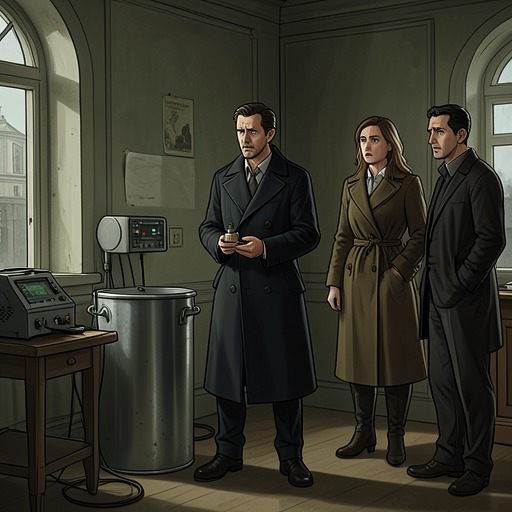
The Bullet
Mickey7The Bullet is Farhome’s answer to the danger posed by Alan Manikova’s conquest of Gault: a relativistic weapon that destroyed the planet’s ecosystem in an instant. By reaching its target at nearly the speed of light without slowing down, it turned the physics of interstellar travel into an almost impossible-to-prevent attack—and made the destruction of a habitable world a defining crime in Union history.
Origins and Strategic Logic
Gault’s final messages reached not only Eden but also Farhome, its next-closest neighbor. Farhome was a younger, poorer second-generation colony, and its government was deeply alarmed by what it learned. Unlike Eden, however, it lacked the ambition and resources to mount a comparable expedition. Its response was simpler and cheaper: it called it The Bullet.
The weapon’s principle followed from the high kinetic energy of interstellar travel, which increases with an object’s mass and the square of its velocity. Eden’s Justice had been vulnerable while decelerating: its torch blinded its crew to the incoming attack from Manikova’s base on Gault’s second moon. The Bullet avoided that vulnerability by never attempting to slow down. It did not need to be especially massive to deliver catastrophic force at relativistic speed.
Impact on Gault
Three months after Eden’s Justice was destroyed, The Bullet struck Gault at 0.97 times the speed of light. The impact released energy equivalent to two hundred thousand fusion bombs into Gault’s ecosystem over roughly a picosecond. The scale and speed of the release left no prospect of recovery: the planet’s ecosystem could not come back from the blow.
The attack was also extraordinarily difficult to detect or defend against. At relativistic speed, the light announcing The Bullet’s arrival reached its target only a fraction of a second before impact. The same speed that made the weapon devastating therefore stripped its target of meaningful warning, while its refusal to decelerate avoided the kind of exposure that had helped doom Eden’s Justice.
Consequences and Significance
The destruction of Gault illustrates how the scarcity of habitable worlds raises the stakes of interstellar conflict. The passage identifies turning such a world into molten slag as widely considered the greatest crime in Union history. Farhome is not blamed for the strike; blame falls on Manikova, whose actions had provoked the response.
The Bullet’s significance lies in the collision of technical economy and irreversible consequence: a response Farhome could afford became an attack no target could realistically stop, and Gault paid the price. The weapon’s legacy also sits beside the Union’s deep stigma against multiples. The narrative contrasts the blame assigned to Manikova with the judgment that, in much of the Union, being a multiple is considered worse in the public mind than being a child stealer or a human head collector.