Linear accelerator
Mickey7The Linear accelerator is the weapon Mickey Barnes chooses when the colony’s usual reliance on Burners meets the danger of creepers in deep snow. Its weight, slow firing rate, and limited versatility make it an awkward field companion, but Mickey knows how to use it, and a past aversion to Burners helps explain his choice. In the snow, its material drawbacks and destructive force become inseparable: it is cumbersome to carry, yet decisive when a creeper surfaces close enough to attack.
Training and technical competence
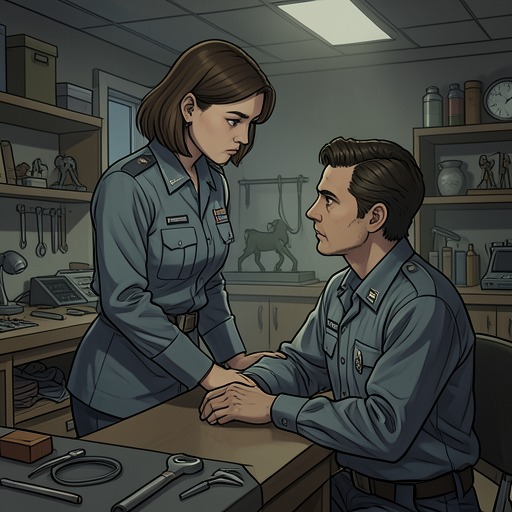
Jemma introduces Mickey Barnes to the Linear accelerator during his training on Himmel Station. The instruction begins with a realistic simulation in which he fights space zombies; he cannot fire a real accelerator on the station, but when he eventually uses one years later, he finds that the real weapon is not much different from the simulated one. The training thus gives him a working familiarity before the weapon becomes a necessity in the colony’s later encounters.
The accelerator is one part of a practical course rather than an isolated technical lesson. Jemma also teaches Mickey how to enter and leave a vacuum suit and assemble combat armor. On the sixth day, they go outside and spend an hour moving around the station’s hull, practicing with recoilless wrenches. From beneath the station, Mickey looks up at the night side of Midgard and identifies the bright patch of Kiruna. The memory places the accelerator within a broader apprenticeship: the weapon belongs to the same hands-on preparation that connects technical knowledge to the physical realities of working in space.
Choosing the weapon in the snow
On a patrol beyond the perimeter, Mickey carries the Linear accelerator while another member of the party has two Burners. Mickey considers the accelerator heavier and less versatile than the alternative, and its maximum rate of fire is only one round per second. He also has a sprained wrist, which he expects will hurt if he must bring the weapon to bear. Yet it is the only weapon on which he has substantial training. His selection is therefore not a claim that the accelerator is an ideal weapon; it is a decision based on what he can actually use under pressure.
The choice is also shaped by an earlier experience on Himmel Station. Mickey has developed an aversion to Burners since that last night there, though the memory still feels raw nine years later and he does not explain it to Cat Chen when she asks why he is carrying an accelerator. Instead, he initially gives her no real reason. Later, he describes his choice as a reversal of habit: his usual approach has already led to his being taken down by the creatures twice, so this time he has chosen differently. The accelerator is not merely an item from the armory; it is a deliberate break with a pattern that has failed him.
Weight, armor, and the threat of creepers
Mickey’s preference for the accelerator also sits within an argument about what protection means in the snow. He objects to the Security team’s combat armor because it adds almost a hundred kilograms, making its wearers too heavy for snowshoes. In loose snow more than a meter deep, being able to stay on top of the surface matters more than adding armor that may make its wearer feel invulnerable. The patrol’s equipment is thus a practical trade-off: mobility against the reassurance of protection, with neither choice removing the danger.
Mickey suspects the creepers may be drawn to the colonists’ metal rather than simply attacking people. He compares the possibility to the way the natives on Roanoke sought water and reasons that armor could attract the creatures, like bacon carried into a wolf’s den. Cat Chen doubts that animals would want metal; Mickey’s answer is that the creepers may not be animals. This remains a hypothesis in the scene, not a confirmed explanation. It nevertheless makes the armor and weapons more than defensive gear in his tactical thinking: the material the colonists carry might itself be part of what provokes the threat.
Use in the field
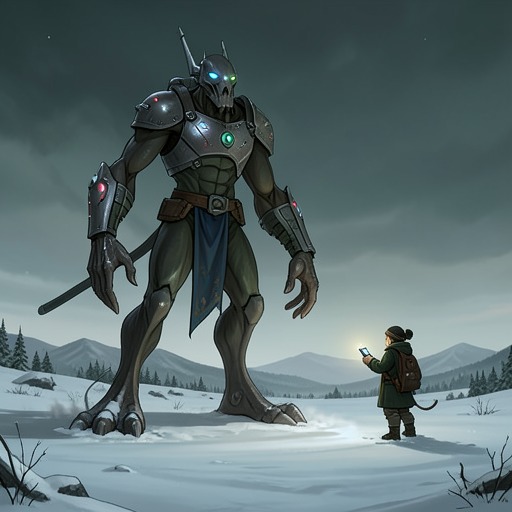
When a creeper appears near a small granite outcrop, Mickey scrambles onto the rock and reaches over his shoulder for the accelerator. His sprained left wrist must take the weight of the barrel. Cat Chen climbs up beside him, and the exposed rock gives them a narrow perch above the snow. As a creeper raises its head almost within reach, Mickey aims and fires. The weapon’s kick pushes him back into Cat Chen; the first three segments of the creature explode into shrapnel. The shot demonstrates both the strain of handling the accelerator and its capacity to stop a close-range attack.
The same weapon later becomes part of Cat Chen’s own preparation. She has not fired an accelerator since basic training on Midgard and admits she hopes she remembers how it works. Mickey explains that the targeting software does most of the work. When she tests the weapon against a bare rock, its recoil and impact blast the top into powdered granite. Soon afterward, she aims carefully at a creeper and fires, destroying its front segments and dropping its body into the snow. Her response confirms that the accelerator works for her as well as for Mickey; the snow around the rock then begins to churn, leaving the immediate threat unresolved.
Function and significance
Across these scenes, the Linear accelerator moves from simulated lesson to remembered expertise, then from burdensome choice to repeatedly demonstrated field weapon. It is never presented as effortless: it is heavy, fires slowly, and makes Mickey’s injured wrist matter at the moment he needs to raise it. Its effectiveness depends on training, aim, and the circumstances of the encounter, not on an abstract promise of superior protection.
The weapon also makes the physical costs of the colony’s decisions visible. Armor can impede movement in the snow; an accelerator can strain an already hurt wrist; a shot can transform a creeper’s body into shrapnel. In that sense, the accelerator is not simply a tool that Mickey carries. Its weight and recoil shape what he can do, while its force changes what happens when a creature emerges. Jemma’s earlier instruction returns at the point where knowledge must become action, and Cat Chen’s later use extends that practical competence beyond Mickey himself.