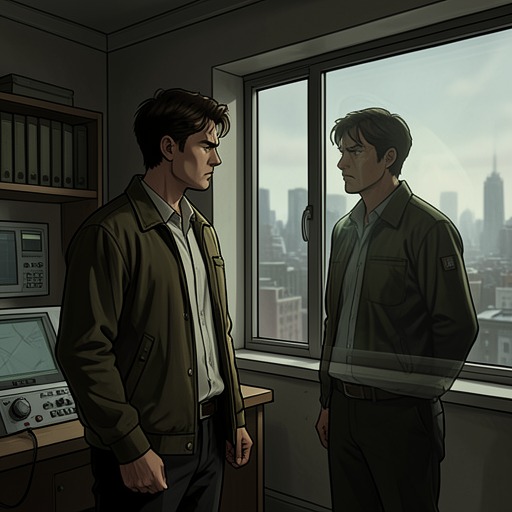
Regeneration Tank
Mickey7The Regeneration Tank is the material point of return in the colony’s system of repeated death and renewed service: Mickey Barnes has emerged from it, and Mickey8 treats it as the place a new instance could be produced after an older one is killed. Yet the tank is no promise of immortality. Marshall makes clear that a person can be denied any return if their personality and body template are erased. In the novel’s logic, the distinction between a death followed by regeneration and a death that ends the process is not abstract; it determines whether a person can come back at all.
Function and the possibility of return
Mickey Barnes refers to having come out of the tank when describing his present stretch of life. That phrasing gives the tank a precise place in the renewal cycle: it marks a point from which a new bodily life begins, while the person’s continued existence depends on more than the body alone. The evidence does not describe the tank’s machinery or the exact procedure by which it operates. Its significance instead emerges from the characters’ practical assumptions about what it can make possible: a new instance can be brought into service after a death, provided the information required for that return remains available.
That possibility shapes Mickey8’s response to Marshall’s threat. Mickey8 argues that the colony, with only 176 people left and preparing for war, needs every body it can get. He insists that the colony cannot afford to discard its only Expendable, and proposes that Marshall kill one of the two Mickeys and send him down the hole, or kill both and produce a new one from the tank. For Mickey8, the tank is therefore not merely a device associated with past experience. It is a practical alternative to keeping two instances alive at once: the colony could eliminate the immediate duplication by ending both and starting again.
Regeneration is not guaranteed
Marshall rejects the assumption that death necessarily leads back to the tank. If both Mickeys are sent down the hole, he says, there will never be another of them: their personality will be wiped from the server, along with their body template. He describes the consequence as a death sentence, not a temporary loss followed by regeneration. His warning separates the tank from the records and templates that make a return possible. The tank may provide a route back, but it cannot restore what has been deliberately erased.
Mickey8’s appeal to the colony’s needs does not change that threat. Marshall agrees that the colony is short of people and at war, but counters that Mickey is not the only person capable of serving as Expendable: Cat Chen has volunteered to take the berth if necessary. This answer removes the force from Mickey8’s claim that the colony must preserve at least one of them for the sake of the role. The question is no longer simply whether a replacement can be produced. It is whether Marshall will permit either Mickey to return, and whether the colony has chosen to replace him with someone else.
The tank within a precarious survival system
Elsewhere, Berto Gomez recalls that creepers took Mickey Six while he was working another crevasse. Mickey had asked what happened to Six after coming out of the tank, and Berto corrects Mickey’s assumption that the creepers ate him: they dragged him down a hole, and Berto lost his signal after fifteen minutes. This recollection does not explain the tank’s operation, but it places emergence from the tank within a history of repeated versions and deaths. A new instance’s return does not erase what happened to the one before it, or guarantee that every disappearance can be resolved by regeneration.
The same uncertainty surrounds Mickey8’s descent. After Mickey8 goes down the hole, Mickey Barnes considers walking away into the snow and opening the seals of his rebreather. He recognizes that this would not necessarily end the cycle: Berto or Nasha might retrieve his body and send another instance down with the pack, if Mickey8 had not already finished the task. The tank remains part of the background possibility of replacement, but the immediate danger is not solved by imagining a future return. One instance’s fate can lead to another being dispatched into the same peril.
Memory, sacrifice, and the meaning of return
Late in the story, Mickey says that he has not uploaded since he came out of the tank. He asks whether the action under discussion would require another upload and is told that it would not. Mickey understands the consequence as the disappearance of this particular part of himself from the continuing record. Marshall answers that the colony will remember what Mickey did even if Mickey does not, and thanks him for having saved it more than once. The exchange distinguishes public remembrance from personal continuity: the colony can preserve the meaning of a sacrifice without preserving the individual’s experience of it.
The tank thus anchors a tension that runs through Mickey’s existence. It represents the possibility of returning to work after death, but return depends on systems of memory and identity that can also be withheld, erased, or left unused. Mickey’s account of coming out of the tank establishes a beginning for his present instance; his later refusal or omission of another upload makes clear that another beginning would not simply be the same life resumed. The object’s narrative force lies in that limit: regeneration can restore a body to the colony, but it cannot by itself guarantee the survival of a particular self.